
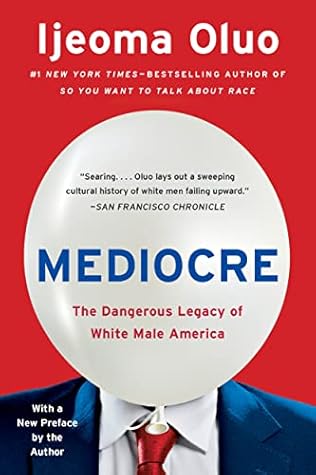
More on this book
Community


Kindle Notes & Highlights
by
Ijeoma Oluo
Read between
March 14 - March 16, 2021

White male mediocrity seems to impact every aspect of our lives, and yet it only seems to be people who aren’t white men who recognize the imbalance.
If you are constantly assumed to be great just for being white and male, why would you struggle to make a real contribution? Why take a risk or make a determined effort that might fail when you can be rewarded for keeping your head down?

KB
How can white men be our born leaders and at the same time so fragile that they cannot handle social progress?
The image of the ideal white man—the bold and confident ones we end up idolizing, giving promotions to, electing to office—that image is often the epitome of mediocrity. And when entrusted with these positions of power, such men often perform as well as someone with mediocre skills would be expected to: we see the results in our floundering businesses and in our deadlocked government. Rather than risk seeming weak by admitting mistakes, white men double down on them.
Ijeoma, get out of my school district!
The man who never listens, who doesn’t prepare, who insists on getting his way—this is a man that most of us would not (when given friendlier options) like to work with, live with, or be friends with. And yet we have, as a society, somehow convinced ourselves that we should be led by incompetent assholes.
I feel seen.
Perhaps one of the most brutal of white male privileges is the opportunity to live long enough to regret the carnage you have brought upon others.
I'd love to see the mediocre white men who I know come to realize the harm the
Each day he sat quietly outside and refused to join his classmates at lunch. After three days, Ryan’s mother relented and began making lunches from home again. Nothing says “American” like a boy making a woman struggle so that he can seem independent.
For real
But over generations, feminism has grown and changed. There is still what is called “white feminism”—the tendency for white feminists to center themselves at the expense of women of color—but at least now we have a name for it. And in naming it, we can think about how to move beyond it.
First, name. Then, move past it.
We find racism in our systems when we look at what the system produces. When we find systems with outputs that negatively affect people of color in a way or to a degree that they do not affect white people, we have a racist impact that can be tied to a racist cause.
A political movement that focuses on class and ignores the specific ways in which race determines financial health and well-being for people of color in this country will be a movement that maintains white supremacy, because it will not be able to identify or address the specific, race-based systems that are the main causes of inequality for people of color. Health care discrimination, job discrimination, the school-to-prison pipeline, educational bias, mass incarceration, police brutality, community trauma—none of these issues are addressed in a class-only approach. A class-only approach will
...more
Truth
If we are going to continue to make progress on issues of race and gender, and if liberal white men want to be on the right side of history, they have to address their personal issues with race and gender.
For real.
But I have never had the luxury of shunning everything in our society that does not appear to be built 100 percent for me.
Privilege
What exactly do people who aren’t white men have that could be more inclusive of white men? We do not have control of our local governments, our national governments, our school boards, our universities, our police forces, our militaries, our workplaces. All we have is our struggle. And yet we are told that our struggle for inclusion and equity—and our celebration of even symbolic steps toward them—is divisive and threatening to those who have far greater access to everything else than we can dream of. If white men are finding that the overwhelmingly white-male-controlled system isn’t meeting
...more
At every college I went to—every single one—at least one teacher of color broke down in tears describing their struggle to advocate for their students of color in such a hostile environment. Higher education is not the racial utopia that Republicans are scared of. It is not some bizarro world where students of color wield power over white students and faculty. It is a white supremacist system at its core, like all our other systems are.
Of course it is, but how devastating for each of those faculty members
Most white Americans have exclusively white friendship circles; three-quarters of white Americans have less than one friend of color.
This is shocking
The thing about anger is that it needs a home.
How can we make anger unhoused? What can we do?
Women and people of color who advocate for diversity and equity are often punished for their efforts in peer, team, and management evaluations. Ironically, the people who are not penalized in their evaluations for their diversity and equity efforts are—say it with me—white men.
Ugh
My education has served me well in this career, even if it was not what I originally imagined for myself. It also, like a job as an analyst likely would have, fits my introverted yet very opinionated personality. I spend a lot of time observing, thinking, commenting. I do not have to compromise my principles or soften my message to make friends or keep a job
I love this.
It should be enough that this is hurting us. It is insulting that I have to point out the ways in which these issues also hurt white Americans in the hopes that I might get more people to care.
In introducing the legislation, Pressley argued, “For far too long, those closest to the pain have not been closest to the power, resulting in a racist, xenophobic, rogue, and fundamentally flawed criminal legal system,” adding, “Our resolution calls for a bold transformation of the status quo—devoted to dismantling injustices so that the system is smaller, safer, less punitive, and more humane.”
Lovely
In discussing how hard the four of them have had to fight during their time in D.C., Omar sounded defiant and determined: “I think we have a beef with almost anyone here because there’s a lack of courage. It seems like we’re all radical because we deeply care about the people we represent and we want to throw down for them.”
I love her.
The following year, enrollment at Mizzou was down sharply, especially of Black students. This isn’t because Black prospective students disagreed with the protests. Black students who decided not to attend the previously well-respected school said that the racism highlighted on campus had turned them off. Some Jewish prospective students said that hearing about swastikas being painted on walls kept them away. And some white prospective students said they didn’t want to be associated with a university so widely known to be racist.
I'm shocked year after year that this isn't the case at Cal Poly in SLO. The bonds with white supremacy are strong here.
“It was shocking, because you have the idea where you are a brotherhood. When you have an issue outside of football and you’re looking for your brothers to be there for you, and when you find out they aren’t, that hurts a little bit.”
I know it's not comparable, because I'm not in mortal danger, but I'm always so disappointed when my colleagues reveal their unwillingness to examine their own biases and continue teaching rooted in white supremacy.
“At some point the silence is a sin against God—because you are required to be the person you want to be, you are required to speak up,” he explained.
Love love love
We must start asking what we want white manhood to be, and what we will no longer accept. We must stop rewarding violence and oppression. We must stop confusing bullies with leaders. We must stop telling women and people of color that the only path to success lies in emulating white male dominance.
How?
Does this sound like too large a task? Too monumental a shift? I can see that. But I can also see how much work it has taken to create and maintain a system of white male mediocrity in this country.
First you must name it. Then you can change it.
We have to find where we have been bonded to these systems, both individually and collectively, and we have to sever those bonds.
How do we sever them? Can we, if our jobs require some sort of compliance? Or must we simply test those boundaries. . .and tenure?
