
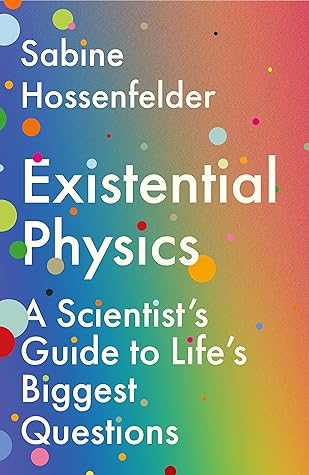
More on this book
Community


Kindle Notes & Highlights

Read between
June 9 - July 7, 2023

If your belief conflicts with empirically confirmed knowledge, then you are not seeking meaning; you are delusional.
If you look at the North Star, you see it as it looked 434 years ago.
Once you agree that anything exists now elsewhere, even though you see it only later, you are forced to accept that everything in the universe exists now.
And if all times exist similarly, then all our past selves—and grandparents—are alive the same way our present selves are. They are all there, in our four-dimensional space-time, have always been there, and will always be there.
“Time is a bit like a landscape. Just because you’re not in New York doesn’t mean it’s not there.”
A measurement is any interaction that is sufficiently strong or frequent to destroy the quantum behavior of a system.
And because in everyday life we can’t ever get rid of the environment, we don’t normally see quantum effects, like dead-and-alive cats, with our own eyes. Quantum behavior just gets destroyed too easily.
We understand fairly well what constitutes a measurement, but the fact that we need to update the wave function upon measurement makes quantum mechanics both indeterministic and time-irreversible. It is indeterministic because we cannot predict what we will actually measure; we can predict only the probability of measuring something. And it is not time-reversible, because once we have measured the particle, we cannot infer what the wave function was prior to measurement.
This means the measurement in quantum mechanics destroys information for good.
If something happens to fall in—an atom, a book, a spaceship—it can’t get back out, ever. Once inside the black hole, it’s eternally disconnected from the rest of the universe.
The evaporation of a black hole is thus time-irreversible: there are many different initial states that result in the same final state.
More seriously, of course, once your grandmother dies, information about her—her unique way of navigating life, her wisdom, her kindness, her sense of humor—becomes, in practice, irretrievable. It disperses quickly into forms we can no longer communicate with and that may no longer allow an experience of self-awareness. Nevertheless, if you trust our mathematics, the information is still there, somewhere, somehow, spread out over the universe, but preserved forever. It might sound crazy, but it’s compatible with all we currently know.
All we can tell from observations is that math is useful to describe the world. That the world is math—rather than just being described by math—is an additional assumption. And because this additional assumption is unnecessary to explain what we observe, it’s not scientific.
Call it the principle of finite imagination: Just because we can’t currently think of a better explanation doesn’t mean there isn’t one. Just because we don’t yet know a better way to describe natural phenomena than mathematics doesn’t mean there isn’t one.
According to the currently established laws of nature, the future, the present, and the past all exist in the same way. That’s because, regardless of exactly what you mean by exist, there is nothing in these laws that distinguishes one moment of time from any other. The past, therefore, exists in just the same way as the present. While the situation is not entirely settled, it seems that the laws of nature preserve information entirely, so all the details that make up you and the story of your grandmother’s life are immortal.
If I take a present state, like the Earth in the year 2022, and apply an evolution law to it, then that will give me a past state in 3978 BCE. If I then take that past state and evolve it forward in time again, I will correctly get back to the year 2022. Trouble is, I can do that for any evolution law. There is always some state six thousand years ago that, together with the right evolution law, will correctly result in what we observe today.
This is why, with natural laws like the ones we currently use, the idea that Earth was created by someone or something with everything in place is impossible to rule out.
However, the God hypothesis has no quantifiable explanatory power. You can’t calculate anything from it. That doesn’t make it wrong, but it does make it unscientific.
Mica is a class of naturally occurring minerals, some of it as old as a billion years. Mica is soft for a mineral, and small particles passing through it—maybe from radioactive decays in surrounding rocks—can leave permanent tracks in it. This makes mica a natural particle detector. Indeed, particle physicists have used old samples of mica to search for traces of rare particles that might have passed through. These studies have remained inconclusive, but they’re not the relevant point here. I am merely telling you this because mica, though it arguably has low levels of consciousness, clearly
...more
The best chance for a breakdown of predictability comes—like the “common” butterfly effect—from weather forecasts. In this case, the dynamical law is the Navier-Stokes equation, which describes the behavior of gases and fluids. Whether the Navier-Stokes equation always has predictable solutions is still unknown. Indeed, it is number four on the list of the Clay Mathematics Institute’s Millennium Problems.
Our brains are not particularly good at crunching through difficult math problems, but they’re remarkably efficient for making complex decisions—while running on only about 20 watts, about the power consumption of a laptop.
