
More on this book
Community


Kindle Notes & Highlights
Read between
May 23 - June 4, 2023

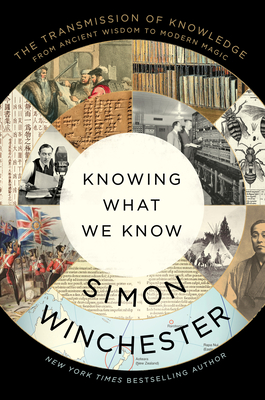
This book seeks to tell the story of how knowledge has been passed from its vast passel of sources into the equally vast variety of human minds, and how the means of its passage have evolved over the thousands of years of human existence.
In the earliest times—back even in hominid days, before Homo was even on the verge of becoming sapiens—the transmission was effected near-entirely as a consequence of experience.
One by the one, from the solar system’s shape to the reason behind rattlesnakes, the ancient beliefs crumbled, certain knowledge became less certain, dogma and doctrine began a steady evaporation until only the fundamentalists clung frantically on, wishing fantasy to become fact.
the new and rationality-based discipline of geology. This new science could at last thrive unmoored from the pious dogma that declared the world to be no more than five thousand years old, which had averred that fossils were objects purposefully inserted into rocks to display the works of the Almighty, and that all seismic and meteorological events, temblors, volcanoes, tsunamis, waterspouts, typhoons, hurricanes, and cyclones were events ordained by Heaven for such capricious reasons as the Divine from time to time decided.
The teaching of children, in other words, is where the story of the transfer of knowledge truly begins.
All are susceptible at any age and stage of life because of a single characteristic possession that is put to good use by many—curiosity, the possession of which Samuel Johnson described three centuries ago as “one of the permanent and certain characteristics of a vigorous mind.”
classification system of different types of curiosity, which still makes sense today—and
Very basically, Berlyne drew up a Cartesian coordinate grid with two axes perpendicular to each other.
Along the vertical axis, the ordinate, he classified curiosity according to the degree to which it is targeted—is it purposeful, or is it dreamily lacking in exact intention?
specific, a curiosity that stems from a need for a distinct m...
This highlight has been truncated due to consecutive passage length restrictions.
and diversive, an aimless, broad-spectrum, low-intensity curiosity
The horizontal axis, the abscissa, indicates what motivates and stimulates the curiosity in the first place.
Is it perceptual—Berlyne’s word—meaning, is it aroused by something surprising
or by something u...
This highlight has been truncated due to consecutive passage length restrictions.
Or is the curiosity epistemic, meaning: Is it aroused by a very real and urgent need for new...
This highlight has been truncated due to consecutive passage length restrictions.
I am going to come down firmly on one side of the grid to note that this is an account, in the main, of the serious and purposeful acquisition of knowledge.
Tho’ much is taken, much abides; and tho’ We are not now that strength which in the old days Moved earth and heaven, that which we are, we are; One equal temper of heroic hearts, Made weak by time and fate, but strong in will To strive, to seek, to find and not to yield.
And this gray spirit yearning in desire To follow knowledge like a sinking star, Beyond the utmost bound of human thought.
And as anyone who remembers a teacher from school days, for most people some long, long while before, no greater gift can there be than the kind of good education that a kindly and thus unforgotten teacher can give.
Rather more than five thousand years ago came one of those periods of epochal change in human development, one of history’s hinge points when all of a sudden—in the matter of the transmission of knowledge—life changed, profoundly. In four quite separated places around the planet, and over an extended period of around two thousand years that began around 3400 BC, the craft of writing was invented. Until recording equipment came along, speech vanished into the air, lingering only in the fugitive vaults of memory and in the oral traditions of some indigenous peoples, but writing enabled the
...more
China in the early nineteenth century offers up a prime example of the disbenefits of clinging to a venerated and unchanging school curriculum dominated by the teaching of myth, legend, and belief.
Out of all this learning, what had in fact been learned, what remembered? What questions needed to be asked to determine what knowledge had been absorbed? And is that the point, indeed? Should examinations show if the examined person knows such things as were determined by the school, or should the tests determine if the examinee has the ability to think in such a way as to be able to know things as needed, and when? Debates over such matters have endured as long as children have been taught.
“Knowledge makes humble. Ignorance makes proud.”
Ancient Mesopotamia appears to have been a largely knowledge-tolerant kind of place, but in more recent times attitudes have changed, and decidedly for the worse.
Also until recently, Mosul had a magnificent university library. This can be thought of as a lineal descendant, in spirit if not in actual brickwork, of Ashurbanipal’s library close by, and yet its modern, melancholy significance stems from the fact that it was destroyed, brutally, and almost all of its one million books and precious manuscripts burned to cinders, in late 2016.
It was destroyed because the leaders of the militant jihadist group known as Islamic State, or Daesh, believed that, as a library, it posed them a particular existential threat.
Iraqis are thought of all over the Arab world as a thoughtful and highly literate people. “Books are written in Egypt, printed in Lebanon, and read in Iraq” goes a famous Arab saying, and thus Iraqis are a people intolerable to t...
This highlight has been truncated due to consecutive passage length restrictions.
“the past is a foreign country and they do things differently there.”
Not a few of the papers were scurrilous and unreliable, peddlers of falsehoods and propaganda. Invariably, newspapers had to carry advertising to survive, proprietors’ pockets being only so deep, and advertisers needed the newspapers to be sold in large numbers to reach such audiences of potential customers as the advertisers wanted. So newspaper circulation wars broke out—most infamously the one fought in the 1890s in New York City between William Randolph Hearst and his former mentor Joseph Pulitzer. Competing attempts to boost circulation often led to monstrous journalistic excesses and
...more
in time Saddam Hussein, architect of it all, was found, tried, and hanged.

Well, in the next war with the next Bush anyway.
A behavioral science paper gave an example of the kind of digital mishap that simply would not have happened twenty years before. It starts with a young woman losing her phone in a bar, late at night. She decides to walk home. She realizes she is not certain of the way, but since she normally relies on Google Maps on her phone, she has suddenly become geographically illiterate. She finds a telephone booth, but she doesn’t know the number of a taxi company, nor can she summon an Uber or a Lyft. She cannot remember her parents’ number either, familiar though it once used to be. All told, her
...more
He cleaved to the conviction that religion was in fact little better than rank superstition and that it occasioned great harm to most humans, impeding the acquisition of knowledge, promoting both fear and the cynical belief that only a church could offer comfort from it, and leading inevitably to repeated episodes of conflict, oppression, and misery.
He said of himself that so far as the Olympic gods were concerned, he was agnostic, but as to the Christian God, he was unreservedly atheist.
