
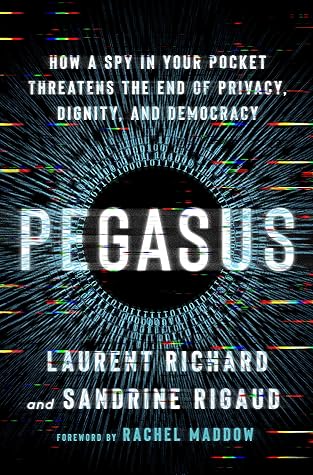
More on this book
Community


Kindle Notes & Highlights


the most potent cybersurveillance weapon on the market: a malware called Pegasus, which had been developed, marketed, and supplied to law enforcement and national security agencies in more than forty countries around the world by the alpha dog in the burgeoning industry—the Israeli tech company NSO.
THE FINAL BLOW to Vincenzetti—a live-by-the-sword, die-by-the sword blow—was heralded by an unexpected message posted on Hacking Team’s own Twitter account in the first dark hours of July 5, 2015. “Since we have nothing to hide,” read the tweet, “we’re publishing our emails, files, and source code.” This hijacked tweet was almost two months in the making. A very patient and cautious hacker who called himself “Phineas Fisher” (he had already hacked the rival Gamma Group) would eventually take credit, publishing a technical explanation of how he found a vulnerability in the system software that
...more
This highlight has been truncated due to consecutive passage length restrictions.
The now legendary hacker had already published, along with his how-to guide, a kind of manifesto reminding his fellow travelers in tech that they were the best guardians against cyberintrusion. “There’s plenty of hackers better than me,” Phineas Fisher wrote, “but they misuse their talents working for ‘defense’ contractors, for intelligence agencies, to protect banks and corporations, and to defend the status quo. Hacker culture was born in the US as a counterculture, but that origin only remains in its aesthetics—the rest has been assimilated.
“For any person who sits in the chair where decisions have to be made in the use of this type of tool, it is attractive—with a certain morbid curiosity to get into people’s lives.… These kinds of tools generate in [public servants] who have them within their reach a feeling of supremacy, of power, of control. And its use becomes perverse; it can become a means of personal satisfaction and not for the benefit of the public interest.”
Looking inside the message and the link, they were able to isolate a signature quirk in the way the domain and server were configured. This WhatsApp message and link were painstakingly engineered to hide any information about the attack and any information about the identity of the attacker. The link and the final server were configured in a particularly locked-down manner. Any attempt to open a nonexistent page on the server did not return the typical “Not Found” message; the server simply did not reply to the request at all, so as not to alert the victim. This already suggested to Claudio
...more
The Security Lab duo made an even more remarkable discovery in the forensic image of Maati’s phone. When Claudio and Donncha combed through the Safari browsing history database and its Session Resource logs, they began to note and then reconstruct certain strange digital detours they were seeing. While trying to determine if Maati’s phone had opened any known Pegasus links, they discovered that the phone (having already been subjected to eighteen months of Pegasus’s standard SMS message attack) was navigating to strange and previously unknown websites in the spring and summer of 2019. Claudio
...more
“Remember, when you say, ‘I want one iMessage exploit, it’s never one exploit,” he explained. “When an iPhone gets compromised with an iMessage exploit, they are using maybe three, four, five different exploits packaged in one. “There’s so many things that [NSO technicians] have to compromise with an iPhone that make it a lot more complicated. They need to compromise a number of [different] security measures that Apple put into place purposely to add layers of complications before you can successfully get complete ownership of the device. “The difficulty with compromising an iPhone is that you
...more
