
More on this book
Community


Kindle Notes & Highlights


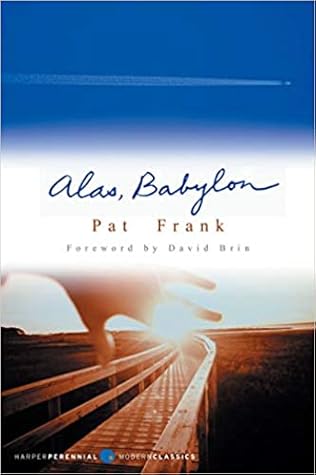
Alas, Babylon was published by J.B. Lippincott in 1959, becoming one of the first novels dealing with the aftermath of a nuclear war. Together with British author Neville Shute’s 1957 blockbuster, On the Beach, the vastly different stories shaped the popular consciousness of an ‘atomic age’ and a suddenly fragile civilization.
~☆~Autumn liked this
The novel is most often described as affirmative—a story celebrating human creativity and perseverance, as well as the meaning of community. Without doubt, these timeless qualities go a long way in explaining its enduring popularity. Yet, the book’s conclusion is more ambiguous, as Randy turns away from his would-be rescuers “to face the thousand-year night.” There is no doubt that my father meant the book as a cautionary tale, presented as it is within the Biblical context of Revelation 18:10: “Alas, alas, that great city Babylon, that mighty city! For in one hour is thy judgment come.” The
...more
~☆~Autumn liked this
Earlier tales followed intrepid characters through scenarios of “after the fall.” But before the 1950s, most of these apocalypse stories portrayed latter-day Noahs struggling against natural or supernatural disasters. Wrath pouring out of heaven, or the sea, or the bowels of the Earth. Few ever focused on the range of possible catastrophes that Technological Man might wreak upon the world with tools of his own making.
Randy heard music below, and knew that Missouri had started his record player and therefore was waxing the floor. Missouri’s method was to spread the wax, kick off her shoes, wrap her feet in rags, and then polish by dancing. This was probably as efficient, and certainly more fun, than using the electric waxer.
“What’s the message say?” “Well, I’ll read it to you,” Florence said, “and then if you want me to read it again I’ll be glad to. It says, ‘Urgent you meet me at Base Ops McCoy noon today. Helen and children flying to Orlando tonight. Alas, Babylon.’” Florence paused. “That’s what it says, ‘Alas, Babylon.’
Alas, Babylon was a private, a family signal. When they were boys, he and Mark used to sneak up to the back of the First Afro-Repose Baptist Church on Sunday nights to hear Preacher Henry calling down hell-fire and damnation on the sinners in the big cities. Preacher Henry always took his text out of the Revelation of St. John. It seemed that he ended every lurid verse with, “Alas, Babylon!” in a voice so resonant you could feel it, if you rested your fingertips gently on the warped pine boards of the church.
Randy and Mark never forgot Preacher Henry’s thundering, and from it they borrowed their private synonym for disaster, real or comic, past or future. If one fell off the dock, or lost all his cash at poker, or failed to make time with a promising Pistolville piece, or announced that hurricane or freeze was on the way, the other commiserated with, “Alas, Babylon!”
And the kings of the earth, who have committed fornication and lived deliciously with her, shall bewail her, and lament for her, when they shall see the smoke of her burning. Standing afar off for the fear of her torment, saying, Alas, alas, that great city Babylon, that mighty city! for in one hour is thy judgment come.
After Randy had the cash, in hundreds, twenties and tens, he said, “Now I’ll tell you why I wanted it, Edgar. Mark asked me to make a bet for him.” “Oh, the races!” Edgar said. “I very rarely play the races, but I know Mark wouldn’t be risking that much money unless he had a sure thing. Running in Miami, tomorrow, I suppose?” “No. Not the races. Mark is simply betting that checks won’t be worth anything, very shortly, but cash will. Good afternoon, Fish-eye.” He left the office and sauntered across the lobby.
“Small nations, when treated as equals, become the firmest of allies.”
I was just making the placebo circuit and dropped in to see Elizabeth’s mother.” “The what?” Lib asked. Randy had heard Dan use the phrase before. “Placebo, or psychosomatic circuit—the middle-aged retirees and geriatrics who have nothing to do but get lonely and worry about their health. The only person they can call who can’t avoid visiting them is their doctor. So they call me and I let them bend my ear with symptoms. I give them sugar pills or tranquilizers—one seems about as good as the other. I tell them they’re going to live. This makes them happy. I don’t know why.”
“Now I’m twice as old as you are,” Bill said, “and I think I know more about what goes on in this world. After all, I know quite a few big men—the biggest. All these war scares are concocted by the Pentagon—no offense meant to your brother—to get more appropriations, and give more handouts to Europe, and jack up taxes. It’s all part of the damnable inflationary pattern that’s designed to cheat people on pensions and with fixed incomes and so forth.
what worries me most is Moscow.” “What’s Moscow saying?” “Not a word. Not a whisper. Usually Radio Moscow would be screaming bloody murder. That’s what worries me. As long as people keep talking they’re not fighting. When Moscow quits talking, I’m afraid they’re acting.” Mark borrowed a cigarette and lit it. “I think the chances are about sixty-forty,” he said, “that they’ve started their countdown.”
Yesterday, he would have stopped instantly. There would have been no question about it. When there was an accident, and someone was hurt, a man stopped. But yesterday was a past period in history, with laws and rules archaic as ancient Rome’s. Today the rules had changed, just as Roman law gave way to atavistic barbarism as the empire fell to Hun and Goth. Today a man saved himself and his family and to hell with everyone else. Already millions must be dead and other millions maimed, or doomed by radiation, for if the enemy was hitting Florida, they would hardly skip SAC bases and missile
...more
Immediately, Florence wanted to start for the office. Having no close relatives, and approaching an age beyond which she could not reasonably hope for a proposal of marriage, and when even speculative second looks from rakish or lonely widowers had grown rare, her whole life centered in the office. Western Union didn’t expect her to open the wire until eight, but she was usually a bit early. Afternoons, she dreaded the relentless downsweep of the hour hand, which at five guillotined her day. After five, nothing awaited her except lovebirds, tropical fish, and vicarious journeys back to more
...more
A clean, smooth, painless shave was one of the things he missed, but not what he missed most. He missed music. It had been a long time since he had heard music. The record player and his collection of LP’s of course were useless without electricity. Music was no longer broadcast, anywhere.
He dried and stepped on the scales. One fifty-two. This was exactly what he had weighed at eighteen, as a freshman at the University. Even after three months on the line in Korea, he had dropped only to one fifty-six. He had lost an average of a pound a week for the past sixteen weeks, but now, he noted, his weight loss was slower. He had held one fifty-two for the past three days. He was leaner and harder, and, truthfully, felt better than before The Day.
“Jim, this is the nicest, most generous thing I can remember. I just hope I can repay you some way, some day.” “Forget it,” Hickey said. “Children need honey. My kids have it every meal.” Randy heard the Model-A’s horn, raucous as an angry goose, and saw it pull up to the curb. Walking to the car, he noticed that it was a clear and beautiful spring day, a better day than yesterday. The spores of kindness, as well as faith, survived in this acid soil.
“There are odd similarities between the end of the Pax Romana and the end of the Pax Americana which inherited Pax Britannica. For instance, the prices paid for high office. When it became common to spend a million dollars to elect senators from moderately populous states, I think that should have been a warning to us.
Randy opened one of the albums. “Old seventy-eights,” he said, his voice almost reverent. “Classic jazz. Listen to this. By Tommy Dorsey—‘Come Rain or Shine,’ ‘Stardust,’ ‘Chicago, Carmen Cavallaro’s ‘Stormy Weather.’ Also ‘Body and Soul.” Artie Shaw’s ‘Back Bay Shuffle.’ All the best by the best. I guess—I’m certain this must have been Father’s collection. I’ve never seen this machine before, but I remember the records.”
“We're a second class power now. Tertiary would be more accurate. I doubt if we have the population of France—or rather, a population as large as France used to have.” He talked of farm areas out of production for an indefinite period, and how the South American nations had begun lend-lease shipments to the northern continent, and how Thailand and Indonesia were contributing rice. Eventually, it was hoped that Venezuelan oil would alleviate the transport fuel shortage, although he doubted that in his lifetime he would again see gasoline for sale to private citizens.
Randy said, “Paul, there’s one thing more. Who won the war?” Paul put his fists on his hips and his eyes narrowed. “You’re kidding! You mean you really don’t know?” “No. I don’t know. Nobody knows. Nobody’s told us.” “We won it. We really clobbered ’em!” Hart’s eyes lowered and his arms drooped. He said, “Not that it matters.”
Alas, Babylon was one of three now-classic postapocalyptic novels published at the end of the 1950s. Australian Nevil Shute’s grim On the Beach appeared in 1957, with its fearful story of a lone surviving submarine and its doomed crew sailing from port to port in a futile search for any living remnants of humankind. And in the same year as Frank’s novel, Walter M. Miller, Jr., published his remarkable A Canticle for Leibowitz, in which a postholocaust technician-turned-monk records a new Renaissance and the rise of new secular states. Others followed in the early 1960s and later—George R.
...more
