
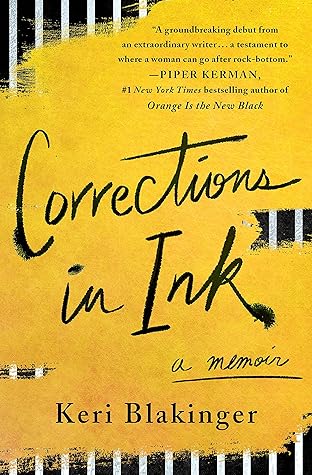
More on this book
Community


Kindle Notes & Highlights


Nobody heard him, the dead man, But still he lay moaning: I was much further out than you thought And not waving but drowning. —“NOT WAVING BUT DROWNING” BY STEVIE SMITH
These are about to be firsts for me. Both my first line and the first time I will not finish my reading assignment. I am tightly wound, a taut rubber band of perfectionism and self-destruction. And I am about to make things worse.
I wish she could see who she will become, and the parts of herself she will leave behind. The darkness that she will learn to live with, and the light she will learn to let in.
I was not acting suspicious! I was ready to be outraged at something, someone, anyone other than myself.
I talked incessantly at adults, but was completely at sea with my peers.
These were all things that had simply not occurred to me before, but the darkness appealed: Maybe I couldn’t be popular, but I could be tragic. I couldn’t be in the know, but I could have my own secret.
The rink itself was an utter dump, a former iron works factory with no heat or bathrooms and a rust-lined roof that would drip bronzy spots onto the ice, as if warning us of its slow plans to collapse. Despite the utterly unwelcoming arena and my intense hatred of the cold, I fell in love.
Being small was an advantage. Social cues didn’t matter—because the point was not to talk, the point was to skate.
We called ourselves SRGC and joked that we were so rejected we weren’t even cool enough to just be a group or a club. So we were a group-club.
They say that eating disorders are about control, but it is not that straightforward. They are also about self-destruction that feels just like success.
To me, it wasn’t Mark I wanted to shout obscenities at: it was the ice itself, a crisp manifestation of my best future with the cloudy swirl of my persistent failings running through it. It was a love-hate relationship, volatile as any teenage romance. When it was good, it was great. When it was not, life lost its meaning.
When you are dopesick you do not make good decisions.
This is to say: Dopesick is not a great frame of mind for hard choices, like how to handle a legal case or whether you want to stay sober.
Usually, Suboxone is prescribed for long-term use, to help people stay off drugs and lower the risk of a relapse; it’s after a period of sobriety—like jail—that heroin is at its deadliest, when you think you can do as much as you used to and don’t realize that high you seek will now kill you.
it’s simply that no one cares if you know. The system does not care if you understand it. If you are lucky, the women around you do.
Our crimes ranged from DUI to burglary, but we’d all landed behind bars because of our addictions.
Normies who have never been down this road may assume that people with eating disorders simply are not hungry, or that they forget to eat. That is extremely, utterly fucking false. The less I ate, the more I thought about it.
At least heroin didn’t make me cry every time afterward. I never tried to stop or tell myself this time was the last—I just didn’t care. In some ways, that reckless abandon is the exact opposite of an eating disorder.
Even when they’re quiet, jails have a distinct sound. Every whisper ricochets off the cinderblock walls and heavy steel doors into a muffled cacophony—the echoing soundtrack of your mistakes in stereo.
When I picked it up again in jail it was because of Susan, the pagan lesbian who’d joked about my apparent newfound fame. “It could be a book,” she told me. “At the least, it’s too weird not to write down.”
Just to be safe, I sent a few pages of what I wrote to people on the outside every few days, mailing out pieces of myself like a molting animal.
The skins I shed were angry, or grateful. Insightful, full of bold self-deception. I’d be full of hope one day and wishing for death the next. Convinced I had finally found God in one sentence, and ranting about cellblock drama two lines later.
My instincts for self-preservation had long been flimsy at best, and heroin and self-hate had dulled whatever was left.
It seemed that crosswords were the one thing I could get right when I’d so clearly fucked up everything else.
I needed to believe that people could change—not for him, but for me. If I did not believe that he could change, how could I expect people to think that I could? Eventually, I told myself, he would come clean. He would get sober. I would get out, and we would have our happily ever after as two changed people. I believed this with the certainty of a wrong answer inked into a crossword, a truth that fits until suddenly it doesn’
Without drugs to shield me from reality, I felt the sharp corners of my grief—not just for my lost degree, but for everything.
On the inside I was dark and detestable; on the outside I was a well of tears and self-pity, a six-letter word for fractured. Broken.
But it’s not like jumping off a bridge gave me some clarity or knocked any sense into me; I was still the same broken person, just now with a back brace and a prescription for morphine.
And while I was not still actively trying to kill myself, I was not exactly trying to live, either. I was just drifting, like debris floating down a gorge stream.
One kid said nobody knew I was on smack. Another said everybody did. They said I seemed troubled but still nice. Altered, but shockingly articulate. Intense, but defeated.
When I think back on those times now, it feels as if I am wading into a black lake, Woolf-like and weighted down by stones of shame. It is not one specific thing that formed this lake—but each bad act is another drop of water adding to the darkness.
Looking back, I don’t think it mattered whether that was enabling—I think it saved my life.
But when you are in jail, all the fuck-yous in the world don’t change the fact that you cannot win and you have no power.
All the futility, the small cruelties, the refusal to see us as fully human—it was not a flaw in the system. It was the system.
Starting in my first week upstate, complete strangers would spot me on the walkway and shout, “Oh, my God, it’s Harry Potter! Why is Harry Potter in prison?”
These weren’t names we’d ever used in the free world, and that kind of made sense: In prison, we were different people.
If I concentrated hard enough, I could almost feel the ice beneath me. For a minute, I could be an earlier version of myself, the version I always want to believe is the truest, most real me: the version that did not know prison, or heroin.
This was not just women singing, this was women learning how to steal joy in a place built to prevent it.
More than half of women in prison are survivors of physical or sexual violence and roughly three-quarters have mental health problems. A fifth of young prisoners—people under thirty—spent time in foster care. Most prisoners grew up poor, many are not literate, and studies show most did not graduate high school.
I knew that so many of the women I lived with had been through everything I had and much more. I was only seeing the end result.
Locking hundreds of traumatized and damaged women in together and threatening them constantly with additional punishments is not rehabilitation. It is not corrections. It is not public safety. It is systemic failure.
But when I look back on it, I still think that this is how change happens; one day at a time, people learn by stacking together individual moments that eventually add up to a different person.
This was how we coped and was probably why I now remember Taconic almost fondly as the best prison I was ever at. It was not any better than the rest; it was just the place where I’d finally learned to cope.
Or were they just trying to make sure we did not mistakenly start to respect ourselves?
Whether or not I had measured up as the daughter they wanted, I was the daughter they had. They did their best to be there for me when I did not expect it or feel like I deserved it.
“I don’t know, man,” I said, still thinking out loud. “I think how quick the time goes in here comes down to who you are, or who you turn into.”
But somewhere in the course of reliving it, I made a decision: I would not hide from my past. I would be relentlessly honest and open about it. If I told my story—on my own terms—then no one could use it against me. I would own it.
As I turned over in my head the years of fur and love and mistakes, I started writing about that raw feeling of regret, but also about addiction and recovery and comebacks. I put it all in a Twitter thread—real tweets, not on paper like in jail. Someone at a criminal justice news website, The Marshall Project, saw my tweets and asked me to make them into a personal essay. There were freelance gigs, speaking engagements, and interview requests—including one from Terry Gross, whose voice I’d once listened to on the way to skating practice, long before I knew anything about prisons or heroin.
“Damn way to go potter. I am truly proud of you,” he wrote. “Believe me, life is measured in what we give & how we touch others. You have definitely touched many and someday you will think the stress and trauma was well worth it.”
I tell them. I tell them about dentures and quotas and planted evidence and books. Their eyes are wide. “There’s, like, hope,” one says, in a tone that could be either a question or a statement.
