
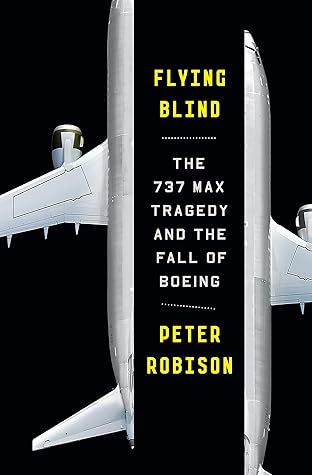
More on this book
Community


Kindle Notes & Highlights

It took three months to design the fix—an enclosure like the one the FAA engineer had ...
This highlight has been truncated due to consecutive passage length restrictions.
Lithium-ion batteries were known to catch fire, as had by then been observed in a range of products large and small. “This wasn’t rocket science,” said one FAA engineer.
Documents submitted to the FAA had put the odds of a failure of their battery at one in 10 million flight hours. Instead it happened twice in 52,000.
Congress, however, was more forgiving.
Roger Williams, a Texas Republican, asked an FAA official a couple of perfunctory questions. “Would you feel comfortable flying on a Boeing 787?” (Yes, came the answer.) “Do we need to get more involved?” (No.) “Less government is the best government,” he concluded.
Boeing managers told the flight controls team that under no circumstances were they to make any changes that would require pilots switching from the previous 737 to the MAX to step into a simulator. The reason: Boeing had promised Southwest $1 million per airplane if simulator training was required—and the carrier by 2019 had ordered 246. That was all the incentive Boeing needed.
As he worked to design its controls, Ludtke was already getting a bad feeling about the MAX. “It’s such a kludge of an airplane,” he said. “These pilots today really rely on automation. And this airplane did not have much.”
At a meeting in 2012, Reed, the FAA engineer who had so reluctantly joined the Boeing Aviation Safety Oversight Office, questioned Boeing managers about the plan to leave the cockpit of the new MAX largely unchanged. It would make the 737 the last big commercial jet flying without an electronic crew alerting system—like
“I was saying, ‘Guys, make the break, put a modern flight deck in this airplane,’ ” Reed recalls. He pointed out that many of the older pilots who grew up with 737s were retiring. Younger pilots had often started in commuter planes made by Embraer in Brazil or Bombardier in Canada, with far more advanced cockpits.
Even the newest military planes had checklists that appeared on touch screens. If a hydraulic pump failed, a message would pop up showing specific actions the pilot should take. On the 737, a light showing “low hydraulic pressure” might illuminate with no further explanati...
This highlight has been truncated due to consecutive passage length restrictions.
Early testing revealed a fateful problem with the MAX. In a wind tunnel with a scale model of the plane about the size of an eagle, engineers noticed that it had a tendency to pitch up during tight, high-speed turns—a result of the bigger engines that were to be mounted to the front of the wings rather than beneath them. Ray Craig, then the chief 737 pilot, took a closer look in a simulator. The pitch-up took place in a part of the flight envelope where few commercial jetliners ever ventured. It was theoretically possible, though, that pilots might make such a turn when they were responding to
...more
The MAX program was already under cost pressure. Managers talked frequently about how any change would have to “buy its way onto the airplane”—suggesting that even safety-related improvements took a back seat to cost.
Boeing’s engineers wondered if they should even refer to the existence of MCAS at all. They decided in June 2013 to use the name internally but externally to refer to it as just a tweak of the existing electronic flight controls, reducing the chance that anyone would ask questions about it. “If we emphasize MCAS is a new function there may be a greater certification and training impact,” said a memo that month, summarizing their discussion.
They’re vulnerable to bird strikes, damage from jetway equipment, or other obstructions. FAA records showed more than two hundred instances of malfunctioning AoA vanes alone since 2004, some of which had set off cockpit alerts. Ewbank and the others urged implementation of a backup system called “synthetic airspeed” already in use on the Dreamliner—essentially a computer program to compare values of all the sensors. If an illogical reading came from any of them—such as the AoA vanes linked to the new MCAS software—it would be deactivated.
In rejecting the safety enhancement, managers twice cited concerns about the “cost and potential (pilot) training impact.” “People have to die before Boeing will change things,” Ewbank was told by his manager.
The shift of Dreamliner production to South Carolina had come with its own drawbacks. The state might have been cheap, but the people Boeing hired—at half the hourly wage of those in Seattle—had little experience building airplanes.
William Hobek, a quality manager there, filed suit in federal court claiming he’d been fired after reporting defects up the chain of command. When he complained, a supervisor replied, “Bill, you know we can’t find all defects,” according to the suit. Hobek called over an inspector, who quickly found forty problems.
Al Jazeera sent a hidden camera into the plant in 2014 and caught some employees on tape saying they’d never fly on the planes because of shoddy workmanship.
Mondays at 6:30 a.m., if he wasn’t traveling, Dennis Muilenburg joined a handful of colleagues for Bible study. Seated on hard chairs in the cafeteria of Boeing’s defense division in St. Louis, which he ran from 2009 to 2013, they took turns reading photocopied passages of scripture and excerpts from books like God in the Marketplace and Doing Business by the Good Book.

Like something out of the Enchantments of Mammon
What’s worse, it appeared to Dickson that the FAA was complicit in the effort. Increasingly, he said, airplanes came with an “IOU,” as managers at both the FAA and Boeing agreed to table disagreements about technical issues in order to avoid delays. “That culture is new, and that culture is toxic,” he said. “It’s putting profits ahead of real compliance.”
Boeing was in the midst of assembling the first MAX in mid-2015 when the agency’s senior management overruled thirteen of its own engineers, one of its pilots, and at least four other managers on what the specialists felt was yet another flaw: the lack of shielding around its rudder cables.
They wanted design changes that would prevent shrapnel from an engine blowout shredding the cables—a situation like the one that brought down the DC-10 in Sioux City in 1989. Boeing executives argued the changes were impractical. But Airbus had had a similar issue on the A320neo, and it did make modifications.
After a visit to an airline in Africa, a Boeing trainer reported to his boss that he’d be writing up a short report: “Should not fly airplanes.”
Most admitted privately that for young pilots, so accustomed to having computers tell them what to do, their 737 was a difficult beast. One high-ranking Boeing executive told people that if he were flying in Asia, he would prefer to be on an Airbus.
Many of Boeing’s instructors wanted to offer more intensive training, but were told the company had other priorities. “We felt like shortcuts were being taken and that the quality of training was being sacrificed,” said Charlie Clayton, a former Boeing trainer. The airlines, too, had “a vested interest in getting pilots out and flying as quickly as they can, as cheaply as they can.”
Incredibly, Boeing’s sales team had already started telling airlines—long before receiving any official blessing—that the plane wouldn’t require simulator training. When someone wrote that same month to ask Klein’s Aircraft Evaluation Group if what Boeing was saying was true, the AEG replied that it wasn’t—in
Teal told Piccola he wanted to make sure everyone was “aligned.” He got an agreement that no one would be making any “new interpretations of existing regulations.” It was one more reminder that Boeing was in charge, and the Forrest Gumps at the FAA should do as they were told.
The pilots told Teal the plane wasn’t “certifiable” in that condition, meaning it wouldn’t pass muster with the FAA.
“All changes are minimal / low collateral damage, therefore no additional flight testing,” one memo said.
colleague replied, “If they are faulty then MCAS shuts down immediately.” That wasn’t true, as it turned out.
“Oh I’m sure it’ll get better when Boeing engineers design a whole new one. Wait? Who is left to do such a thing?” one worker wrote in an email later turned up by investigators. “No one!” came the reply.
Sitting in a hotel room in Miami with a Grey Goose, he vented to his deputy, a former Ryanair pilot named Patrik Gustavsson, about the plane’s “egregious” performance in the simulator. No one had told him that MCAS, originally intended to prevent stalls at high speed, could now possibly fire at speeds as low as 150 miles per hour. “I’m levelling off at like 4000 ft, 230 knots and the plane is trimming itself like craxy [sic],” he wrote. “I’m like, WHAT?”
Gustavsson’s first reaction was the sheer frustration of the fed-up office worker. “Oh great,” he replied—now they had to update the description in the manual. But Forkner appeared to have deeper concerns. He wrote that it meant he had “lied (unknowingly) to the regulator” about the system’s authority over the stabilizer, its ability to flummox a pilot. “Why are we just now hearing about this?” Forkner asked.
“I don’t know, the test pilots have kept us out of the loop,” Gustavsson replied. “They’re all so damn busy, and getting press...
This highlight has been truncated due to consecutive passage length restrictions.
They couldn’t have known it at the time, but they were remarking on the 737 MAX’s fatal flaw, the feature that, two years later, would co...
This highlight has been truncated due to consecutive passage length restrictions.
Thanks to the lobbying Forkner and his colleagues had done, pilots like Suneja or Harvino, who’d already flown the 737 Next Generation, didn’t need to step into any simulator to fly the MAX. (Cost to the airlines in lost crew salary: “Zero,” as a Boeing employee wrote in one email.)
“The lies, the damned lies,” one person wrote, despairing that a pilot had been asked to sign one certification document “clearly based on a lie.”
“I’ll be shocked if the FAA passes this turd,” one wrote in a message later turned over to congressional investigators.
“I still haven’t been forgiven by God for the covering up I did last year,” the employee said in an instant message.
“Would you put your family on a MAX simulator trained aircraft? I wouldn’t.” “No,” came the reply.
The manager lamented how “the lowest ranking and most unproven supplier” had won the simulator contract, “solely based on bottom dollar.”
“It’s systemic. It’s culture. It’s the fact that we have a senior leadership team that understand very little about the business and yet are driving us to certain objectives. Its [sic] lots of individual groups that aren’t working closely and being accountable…. Sometimes you have to let things fail big so that everyone can identify a problem.”
At the factory on Lake Washington near Seattle where the 737s were made, that’s exactly what Ed Pierson feared he was seeing. Pierson had been a navy officer for thirty years, commanding a squadron before joining Boeing in 2008. After working in the flight test unit under Bomben, he’d become a senior manager in 737 assembly.
“Frankly right now all my internal warning bells are going off. For the first time in my life, I’m sorry to say that I’m hesitant about putting my family on a Boeing airplane.”
He laid out all of the evidence that quality was suffering and asked Campbell to shut down the line. “We can’t do that. I can’t do that,” Campbell said. Pierson replied that he had seen operations in the military shut down over less substantial safety issues. Campbell answered tersely, “The military isn’t a profit-making organization.”
he was especially excited about working with the industry, rather than against it, to address safety issues. Over the previous two years, Bahrami proudly said, enforcement actions had dropped 70 percent.
“We used to measure success by how high our stack of hate mail was,” he said. “That’s no longer the case.”
On a call that year with analysts, Muilenburg complimented the government for its “focus on deregulation” and the “streamlined” certification process...
This highlight has been truncated due to consecutive passage length restrictions.
After lobbying from Boeing and others, the bill authorizing funding for the FAA the next year went further than ever before in handing control to the manufacturers, dis...
This highlight has been truncated due to consecutive passage length restrictions.
The FAA was stripped of some of its most fundamental authority—to decide, for instance, whether a manufacturer like Boeing was qualified to certify its own work. Under the new law, delegation to private industry was considered the default. If regulators had doubts about a system—the Dreamliner’s batteries, say, or the MAX’s flight controls—they first had...
This highlight has been truncated due to consecutive passage length restrictions.
