
More on this book
Community


Kindle Notes & Highlights

by
Peter Oborne
Read between
May 1 - May 2, 2021

He knew he was lying because as prime minister he was responsible for the decision not to publish.XLIII
The prime minister’s biggest lies involved Brexit.
He repeatedly insisted that there would be no customs checks or controls for goods moving from Great Britain to Northern Ireland.
Boris Johnson, who had overseen negotiations and personally signed off the deal, knew all this. Yet he repeatedly stated the opposite.
In Parliament on 22 October he said: ‘There will be no checks between Great Britain and Northern Ireland.’XLVII This bare-faced lie in all its moral squalor remains on the Commons order paper.
Launching the Tory election campaign outside Downing Street two weeks later he told the nation: ‘We can leave the EU as one UK, whole...
This highlight has been truncated due to consecutive passage length restrictions.
The 2019 general election was held on the eve of Brexit, the most momentous event in post-war British history. Yet Johnson’s Brexit fabrications were not held up to serious inspection by the media at any stage.
is sometimes said that British politicians can be divided into vicars and bookmakers and voters prefer the latter.LVI Johnson falls into the bookmaker class.
Voters enjoy his good humour and low tricks. They let him get away with anything.
Yet most of Johnson’s general election lies were not innocent. They were part of a deliberate and carefully calculated strategy of deception.
There is irrefutable evidence that Conservative Party lies and distortions in the 2019 election were cynical, systematic and prepared in advance. Johnson’s Conservatives deliberately set out to lie and to cheat their way to victory. The strategy triumphed.
Profumo was the paradoxical embodiment of a governing system where integrity counted. Misleading the Commons was regarded with special horror.
Erskine May, the authoritative procedural manual for Parliament, still warns members not to do this,
Meanwhile the Ministerial Code insists: ‘It is of paramount importance that Ministers give accurate and truthful information to Parliament, correcting any inadvertent error at the earliest opportunity. Ministers who knowingly mislead Parliament will be expected to offer their resignation to the Prime Minister.’VIII
But Erskine May and the Ministerial Code are now ignored.
Ministers (including the prime minister) lie and cheat with impunity. Their falsehoods remain contemptuously uncorrect...
This highlight has been truncated due to consecutive passage length restrictions.
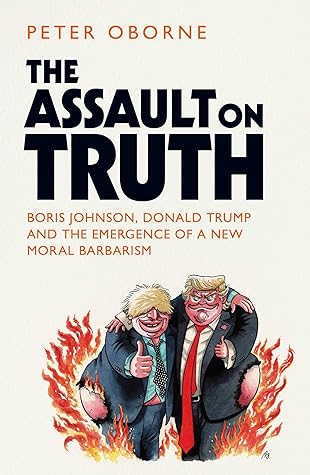
Not so Boris Johnson. As a liar he cannot be compared to Tony Blair. He has never needed a noble justification for lying. He lies habitually, with impunity, and without conscience. This puts his dishonesty into the same category as Donald Trump’s. Although far below Trump’s in scale and stridency, it is epic by British standards.
Superficially the US president and the British prime minister could hardly be less alike:
Yet the gulf isn’t as great as it seems. Both men are noted for making outlandish claims which have little or no connection with reality.
Bill Clinton and Tony Blair thought their lies were justified because they were in a good cause.
That’s not true of Boris Johnson and Donald Trump.
They invent damaging falsehoods about political opponents, whether it be Johnson’s unsupported assertion that Jeremy Corbyn wanted to dismantle the British armed forces or Trump’s repe...
This highlight has been truncated due to consecutive passage length restrictions.
They’ve reached the top despite the profound distrust of colleagues, sinister connections on the far right, a record of racism and long records of cheating and fabrication which had become apparent well before they reached the highest office.
Both are lazy.
Neither bothers wit...
This highlight has been truncated due to consecutive passage length restrictions.
Both flourish in a world of illusion and ...
This highlight has been truncated due to consecutive passage length restrictions.
Above all, Johnson and Trump turned themselves into popular entertainers who possess the irreplaceable art of arresting the attention of voters.
Johnson and Trump had stumbled on a new way of doing politics.
‘The status of politics as represented in the media is ambiguous between entertainment and the transmission of discoverable truth.’
Johnson was twenty-three when he was first sacked for lying.III
Johnson, a trainee on The Times, was instructed to write about it.
It is worth noting the nature of the story, a distant piece of history, interesting but with no present political or other significance. But The Times then still prided itself on being a journal of record and Johnson had to go.
The future British prime minister crossed the street to the Daily Telegraph, which quickly made him Brussels correspondent, normally a dead-end appointment in a city notorious for dull, bureaucratic stories.
He stumbled upon a new form of journalism which thirty years later would beco...
This highlight has been truncated due to consecutive passage length restrictions.
He filed a sensational story on plans to blow up the Berlaymont building, headquarters of the European Commission.VII
Johnson told Telegraph readers that the Berlaymont was to be replaced by a ‘kilometre-high skyscraper topped by a communications mast’.
That Brussels harboured plans to monitor smelly European farmyards,
to standardise coffin sizes.X
Johnson told Telegraph readers that Brussels posed a threat to British pink sausages.XI
That it wanted to standardise condom sizes because Italians had smaller penises (in fact the EU was concerned about the safety of condoms,
These stories typically contained a grain of truth, but were in essence fabrications.
The Times (a rival paper), later listed many of them on the Tortoise news website. He noted a common theme because they ‘invariably portrayed “Brussels” as a den of conspirators determined to create a European superstate which would destroy Britain’s sovereignty, traditions and way of life’.
Black wrote a generous defence of Johnson in The Spectator, arguing that he ‘was such an effective correspondent for us in Brussels that he greatly influenced British opinion on this country’s relations with Europe’.XVI
When Johnson left Brussels, the Times reporter James Landale adapted Hilaire Belloc’s ‘Matilda’: ‘Boris told such dreadful lies / It made one gasp and stretch one’s eyes.’
Johnson was sacked for lying for a second time in 2004.
Amid this confusion of roles, Johnson was confronted with tabloid allegations that he was in an affair with a colleague, which he described as ‘complete balderdash’ and ‘an inverted pyramid of piffle’.
The Guardian to announce ‘an end to an unlikely but uniquely engaging political career’.
The Guardian’s verdict, while understandable, was premature. Fifteen years later Boris Johnson, who’d been sacked for lying both by The Times and by the Tory Party, became prime minister. He had been elected by a majority of Tory MPs – and was powerfully endorsed by The Times.XXII
The transgressive discourse I explored in the paragraphs above can be traced to the so-called New Journalism of the 1960s and 1970s,
writers such as Truman Capote, Norman Mailer and Tom Wolfe deliberately blurred the boundaries between reporting and fiction.
