
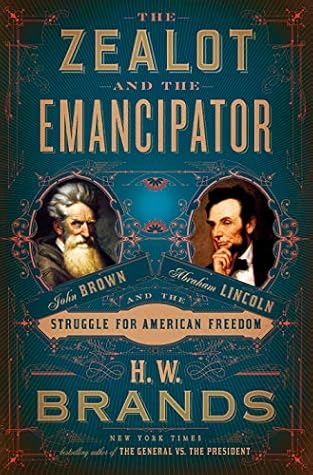
More on this book
Community


Kindle Notes & Highlights

by
H.W. Brands
Read between
June 24 - July 20, 2022

Abolitionism became a growing force in American politics. William Lloyd Garrison founded The Liberator, a Boston paper that even its subscribers often judged intemperate in its treatment of slavery and slaveholders.
Lovejoy’s enemies smashed his printing presses repeatedly, eventually driving him across the Mississippi to Alton, in the free state of Illinois, where he launched a new abolitionist paper.
“Here, before God, in the presence of these witnesses, from this time I consecrate my life to the destruction of slavery.”
ABRAHAM LINCOLN HAD no such epiphany and made no such declaration. Lincoln lacked Brown’s unquestioning religious faith. Yet he confronted the same question Brown did: What was the moral man’s obligation when faced with an immoral institution like slavery?
Quakers had been among the first groups in America to oppose slavery and who still provided shelter to fugitives from the South.
From this night spent with John Brown in Springfield, Mass., 1847, while I continued to write and speak against slavery, I became all the same less hopeful of its peaceful abolition. My utterances became more and more tinged by the color of this man’s strong impressions.”
“They believe that the institution of slavery is founded on both injustice and bad policy, but that the promulgation of abolition doctrines tends rather to increase than to abate its evils,” the two lawmakers said of themselves. They believed Congress had no power to interfere with slavery in the states, but did have power over slavery in the federal District of Columbia.
Clay appreciated that emancipation was a practical issue as well as a moral one, and practical matters had to be acknowledged. “Cast into life where slavery was already widely spread and deeply seated, he did not perceive, as I think no wise man has perceived, how it could be at once eradicated, without producing a greater evil, even to the cause of human liberty itself.”
“Popular sovereignty” was what Douglas called the concept of allowing settlers to determine the fate of the territories with respect to slavery.
Gerrit Smith
abolitionist Amos Adams Lawrence
Lincoln saying, “The day of compromise has passed. These two great ideas have been kept apart only by the most artful means. They are like two wild beasts in sight of each other, but chained and held apart. Someday these deadly antagonists will one or the other break their bonds, and then the question will be settled.”
Lincoln said. “Much as I hate slavery, I would consent to the extension of it rather than see the Union dissolved, just as I would consent to any great evil to avoid a greater one.”
Our progress in degeneracy appears to me to be pretty rapid. As a nation, we began by declaring that ‘all men are created equal.’ We now practically read it ‘all men are created equal, except negroes.’ When the Know-Nothings get control, it will read ‘all men are created equal, except negroes, and foreigners, and Catholics.’ When it comes to this I should prefer emigrating to some country where they make no pretense of loving liberty—to Russia, for instance, where despotism can be taken pure, and without the base alloy of hypocrisy.”
Yet Henry Beecher, for all his fame, wasn’t even the most powerful abolitionist in the Beecher family. That honor went to his sister Harriet, who married a man named Stowe. And as Harriet Beecher Stowe she wrote the best-selling American novel of the nineteenth century, Uncle Tom’s Cabin, which won more converts to the antislavery cause than all her brother’s sermons—and all the words written and spoken by any other abolitionist.
professional politician, he went on, you never could trust, for even if he had convictions, he was always ready to sacrifice his principles for his advantage.”
The Constitution gave the states control over slavery within their borders.
After all, Jefferson—and Washington and Madison and nearly every other Southern delegate to the Continental Congress—were slaveholders. Taney concluded from all this that Africans and their descendants in America, whether slaves or free blacks, were not citizens under the Constitution, and never could be.
The Dred Scott decision was only the second time in history that the Supreme Court had overturned a federal law.
ABRAHAM LINCOLN’S Springfield speech caused the sensation he hoped for, and then some. Many of his allies thought he had taken things too far with his “house divided” imagery. William Herndon had known Lincoln was going to use the phrase and image, for Lincoln had read him the speech ahead of time. “It is true,” Herndon said of the metaphor. “But is it wise or politic to say so?” Lincoln subsequently read the speech to an audience of a dozen close confidants. “Some condemned and not one endorsed it,” Herndon said of the provocative line.
“I cannot but regard it as possible that the higher object of this contest may not be completely attained within the term of my natural life. But I cannot doubt either that it will come in due time.” And he wanted to be on the side of righteousness. “I am proud, in my passing speck of time, to contribute an humble mite to that glorious consummation, which my own poor eyes may not last to see.”
There is a physical difference between the two which, in my judgment, will probably forever forbid their living together upon the footing of perfect equality; and inasmuch as it becomes a necessity that there must be a difference, I, as well as Judge Douglas, am in favor of the race to which I belong having the superior position.”
“There was in his debates with Douglas, which, as to their form at least, were largely extemporaneous, occasionally a flash of the same lofty moral inspiration; and all he said came out with the sympathetic persuasiveness of a thoroughly honest nature, which made the listener feel as if the speaker looked him straight in the eye and took him by the hand, saying: ‘My friend, what I tell you is my earnest conviction, and, I have no doubt, at heart you think so yourself.’ ”
Now, if it is deemed necessary that I should forfeit my life for the furtherance of the ends of justice, and mingle my blood further with the blood of my children and with the blood of millions in this slave country whose rights are disregarded by wicked, cruel, and unjust enactments, I say let it be done.”
“I, John Brown, am now quite certain that the crimes of this guilty land will never be purged away but with blood,” he declared.
Garrison wrote in The Liberator. “The brutal dastards and bloody-minded tyrants who have so long ruled the country with impunity are now furiously foaming at the mouth, gnawing their tongues for pain, indulging in the most horrid blasphemies, uttering the wildest threats, and avowing the most treasonable designs. Their passions, ‘set on fire of hell,’ are leading them into every kind of excess, and they are inspired by a demoniacal phrenzy.” Garrison quoted from the Book of Revelation to mark the South as the modern Babylon; he turned to the ancient Greeks—and John Brown—to declare, “Whom the
...more
You think slavery is right and ought to be extended; while we think it is wrong and ought to be restricted. That I suppose is the rub. It certainly is the only substantial difference between us.”
declare that the maintenance inviolate of the rights of the states, and especially the right of each state to order and control its own domestic institutions according to its own judgment exclusively, is essential to that balance of powers on which the perfection and endurance of our political fabric depends.
Lincoln had spoken like a lawyer when he should have spoken like a prophet, or at least a man of moral courage. “Weakness, timidity and conciliation towards the tyrants and traitors had emboldened them to a pitch of insolence which demanded an instant check,” Douglass said of the secessionists.
Douglass wanted the conflict between the secessionists and the Union to be about slavery; Lincoln wanted it to be about states’ rights—which, in his view, included the right to permit slavery but not the right to secede. Douglass saw the struggle as essentially moral; Lincoln saw it as political. Douglass was an idealist; Lincoln, a pragmatist.
“It is the dawn of a new era,” Chase said. “The latest generations will celebrate it. The world will pay homage to the man who has performed it.”
The Kansas slayer and Harpers Ferry raider had embraced violence in the struggle against slavery, while Lincoln had condemned it. Lincoln chose instead the peaceful path of democratic politics. But Lincoln’s path had by now led to slaughter a thousand times greater than anything John Brown ever committed. And unless the South experienced a sudden change of heart, the slaughter would only continue.
Lincoln had reason to be sensitive, for during this period he was stretching the Constitution to the breaking point. In mid-September he suspended the writ of habeas corpus for individuals arrested as “spies or aiders or abettors of the enemy.” The suspension was broad, applying throughout the country, and it was open-ended, lasting for the duration of the war or until it was explicitly revoked.
Jefferson Davis had recently been quoted as saying the war was not about slavery. “This war must go on till the last of this generation falls in his tracks, and his children seize his musket and fight our battle, unless you acknowledge our right to self-government,” Davis had said. “We are not fighting for slavery. We are fighting for independence, and that, or extermination, we will have.”
“Fondly do we hope, fervently do we pray, that this mighty scourge of war may speedily pass away. Yet if God wills that it continue until all the wealth piled by the bondsman’s two hundred and fifty years of unrequited toil shall be sunk, and until every drop of blood drawn with the lash shall be paid by another drawn with the sword, as was said three thousand years ago so still it must be said, ‘The judgments of the Lord are true and righteous altogether.’ ”
Lincoln himself had raised the issue of blood atonement in his second inaugural address. Now his own blood was part of the reckoning, and his link to John Brown more compelling. Brown had foretold blood atonement while becoming one of the first sacrifices; Lincoln at the time had resisted the concept for his country and scarcely imagined it for himself. But he made decisions whose consequences included a bloodletting far greater than anything Brown had envisioned, and finally his own death. Brown was a first martyr in the war that freed the slaves, Lincoln one of the last.
God worked in mysterious ways; Lincoln wasn’t perfect, but he was perfectly suited to his task. “Taking him for all in all, measuring the tremendous magnitude of the work before him, considering the necessary means to ends, and surveying the end from the beginning, infinite wisdom has seldom sent any man into the world better fitted for his mission than Abraham Lincoln.”
