
More on this book
Community


Kindle Notes & Highlights


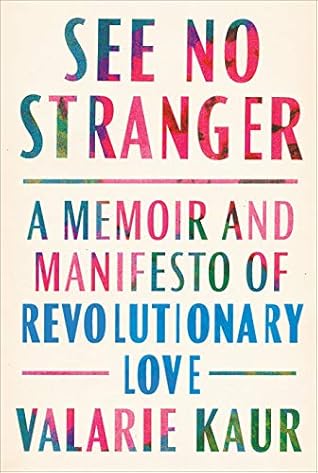
“Revolutionary love” is the choice to enter into wonder and labor for others, for our opponents, and for ourselves in order to transform the world around us.
The story unfolds in three parts. Part One: See No Stranger is about learning how to love others. When we wonder about people, grieve with them, and choose to fight with and for them, we can build the kind of solidarity the world needs. Part Two: Tend the Wound is about learning how to love even our opponents. When we rage in safe containers to tend to our own wounds, and listen to understand theirs, we can gain the information we need to reimagine solutions. Part Three: Breathe and Push is about learning how to love ourselves, how to breathe amidst labor, push ourselves to go deeper, and
...more
Wonder is our birthright. It comes easily in childhood—the feeling of watching dust motes dancing in sunlight, or climbing a tree to touch the sky, or falling asleep thinking about where the universe ends. If we are safe and nurtured enough to develop our capacity to wonder, we start to wonder about the people in our lives, too—their thoughts and experiences, their pain and joy, their wants and needs. We begin to sense that they are to themselves as vast and complex as we are to ourselves, their inner world as infinite as our own. In other words, we are seeing them as our equal. We are gaining
...more
But when we choose to wonder about people we don’t know, when we imagine their lives and listen for their stories, we begin to expand the circle of those we see as part of us. We prepare ourselves to love beyond what evolution requires.
We can look upon the face of anyone or anything around us and say—as a moral declaration and a spiritual, cosmological, and biological fact: You are a part of me I do not yet know.
Wonder is where love begins, but the failure to wonder is the beginning of violence. Once people stop wondering about others, once they no longer see others as part of them, they disable their instinct for empathy.
I had fallen for the great bribe of white supremacy: the promise of acceptance for people of color who put down other people of color.
who we see as one of us determines who we let inside our circle of care and concern.
The indigenous population of California fell from 150,000 to 30,000 in just twenty-seven years from 1846 to 1873, making the California genocide the most documented genocide in North America.
In the United States, white supremacy is intertwined with Christian supremacy, one an extension of the other. Any theology that teaches that God will torture the people in front of you in the afterlife creates the imaginative space for you to do so yourself on earth.
The act of naming the violence and grieving loss in community is how the hole turns into a wound that can heal.
Grief is the price of love. Loving someone means that one day, there will be grieving. They will leave you, or you will leave them. The more you love, the more you grieve. Loving someone also means grieving with them.
the trauma of violence and oppression is inherited from our ancestors, might we also inherit their resilience and bravery?
First people grieved together. Then they organized together. Often, they sang and celebrated together.
Baba Ji was slated for deportation on the grounds that he was likely to become a “public charge,” dependent on the government for subsistence, because there was too much prejudice against his class of people for him to earn a living. The state cited racism to justify its racism.
Hate crimes peaked in the wake of 9/11 but then remained high.
Any act to change the world around us begins within us. It starts with a sense of agency, a sense that we have the power to effect change. The Latin root of the word “power” means “to be able.” When we feel helpless in the face of injustice, it is easy to give in to the idea that this is just the way things are, because it’s the way things have always been.
government profiling continued to signal to the public that people who were brown or turbaned or Muslim should be treated as automatically suspect and potentially terrorist. This is why hate crimes remained high and never again fell back to the levels they were at before 9/11. State violence fueled public hatred, which led to more violence.
Brynn’s words echoed in my ears: “ancestral solidarity.” People of color survived oppression throughout our history through acts of solidarity. Shallow solidarity was based on the logic of exchange—You show up for me, and I will show up for you. But deep solidarity was rooted in recognition—I show up for you, because I see you as part of me. Your liberation is bound up in my own.
When we can no longer see the faces of the people sworn to protect us, public safety is an illusion.
Dr. King named three evils—racism, poverty, and militarism. But he left out a fourth—sexism. The assumption that women and girls are less than equal and therefore deserve less dignity and freedom is perhaps the most ancient, pervasive, and insidious evil of them all.
So, I invite you to step into this rich part of my tradition with four questions. First, what is your sword, your kirpan? What can you use to fight on behalf of others—your pen, your voice, your art, your pocketbook, your presence?
Second, what is your shield, your dhal? What can you use to protect yourself and others when the fight is dangerous—your camera, legal counsel, a group of allies, public witness?
Third, what is your instrument, your dilruba? In Sikh legend, our ancestors designed the dilruba, a string instrument small enough for soldiers to carry on their backs into the battlefield, so that they could lift their spirits in music,
Finally, who is your sacred community, your sangat?
My fear of anger taught me nothing. Your fear of that anger will teach you nothing, also. —Audre Lorde
thought of Arendt’s analysis that we each have the potential to be the prisoner and the guard, to bear the violence and commit the violence.
When we cannot see that evil is driven by a person’s wounds, not their innate nature, we become terrified of each other. But the moment we see their wounds, they no longer have absolute power over us.
Oxytocin decreases aggression in a mother’s body overall with one exception—in defense of her young. When babies are threatened, oxytocin actually increases aggression. For mothers, rage is part of love: It is the biological force that protects that which is loved.
The aim of divine rage is not vengeance but to reorder the world. It is precise and purposeful, like the focused fury projected into the world from the forehead of the goddess. It points us to the humanity of even those who we are fighting.
Divine rage can make people uncomfortable: It can feel disruptive, frightening, and unpredictable. There are those who wish to police such rage in the name of civility. But civility is too often used to silence pain that requires people to change their lives.
Step away to rage, return to listen, and reimagine the solutions together.
How do we hold people accountable for wrongdoing and yet at the same time remain in touch with their humanity enough to believe in their capacity to be transformed? —bell hooks
It reminds me of a line from Toni Morrison’s novel Love: “Hate does that. Burns off everything but itself, so whatever your grievance is, your face looks just like your enemy’s.”
The question therefore is not whether or not to listen to our opponents. The questions are: When is it my role to listen? When am I emotionally and physically safe? When can I take on the labor of listening when others are not safe to do so? We can all be one another’s accomplices. At any given time, there are some opponents I cannot wonder about—I need others to do that labor for me as I tend to the wounds they inflict. But there are some opponents I find I am in a position to listen to. In these moments, it is time to turn to the practice of how.
The most critical part of listening is asking what is at stake for the other person. I try to understand what matters to them, not what I think matters.
We can have all the empathy in the world for a group of people and still participate in the structures and systems that oppress them. We might believe we are listening, but we have journeyed only half of the circle. We have drawn close to the story and lost ourselves in another’s experience, but we haven’t returned to ourselves and asked: What does this demand of me? Is it the reckoning of my privilege? Is it an expansion of whose struggles connect with mine? What will I do differently now?
This was my loving act: to see my worst opponent as someone who deserved healing and let others tend to his wound.
I had fallen for the trap in so many dialogues—the rush to be polite, to seek out sameness but not difference, to steer clear of discomfort and avoid hard truths. But the purpose of listening across lines of difference is not agreement or compromise. It is understanding. True understanding is not possible unless we risk changing our worldview. Otherwise we think we have built bridges to one another, but the bridges are rooted in sands that can shift with the tide. Solidarity is only possible if we are brave enough to reckon with the past and how the past shapes the present. In the United
...more
White supremacy as an ideology had been pushed to the margins of American culture. But white supremacy as a system of structural advantage that favors white people persists: It animates the institutions we operate in.
But there is no reconciliation without truth.
In these moments, we can choose to remember that the goal of listening is not to feel empathy for our opponents, or validate their ideas, or even change their mind in the moment. Our goal is to understand them.
Since the genocide and colonization of indigenous peoples, antiblack racism has been the country’s most enduring mechanism for creating hierarchies of human value—every other form followed from it.
I knew that our struggles as communities of color were interconnected, but I was beginning to understand that our movements needed to center black lives if we were to combat the hate of the men at this table.
His rage was a symptom of his pain.
