
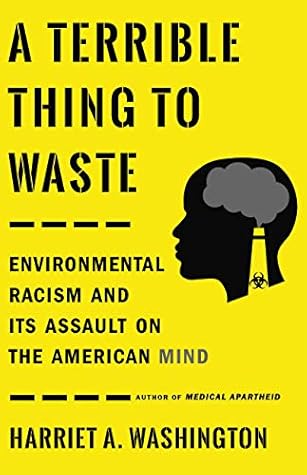
More on this book


Kindle Notes & Highlights

Read between
September 3 - September 19, 2020

People of color are least likely to have the option of working from home, which means they’re less likely to be able to practice social distancing and avoid crowded workplaces and mass transit.7 Adequate protective gear has been scarce for most “essential” workers in factories and the disproportionately ethnic workers who operate and clean mass transit and staff hospitals, nursing homes, and restaurants. Decades of credit and mortgaging practices such as redlining, and the biases that precluded access to such initiatives as the Servicemen’s Readjustment Act of 1944, or G.I. Bill, have made it
...more
Every documented risk factor for coronavirus infection and death is made worse by environmental racism. The oft-cited risks may be proximate causes, but living in a poison-laced environment is the ultimate risk factor.19
Yet iodine deficiency remains the world’s leading cause of preventable mental retardation. Prenatal iodine deficiency as well as deficiency in adulthood leads to compromised intelligence as measured by IQ testing, especially in the developing nations that report some of the world’s lowest IQ scores.
Within the United States, African Americans suffer the nation’s highest level of iodine deficiency. According to the government’s National Health and Nutrition Examination Survey (NHANES) data for 2005–2008, African Americans’ urinary iodine reading of 137 µg/L is lower than that of Mexican Americans at 174 µg/L and of non-Hispanic whites at 168 µg/L. No separate data are given for Native Americans or other ethnic groups.
cancer, liver disease, and cognition problems such as memory loss. As I read transcripts related to the suit, I was struck by Cochran’s exclamation, “There is always some study, and they’ll study it to death, then thirty years later, you find out it’s bad for you.… We know it’s bad for us right now!”8 In language that everyone can understand, Cochran was expressing an important precept that we have long shunned in the United States, called the precautionary principle.
Meanwhile, the standard of proof demanded by the industries that use and disseminate these chemicals is sometimes so high that masses of people suffer their effects in the time it takes to sufficiently prove their harmfulness. In the case of lead alone, the Environmental Defense Fund has noted that thousands of children were poisoned (at a cost of $50 billion to the nation) while we awaited “sufficient” proof to take action.9 As Cochran suggested, there is a better way. The European Union, for instance, requires human safety tests before any new industrial chemical is unleashed into the
...more
Medical journals offer evidence that many of the 140,000 untested industrial chemicals in worldwide use impede intelligence. As we will see, these chemicals are far more likely to find their way into African American, Hispanic, and Native American communities—affecting their water, land, and even schools—than into white communities.
A Terrible Thing to Waste explains that establishing convincing proof, which is often presented as a purely scientific question, is very often an economic and political strategy deployed by industry and/or government to evade responsibility. Achieving scientific certitude is difficult given the plethora of variables and our often insufficient command of causal interrelationships.
By eliminating pervasive lead, mercury, hydrocarbons, industrial chemicals, prenatal exposures to alcohols, and even exotic pathogens like “red tide” algae poisonings, worm infestation, and trichinosis, we can save the assailed brains of untold people of color. As a bonus, by using techniques ranging from heavy metal and contaminant abatement to educational enrichment to laws against industrial pollutants, we’ll increase the health of our nation as a whole, and likely also help address the dangerous effects of dire poverty. U.S. government action will also be necessary. A federal mandate could
...more
The United States will continue to face difficulty catching up with China and India, our nation’s current economic competitors, in part because state education funding has been slashed in recent years.
Yet we have largely failed to appreciate the well-documented connection between environmental exposures and lower intelligence and IQ. Certainly we have failed to act upon it. Acknowledging the potent effect of environmental poisons on intelligence would contradict the hereditarian theories of innate, permanent inferiority as expressed by IQ scores, theories that are uncritically accepted by many.
This myopia robs us of a potent tool—the reduction and removal of human exposures to environmental poisons that cause damage far beyond cancers, lung disease, and other serious physical illnesses. They also damage the brain and lower intelligence, creating not only individual tragedies but a needless collective loss of intelligence.
So IQ is indeed malleable—we just need to determine what causes it to change. If we do that, we will be empowered to craft strategies and tools for raising it within marginalized ethnic minority groups of African Americans, Hispanics, and Native Americans, just as we raised the low IQs within pockets of America by using iodine supplementation.
From the beginning, Binet insisted that the test was valid only for measuring the weaknesses of pupils who were already performing inadequately, not for predicting who might perform inadequately. He always denied that it could be used for the latter purpose.
Today many intelligence tests give a single intelligence quotient, held to be a measure of general intelligence. IQ tests purport to measure only fluid intelligence. Fluid intelligence is associated with the ability to solve problems that require no prior knowledge, such as abstract logic puzzles that one has never seen before and for which one has no context. Crystallized intelligence, on the other hand, is related to one’s ability to use learned knowledge. IQ questions regarding vocabulary and analogies, which can more readily be answered by those who have read widely and know a lot of
...more
Before World War II, the shorter stature of the average Japanese national was assumed to be a racial, genetically transmitted trait. But after Westernization and economic prosperity led to an enriched diet, the average height of the Japanese increased dramatically, and far too quickly to be ascribed to genetics.
In spite of this, medical writings often equate race with a particular genetic profile, although a person’s supposed race and her genetics map very poorly onto each other. “If we were to select any two ‘black’ people at random and compare their chromosomes,” writes Sharon Begley in Newsweek, “they are no more likely to be genetically similar than either would be when compared to a randomly selected ‘white’ person.”
Race is a social construction, and although it has medical consequences, these too are socially driven. They are not definitive or determinative. In short, your medical condition tends to reflect the race to which you are perceived as belonging.
Moreover, those Asians who occupy the top strata of IQ rankings find this status to be a double-edged sword. It doesn’t as much laud Asians as it uses them to denigrate other, darker people of color. As UC Hastings law professor Frank Wu, author of Yellow: Race in America Beyond Black and White, writes, “Asian Americans are brought into the discussion only for the purpose of berating blacks and Hispanics.”
So the KKI encouraged landlords of about 125 lead-tainted housing units to rent to families with young children. It offered to facilitate the landlords’ financing for partial lead abatement—only if the landlords rented to families with young children. Available records show that the exposed children were all black.
So, in yet another example of industrial greed trumping public safety concerns, GM chose to use lead as an anti-knock additive in a 4:1 mix of gas to TEL, despite the fact that lead was costlier, less readily available, and, as GM knew from the beginning, “very poisonous.”
So the poisonous nature of lead paint was well known from the beginning. Safe, lead-free alternatives like ethanol and unleaded house paint were also available from the beginning. But the LIA’s aggressively deceptive marketing efforts in the early twentieth century made lead paint popular among homeowners and landlords.
Am I suggesting that chemicals suspected of causing illness be restricted or removed from the market even before we can prove that they cause the sickness, including memory loss, IQ loss, confusion, and behavioral problems suffered by those who are exposed to them? Yes.
The United States has approved 60,000 chemicals for industrial uses that expose Americans in the workplace, in fence-line communities, and in company towns, and that poison us by leaching into our water and air. Regulations do not require companies to test the effects of such chemicals on humans prior to using them, and they don’t. We typically learn of health hazards only after people are exposed to them, and because environmental pollution exposes victims to a mixture of untested substances, teasing out and accurately characterizing the effects of any one chemical can be difficult. Moreover,
...more
The lead industry relentlessly—and successfully—questioned the science showing that its products were killing children in their own homes. Industry so often resorts to the tactic of introducing doubt that, as later chapters in this book document, it has successfully halted or delayed the restriction and banning of clearly toxic substances. For more than a half century the LIA internally acknowledged lead’s toxicity while publicly casting doubt on its dangers and blaming victims by ascribing illness to “improper handling.”
The pressure to improve health is now placed on individuals as their behaviors are criticized, scrutinized, and sometimes demonized, in the hopes of modifying their behaviors into healthier ones. Personal responsibility for health is important and a good concept in theory. However, a difficulty arises when avoiding disease requires avoiding lead fumes and dust, shunning tainted tap water, or evading mercury emissions from coal-fired power plants, because individuals have little power to control their exposure to industrial pollutants that frequently poison their workplace and neighborhoods.
These laws, pushed through the WTO by the industry, force developing nations to adhere to Western pharmaceutical patents—and to accept high Western prices. These patents protect high corporate profits, but allow pricing above what the populace of countries like Thailand, Sudan, the Democratic Republic of the Congo, and Brazil can afford. They also allowed companies to abandon the development of medications they deem unprofitable, often medicines intended for
diseases of the developing world. The TRIPS regulations even prevent countries like India from making cheap similar drugs that once helped to fill the pharmaceutical void in the developing world.
This mixture of corporate half-truths and racist blame-the-victim characterizations helped create an image of lead poisoning as a racial ailment that was of little concern to the average American.
In another study, Denno followed 487 young African American men in Philadelphia from birth to age twenty-five. They all shared
the same urban environment and school system. She assessed three hundred variables including blood lead, and found that childhood blood lead was the single most predictive factor for disciplinary problems and juvenile crime. It was also the fourth largest predictor of adult crime.53
Even so, lead has still not been eradicated, and two of every three poisoned children in Baltimore are living in the same pre-1950 rental homes that Needleman’s plan sought to abate.
Young African American men are killed by police officers at nine times the rate of other Americans—1,134 were killed by police officers in 2015 alone.70 There is no salient justification for the disparity: black men are no more likely to be armed or aggressive than their white peers.
Police brutality is another risk to life and health in blighted communities of color. At least two of the noncombative, unarmed African Americans killed by police as they went about their daily routines were victims of something besides police violence: both Freddie Gray, twenty-five, and Korryn Gaines, twenty-three, suffered from lead poisoning.
The lead that once permeated the entire nation’s homes and air now persists in enclaves of color. These include Flint, Michigan, which garnered the nation’s attention when its people finally learned that their neighborhoods had been secretly flooded with poisoned water; East Chicago; and New York City, whose poisoned denizens still suffer in quiet desperation as a result of segregation, deception, and fatal greed; among many others.
The worst contaminant could not be seen or tasted: lead. Flint water’s lead levels were so high that it fell into the EPA’s classification for hazardous waste.
Now, the city is enveloped in a public health emergency, with high levels of lead in its water supply and in the blood of its children. Although lead poisoning is devastating to adults like Joe Clements, it is much more deadly to children—with far smaller amounts causing IQ loss, hearing loss, attention deficit hyperactivity disorder, dyslexia, and even death.
As a result, socioeconomics is often set in opposition to racial bias, suggesting that health issues such as lead exposure are driven by economics or nonracial social issues rather than racial issues. In fact, socioeconomics
and race are inextricably intertwined. Residential segregation by race, an example of an institutional racism, has created racial differences in education and employment opportunities, which in turn produce racial differences in SES. In addition, segregation is a major determinant of racial differences in neighborhood quality and living conditions including access to medical care.
Because race is actually a component of the most pertinent definitions of socioeconomics, putting socioeconomics in rhetorical contrast to race is illogical. Instead, we must understand that race is an important component of SES. Moreover, scientific reports have consistently demonstrated that race poses a stronger risk factor for the placement of environmental poisons than poverty. Poverty is a driver of environmental exposures, but race is a greater driver. Reflecting this truth, the definition of SES in public health spheres explicitly includes race as a factor. As Professor David R.
...more
“The chemical industry argues that the effect of toxins on children is subtle and of little consequence. But that is misleading.”87 To be sure, not every chemical is harmful, or harmful in small doses. But lead is: You’ll recall that the CDC states that there is no safe level of exposure.
An IQ drop of five points makes a child a bit slower to learn, and reduces her memory capacity as well as her ability to read and calculate. Her tests will reveal consistently lower scores. But in addition to IQ loss, lead poisoning sabotages a child’s ability to learn by engendering learning disabilities, hearing loss, balance disorders, hyperactivity, perceptual disorders, attention deficit disorders, and a reduction in perceptual reasoning skills. Lead also causes violent tendencies, greater impulsivity, and disruptive classroom behavior. This synergy renders the child less able to compete
...more
Asthma is still common in many African American communities partly because the oil and natural gas industries located predominately in or near them violate EPA air-quality standards for smog due to natural gas emissions. “Dirty” emissions from power plants combine with motor-vehicle pollution to form ozone smog, which triggers respiratory ailments, including asthma.
The CDC reports that the combined national annual cost of asthma includes 10 million lost school days, 1.8 million emergency-room visits, 15 million outpatient visits, and nearly 500,000 hospitalizations, to say nothing of its $14.5 billion cost in 2000. African Americans and Hispanic Americans are three to four times more likely than whites to be hospitalized or to die from asthma.
Across the nation the befouled air hangs heaviest over communities of color. University of Minnesota researchers found that about 69 percent of Hispanic children, 68 percent of Asian American children, and 61 percent of African American children live in areas that exceed EPA ozone standards, compared with 51 percent of white children. African Americans and other people of color breathe 38 percent more polluted air than whites and are also exposed to 46 percent more nitrogen oxide than whites.3
African Americans and other people of color are 79 percent more likely than white U.S. residents to live in neighborhoods where these potent “brain thieves,” emitted from bus depots, lead smelters, petrochemical plants, refineries, garbage dumps, incinerators, and even nearby highways, pose the greatest health danger.
Bullard, director of the Environmental Justice Resource Center at Clark Atlanta University, has written a dozen books about environmental health in America, including his 1990 classic Dumping in Dixie: Race, Class and Environmental Quality. Because of his analyses, we first learned that race, not income, is the single most important factor in the siting of many sources of brain-harming environmental exposures, a revelation which spurred development of the environmental justice movement. “African American households with incomes between $50,000 and $60,000 live in neighborhoods that are more
...more
In 1979, Bullard and his wife, attorney Linda McKeever Bullard, sued to stop the siting of yet another municipal landfill in Houston’s suburban Northwood Manor neighborhood. Except for the fact that it was over 82 percent African American, this suburban middle-class community was an unlikely location for a garbage dump, illustrating that African American neighborhoods, middle-class and poor alike, were preferential toxic waste sites.
Many of us have been taught to think of race as a fixed, genetically mediated, biological characteristic of humans. However, “‘race’ is chiefly a social category that encompasses what is commonly referred to as ethnicity—common geographic origins, ancestry, family patterns, cultural norms and traditions, and the social history of specific groups,” explains Professor David R. Williams of the Harvard T. H. Chan School of Public Health. Medical journal articles and reports that refer to race rarely define it, and when they do, the definitions are inconsistent and vary in their validity. The same
...more
When it comes to Alzheimer’s, air pollution has become a prime suspect. Recently, laboratory studies have suggested that iron particles like magnetite contribute to the disease’s characteristic protein plaques. In the journal F1000Research, Soong Ho Kim reports that the characteristic amyloid plaques of Alzheimer’s quickly appeared in mice after they were exposed to tiny components of polluted air, called nickel nanoparticles.30
