
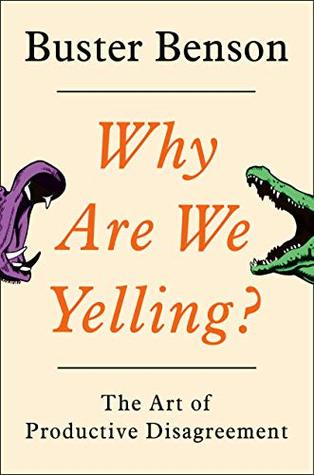
More on this book

Community


Kindle Notes & Highlights
Read between
July 1 - July 8, 2021

MISCONCEPTION 1 Arguments Are Bad
Why do we argue if it’s both unpleasant and unproductive?
in the moment, arguments perform a crucial—and underappreciated—job for us by waving a flag that something important to us is being endangered, whether it’s a personal preference, a hunch about the best strategy for meeting a shared goal, or a core value of ours.
But if we make a habit of pushing the frustration too far down, sometimes we begin to believe we’re at fault for being frustrated, and we beat ourselves up about it. If we do that, the arguments decrease in frequency, but we’re left with a constant low-level anxiety that slowly wears away at our mental and physical health.
Dr. John Gottman says that a relationship without conflict is a relationship without communication and is bound to fail.

Goes on to cite Dr.’s recommendation of an “optimal” 5:1 ratio of positive : negative interactions (wherein I assume positive = warm vs. negative = conflict)
We weren’t taught how to navigate negative encounters so that we are able to acknowledge the negative and strengthen the positive.
Kim Scott, the author of Radical Candor, calls this impulse toward kindness “ruinous empathy” because it actually causes more problems than it solves.
Disagreements are a sign of group health, not pathology, and cultures that allow the airing of grievances in a way that addresses them productively are more likely to create successful relationships, businesses, and communities.
Surprising truth: people are happier, and groups are higher-functioning, when the flow of necessary disagreements is open and they have an honest chance to be heard.
MISCONCEPTION 2 Arguments Change Minds
We can really change only two things: our own minds and our own behavior.
The key word in our definition of a disagreement (an unacceptable difference between two perspectives), isn’t “difference.” It’s “unacceptable.” Once the clash between perspectives becomes unacceptable, our motivation shifts from understanding minds to changing them, and from that shift springs a world of trouble.
Persuasion is all about piling incentives, rewards, and sometimes threats onto a decision in order to tip the scales in your favor.
We have a tendency to continue to maintain old perspectives even after we’ve “decided” to change our mind. That’s called the continued influence effect,
MISCONCEPTION 3 Arguments End
Arguments have deep roots and will always find a way to grow back again.
Arguments don’t end, because they have long, long roots. They might disappear from the surface of reality, but they’re just hiding.
This is obvious when you actually consider it, but when a disagreement over “What is meaningful to me?” is mistaken for another kind of disagreement, like “What is the right way to balance our preferences?” it can easily get stuck in a bad way.
The easiest thing you can do to have more productive disagreements immediately is to remember to ask the other person: “Is this about what’s true, what’s meaningful, or what’s useful?” Is this about the head, the heart, or the hands? If you can agree on the answer, then you’re on your way.
The three realms are: anxiety about what is true (the head realm of information and science), anxiety about what is meaningful (the heart realm of preferences and values), and anxiety about what is useful (the hands realm of practicality and planning).
THE GIFT OF DISAGREEMENT Truth 1: Arguments aren’t bad. They’re signposts to issues that need our attention. Truth 2: Arguments aren’t about changing minds. They are about bringing minds together. Truth 3: Arguments don’t end. They have deep roots and will pop back up again and again, asking us to engage with them.
Done right, arguments are opportunities. A productive disagreement is something you’ll look forward to rather than dread. It’s one that leads to a mutually beneficial outcome.
A productive disagreement yields fruit: the fruit of security, by removing a threat, reducing a risk, resulting in a deal, or concluding with a decision; the fruit of growth, by revealing new information about the world or each other that makes us see and understand reality more deeply; the fruit of connection, by bringing us together and giving us opportunities to forge trust with one another; and the fruit of enjoyment, by teaching us to operate with a collaborative mind-set that emphasizes playfulness, adventure, fun, and sometimes even awe.
I want to emphasize just how much this change will impact your day-to-day life by telling you about three superpowers you will acquire by practicing this art.
Disagreements won’t be frustrating.
You’ll end up having fewer repetitive, frustrating disagreements,
The world will become bigger,
Cynicism, futility, and frustration aren’t pleasant, but they’re the devil we know.
You’ll also notice that anxiety doesn’t have to lead to a disagreement. The kind of anxiety we’re discussing is caused by any internal inconsistency between two perspectives. Sometimes one perspective is your beliefs and another is someone else’s beliefs; other times one perspective is your expectations about what’s real and the other is new information that contradicts those expectations.
The bagel meme trended on Twitter for a day or two, and it’s a good example of why the internet is fun: we’re playing social games that help us reduce shared anxieties, even silly ones, while at the same time pouring our other anxieties into the platform.
The setup of any joke, story, or headline in the news requires the creation of anxiety.
When you notice anxiety, pause and ask yourself: are you anxious about what is true, what is meaningful, or what is useful?
When dissonance is low, the question of “What is useful?” might be enough to resolve it without additional help. When dissonance is high, it might not be enough, which means people who disagree will need to keep looking for another way to resolve the anxiety.
If everyone is using these networks to reduce anxiety while also increasing their chances of being exposed to it, a positive feedback loop of growth begins to develop.
People who value cool rationality make this mistake all the time—we focus on arguments in their simplest form (what is true?) when all the emotional evidence is screaming that it’s really an argument much more rooted in meaning, value, and/or purpose. Disagreements about information are by far the simplest conflicts to resolve, because there’s a source of truth out there, somewhere within reach. All we have to do is reach for it—problem solved.
The goal here is to visualize the cognitive dissonance from both sides, even if you don’t believe both sides are reasonable. This distinction is important.
running experiments on Facebook and in the real world
LOL at this phrasing
Unfair caricatures are just one of the side effects of what psychologist and economist Daniel Kahneman calls “System 1”—the fast, instinctive, emotional system of our brain that tries to make most of our decisions while requiring the least amount of energy. This system relies on habits of thought and quick, reliable shortcut strategies to get things done. It stands in contrast to System 2—the slow, more deliberative, more logical thinking system that takes a lot of energy and is what we typically think of as conscious thinking.
RE: Kahneman's "Thinking Fast and Slow"
These internal voices rise up quickly; that’s how System 1 works. Our internal voices are automatic, filled with emotional and urgent declarations often related to safety.
The four voices I’d like to call out are the voice of power, the voice of reason, the voice of avoidance, and the voice of possibility.
It resolves disagreements by forcefully shutting them down.
It = the voice of power
The only downside of the voice of power is that a battle must occur, which potentially damages both sides.
A reason could be as simple as the threat of force but is usually attributed to some higher authority than just raw strength: the greater good, common sense, tradition or convention, etc. The voice of reason is an upgrade over the voice of power because it can win without a fight—though it’s not guaranteed to work on someone who’s deploying the voice of power.
As our world becomes more blended in terms of cultural traditions and norms, and gives voice to previously disenfranchised demographics, increasingly we can’t assume that everyone around us thinks that our norms are normal.
The takeaway here is that the voice of reason relies on having the voice of power to fall back on during escalations, and is best suited to disagreements with people who share respect for the higher authority, and are members of the same groups and institutions, that your reasons draw from.
Conflict avoiders have identified flaws in the voices of power and reason and so have chosen to address conflicts by simply refusing to participate in them in the first place.
When all the choices seem flawed, the voice of avoidance can speak loudly—telling you that you can stay quiet.
What separates this voice from the voices of power and reason is its ability to hide—there are no outwardly expressed rules around avoidance or consequences for breaking those rules.
When the world isn’t literally at war and we aren’t being held to completely unfair demands, choosing not to participate in a conflict has few negative consequences other than maybe annoying the more conflict-tolerant people around us.
The only problem with this is that avoidance doesn’t fix the problem; it just avoids the conflict altogether in the hope that it will go away, and so the problem hides for a while.
