
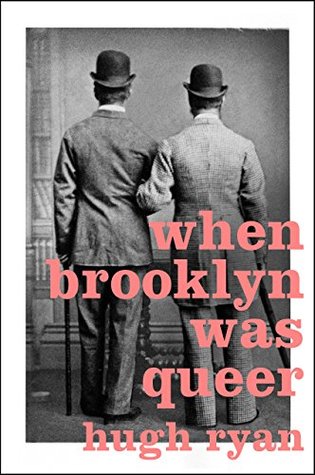
More on this book


Kindle Notes & Highlights

We were only a couple of weeks married when she told me that she could not possibly love any man. About the same time I began to learn that prior to our marriage my wife had displayed an extraordinary infatuation for actresses … and had been in the habit of going out in boy’s clothes to see the town. An illustrated account of some of her exploits was printed in a Saturday serial.… When she told me of her peculiar temperament I replied that if such were unfortunately the case, still, although it would be a calamity to me, so long as she loyally adhered to me, and did nothing to discredit my
...more
Phebe liked this
Early twentieth-century medical science was dominated by the eugenics movement, which believed social problems were rooted in deviant bodies and inheritable traits. This movement reached its apogee with the sadistic, anti-Semitic science of the Holocaust, which has allowed us to conveniently forget the power and prevalence of the eugenics movement in America.
this is the biased, thoroughly unscientific swamp from which our modern ideas about sexuality arose.
In the first chapter, she offers an interesting etymology of the word fairy: It probably originated on sailing vessels of olden times when voyages often lasted for months. While the crew was either actually or prospectively suffering acutely from the absence of the female of the species, one of their number would unexpectedly betray an inclination to supply her place. Looked upon as a fairy gift or godsend, such individual would be referred to as “the fairy.” 14 It’s impossible to know how apocryphal this story is, but it again highlights the connection between sailors and queer sexuality, as
...more
This connection between brassy women and fairies would be celebrated in the 1910s by such performers as the Brooklyn-born Mae West, whose stage persona was said to be inspired by popular vaudeville drag queens such as Bert Savoy and Julian Eltinge
instead of seeing herself as “a male person with female ways,” June defined inverts such as herself as having a “female brain in a female body” that had “various abnormal developments along the line of male structure.”

YOU TOLD EM, JUNE
Dear Mr. Wilson—I am a woman in trouble and I want my rights. It is no crime for a female to wear male attire, and yet I have been arrested here in Brooklyn for doing it. I want a permit from you or some one else to wear the costume I have adopted. I am tired of being kicked around and abused and poorly paid. If I can appear as a man and do man’s work, I shall be more respected, better paid and happier. Won’t you please see what can be done for me?
New York state law, which made it a crime to wear a mask or costume only while attempting to commit another crime. The statute was based on an older law that was enacted in 1845 as a way to prosecute upstate New York farmers who rioted and fought off tax collectors while dressed in faux–Native American garments. However, in the late 1800s and early 1900s, the masquerade law was often used as an imprecise but effective method of prosecuting inverts. (Interestingly, the law would be revived again some one hundred years later to prosecute Occupy Wall Street protesters.)
Over the twentieth century, “coming out” to an older, wiser queer person would become one of the defining experiences of being queer. The phrase coming out is derived from debutante culture, and it once referred exclusively to being brought out into gay society (as opposed to our modern usage, which is more about proclaiming your sexual identity to the straight world).
Hampton was quickly immersed in the world of A’Lelia Walker, the glamorous patron of many of the queer voices of the Harlem Renaissance, whom Langston Hughes dubbed “the joy goddess of Harlem.”
Friend’s sexuality could be deduced from such poems as “Meaning,” which read in part: This love is solitary that will die this death; it weeps on your breast, gathers loneliness of all men who at the self-same hour lying behind dark shades in a rotting house shut out the light of history, shut out that love61
During the war, military policy leaned toward rehabilitating homosexuals or finding ways for them to serve despite their sexuality, but afterward (when they were no longer necessary), they were explicitly banned from service. In peacetime, the dismissal rate for homosexuals would be nearly three times what it was during World War II—and during the Korean War dismissal numbers would again dip. Gays and lesbians were good enough to die as soldiers, but not to live as veterans.
a very different set of housing policies was pushing middle-class (and less precarious working-class) white families out of the city, and into single-family homes in the suburbs. These included many of the same families that NYCHA administrators had imagined would move into their new public housing developments, which were intended at the start to be racially integrated communities for the striving classes. But racist suburban housing policies would ensure that only white families could escape the city’s decaying urban core, thus creating what is popularly known as white flight. As a result,
...more
first “Levittown” was on Long Island, and it had 17,400 houses with eighty-two thousand residents. New York City families waited in line for days to purchase homes in Levittown, with fourteen hundred contracts being drawn up on a single day in 1949.115 And each and every one of them was for a white family. Levittown leases included a clause that read, “The tenant agrees not to permit the premises to be used or occupied by any person other than members of the Caucasian race.”
To qualify for FHA funding, most building developers simply didn’t build any homes for people of color at all. Even when people of color had the money and the desire to leave the city, they thus rarely had the option to do so. Out (or too-obvious) queer people, particularly queer people of color, were left with even fewer options. They were considered unfit for the suburbs and for the projects, while their old neighborhoods had been destroyed to make way for both.
Phebe liked this
In the long term, new residents would establish their own queer institutions and locales, in such areas as Crown Heights (home to the Starlite Lounge, a bar for queer black Brooklynites for decades) and Park Slope (where a large lesbian community would form in the 1980s). However, the building up of a new community takes time, leaving a gap in history before these new institutions appeared.
