
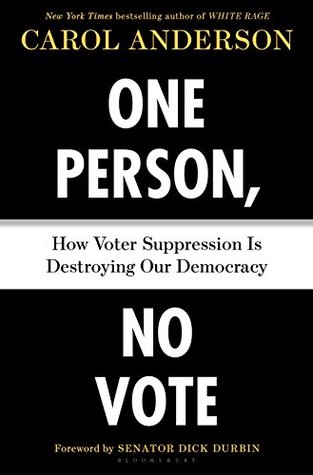
More on this book
Community


Kindle Notes & Highlights

Read between
January 13 - January 17, 2019

Minority voters did not just refuse to show up; Republican legislatures and governors systematically blocked African Americans, Hispanics, and Asian Americans from the polls.
people (poverty, lack of mobility, illiteracy, etc.) and then soak the new laws in “racially neutral justifications—such as administrative efficiency” or “fiscal responsibility”—to cover the discriminatory intent.
That became most apparent in 1890 when the Magnolia State passed the Mississippi Plan, a dizzying array of poll taxes, literacy tests, understanding clauses, newfangled voter registration rules, and “good character” clauses—all intentionally racially discriminatory but dressed up in the genteel garb of bringing “integrity” to the voting booth. This feigned legal innocence was legislative evil genius.
What the states could not accomplish by law, they were more than willing to achieve by violence. The wholesale slaughter of African Americans in Colfax, Louisiana (1873), Wilmington, North Carolina (1898), and Ocoee, Florida (1920), resulted in the loss of hundreds of lives simply because whites were enraged that black people had voted.64
The tools of Jim Crow disfranchisement worked all too well. In 1867, the percentage of African American adults registered to vote in Mississippi was 66.9 percent; by 1955, it was 4.3 percent.74
What ruined the U.S.’s credibility, the Soviets gleefully claimed, was that people who “dream of nooses and dynamite … who throw rocks at defenseless Negro children—these gentlemen have the audacity to talk about ‘democracy’ and speak as supporters of ‘freedom.’ ”86 Don’t be fooled, the Kremlin warned—the U.S. goal was to export Jim Crow, not democracy. “American racism and its savage practice of cruel persecution and abuse of minorities is … the true nature of the American ‘democracy’ which the United States is trying to foist on other countries and peoples.”87
The Civil Rights Act (1957), while seemingly a landmark piece of legislation, was actually a paper tiger that had no ability to protect the right to vote.
Therefore, 2016 was the first federal election in fifty years held without the protection of the Voting Rights Act. As a result, the rash of voter ID laws, purged voting rolls, redrawn district boundaries, and closed and moved polling places were the quiet and barely detected fire that burned through the 2016 presidential election, evaporating millions of votes and searing those who hadn’t even been under the original VRA.174 In Wisconsin, for example, black voting rates plummeted from a high of 78 percent in 2012 to less than 50 percent in 2016. In Milwaukee County, which is overwhelmingly
...more
In 2015, Oregon pioneered automatic voter registration (AVR). Citizens who “apply for or renew their driver’s license” at the DMV are automatically registered to vote unless they opt out. Under AVR, Oregon added 68,583 new voters in just six months. By the end of July 2016, the state’s “torrid pace” had swelled the rolls by 222,197 new voters. And equally impressive, its voter turnout rate in the 2016 election increased from 64 to 68 percent, “more than any other state”—but also the income, age, and racial diversity of the electorate was enhanced by AVR, as was the participation of first-time
...more
These state initiatives to remove the barriers to the ballot box, including the use of mail-in ballots, which has had tremendous success in Colorado, are beginning to ricochet around the nation. To date, ten states have implemented AVR and “15 states have introduced automatic voter registration proposals in 2018.” Illinois and Rhode Island, in fact, have expanded the program to include other agencies beyond the DMV, such as those “serving people with disabilities” and social service agencies, that also have the capacity to electronically send verified files to election officials.
Yet, a key factor affecting the U.S.’s low ranking among developed democracies is the sheer magnitude of age-eligible adults who are not registered. Currently, seventy-seven million Americans aren’t on the voter rolls.
Years of gerrymandering, requiring IDs that only certain people have, illegally purging citizens from the voter rolls, and starving minority precincts of resources to create untenable conditions at the polls have exposed our electoral jugular and made the United States vulnerable to Russian attacks on our democracy.
Thus, when thirty-one states are vying to develop new and more ruthless ways to disfranchise their population, and when the others are searching desperately for ways to bring millions of citizens into the electorate, we have created a nation where democracy is simultaneously atrophying and growing—depending solely on where one lives. History makes clear, however, that this is simply not sustainable. It wasn’t sustainable in the antebellum era.48 It wasn’t sustainable when the poll tax and literacy test gave disproportionate power in Congress to Southern Democrats.49 And it’s certainly not
...more
