
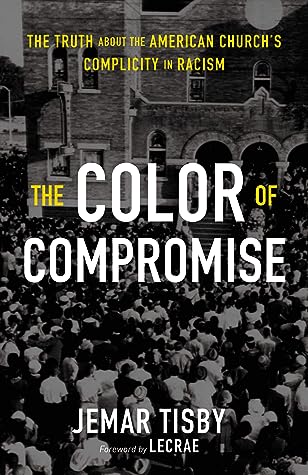
More on this book
Community


Kindle Notes & Highlights
by
Jemar Tisby
Read between
June 24 - July 22, 2020

Scripture never hides the ugly parts of history when it comes to the people of God.
The failure of many Christians in the South and across the nation to decisively oppose the racism in their families, communities, and even in their own churches provided fertile soil for the seeds of hatred to grow. The refusal to act in the midst of injustice is itself an act of injustice. Indifference to oppression perpetuates oppression. History and Scripture teaches us that there can be no reconciliation without repentance. There can be no repentance without confession. And there can be no confession without truth.

https://www.wthrockmorton.com/2016/08/25/the-popular-bonhoeffer-quote-that-isnt-in-bonhoeffers-works/
racism is a system of oppression based on race.
racism includes the imposition of bigoted ideas on groups of people.
it is accurate to say that many white people have been complicit with racism.
White complicity with racism isn’t a matter of melanin, it’s a matter of power.
In the United States, power runs along color lines, and white people have the most influence.
Historically speaking, when faced with the choice between racism and equality, the American church has tended to practice a complicit Christianity rather than a courageous Christianity. They chose comfort over constructive conflict and in so doing created and maintained a status quo of injustice.
At several points in American history—the colonial era, Reconstruction, the demise of Jim Crow—Christians could have confronted racism instead of compromising.
The same Bible that racists misused to support slavery and segregation is the one abolitionists and civil rights activists rightly used to animate their resistance.
All too often, Christians name a few individuals who stood against the racism of their day and claim them as heroes. They fail to recognize how rarely believers made public and persistent commitments to racial equality against the culture of their churches and denominations.
the economy of the European colonies in North America depended more and more on slave labor.
The development of the idea of race required the intentional actions of people in the social, political, and religious spheres to decide that skin color determined who would be enslaved and who would be free.
Slave women in North America had an average birthrate of 9.2 children,
OMG
It must be noted, however, that Europeans did not introduce Christianity to Africans. Christianity had arrived in Africa through Egypt and Ethiopia in the third and fourth centuries. Christian luminaries like Augustine, Tertullian, and Athanasius helped develop Trinitarian theology and defended the deity of Christ long before Western Europeans presumed to “take” Christianity to Africans.
from the beginning of American colonization, Europeans crafted a Christianity that would allow them to spread the faith without confronting the exploitative economic system of slavery and the emerging social inequality based on color.
It took decades for patterns of unfree labor to harden into a form of slavery that treated human beings as chattel and dictated a person’s station in life based on skin color.
Worth noting that Greece, Rome, & other civilizations practiced slavery for generations without automatically assigning slavery & human worth to skin color.
Instead of highlighting the dignity of all human beings, European missionaries told Africans that Christianity should make them more obedient and loyal to their earthly masters.
Probably using Ephesians 6 & Philemon as justification.
the British monarch of “violating its most sacred rights of life and liberty in the persons of a distant people . . . captivating & carrying them into slavery in another hemisphere or to incur miserable death in their transportation thither.” The antislavery clause was excised from the final draft of the declaration due to the objections of delegates from Georgia and South Carolina as well as some northern states that benefited from slavery.
Did not know this!
When Africans in America heard white leaders proclaim natural rights and equality for all, naturally they applied those statements to their own situation. In a 1773 letter to the Massachusetts General Court, a committee of slaves wrote, “We cannot but expect your house will again take our deplorable case into serious consideration, and give us that ample relief which, as men, we have a natural right to.”5
This is also news to me.
the Scriptures seemed to accept slavery as an established reality.
Again, a very different form of slavery.
Harsh though it may sound, the facts of history nevertheless bear out this truth: there would be no black church without racism in the white church.
Many white Christians comforted themselves with the myth that slavery allowed them to more adequately care for the material and spiritual needs of enslaved Africans.
Colonialism at its finest. 😕
“Sunday morning only became the most segregated time of the week after the Civil War. Before emancipation, black and white evangelicals typically prayed, sang, and worshiped together.”13 Yet this interracial interaction did not come from the egalitarian aspirations of white Christians; rather, interracial congregations were an expression of paternalism and a means of controlling slave beliefs and preventing slave insurrection.
Slaveholder paternalism viewed the enslaved as perpetual children incapable of adequately making their own decisions, dependent on white people for guidance and protection.
If I were kidnapped, shipped halfway around the world in a filthy ship's galley, sold like a cow at market, & sent to a plantation I'd never seen where they didn't speak my language, how many generations would it take for my descendants to assimilate enough to NOT appear childlike?
The second fact, that many Christians supported slavery to the extent that they were willing to risk their lives to protect it, has not been fully considered in the American church, even though 150 years have passed since the war.
The Dred Scott decision left no question in the minds of antislavery activists that the federal government, especially under the leadership of President James Buchanan, planned to extend and protect slavery across the growing nation.
How do strict constructionists deal with Dred Scott?
unfortunately, the most potent biblical antislavery argument—demonstrating the differences between slavery in the ancient Near East and that of the American South—also took the most effort to understand. Attempting to list the differences between slavery as practiced in the Bible and race-based chattel slavery required an in-depth grasp of cultures thousands of years removed from the mid-1800s. The argument required a rather sophisticated knowledge of the differences between Old Testament Israel and the New Testament people of God. For most Christians, even those sympathetic to the plight of
...more
It should give every citizen and Christian in America pause to consider how strongly ingrained the support for slavery in our country was. People believed in the superiority of the white race and the moral degradation of black people so strongly that they were willing to fight a war over it.
Pastors and theologians supported the Confederacy by providing theological ballast and biblical backing for the continuation of slavery. They prayed over the troops, penned treatises on the inferiority of black people, and divided denominations over the issue of enslavement. The Civil War paints a vivid picture of what inevitably happens when the American church is complicit in racism and willing to deny the teachings of Jesus to support an immoral, evil institution.
southerners blended Civil War memory and Christian dogma together as a way of confirming their shared suffering and giving their losses divine significance.
While it is true that many southerners after the Civil War did not mourn the demise of slavery, others, including many clergy and religious leaders, did not change their mind on the biblical permissibility of slavery: “On the racial question, indeed, the southern historical explanation as embodied in the Lost Cause provided the model for segregation that the southern churches accepted.”6 White supremacy lurked behind the Lost Cause narrative and helped cement the practice of segregation in the church as the new normal.
Tellingly, most of these monuments were erected several decades after the Civil War. There was a significant spike in monument construction from 1900 to the 1920s and a second explosion of Confederate flags and iconography from the 1950s to the 1960s.
“The installation of the 1,000-plus memorials across the US was the result of the orchestrated efforts of white Southerners and a few northerners with clear political objectives: They tended to be erected at times when the South was fighting to resist political rights for black citizens.”9 These monuments not only memorialized Confederate soldiers, but they also inscribed white supremacy into the landscape of public spaces across the North and the South.
THIS is why they have to go. Now I understand. Correlate the timing and it may not give evidence of causation, but it certainly implies connection.
One implication of this political compromise was that it effectively ensured that the battle for civil rights in America, even among Christians, would involve ongoing disputes over the role of the federal government in proactively ensuring the civil rights of marginalized people.
In a stark demonstration of the hypocrisy and illogical nature of racism, Jim Crow advocates almost never mentioned the long-standing and more common pattern of powerful white men raping vulnerable black women.
Cone goes on to explain, “The cross helped me to deal with the brutal legacy of the lynching tree, and the lynching tree helped me to understand the tragic meaning of the cross.”42 Cone showed that black people could better understand Christ’s suffering by recalling their own sorrow as it related to the lynching tree. At the same time, the cross provided comfort because black people could know for certain that in his life and death, Christ identified with the oppressed.
Black visitors had a special day set aside just for them called “Colored American Day” when organizers promised to serve 2,000 free watermelons.
W. T. F.
Augustus literally had to cross an ocean and travel to another continent to escape the racism that prevented him from becoming a priest in America.
while avoiding explicitly race-based language, Social Security provisions excluded most base-level agricultural and domestic workers—the vast majority of whom were black women and men.38 This exclusion was not accidental; it was by design.
Today, even though many people think of segregation as something that occurred primarily in the South, the truth is that redlining affected countless neighborhoods in metropolitan areas across the country—St. Louis, San Francisco, Chicago, Cincinnati, and New York City, just to name a few.
Rather than stay and adapt to a new community reality or assist in integrating the neighborhood, many white churches chose to depart the city instead.
Those who did stay would often complain about how they didn't add new members, but they would actively resist recruiting within their own neighborhoods.
Christians of the North have often been characterized as abolitionists, integrationists, and open-minded citizens who want all people to have a chance at equality. Christians of the South, on the other hand, have been portrayed as uniformly racist, segregationist, and antidemocratic. The truth is far more complicated. In reality, most of the black people who left the South encountered similar patterns of race-based discrimination wherever they went.
Compromised Christianity transcends regions. Bigotry obeys no boundaries. This is why Christians in every part of America have a moral and spiritual obligation to fight against the church’s complicity with racism.
In reality, precious few Christians publicly aligned themselves with the struggle for black freedom in the 1950s and 1960s.
it is the very reasonableness of the letter that reveals the underlying problem of complicity with racism. This letter from white Christian moderates illustrates the broader failure of the white church, a failure to recognize the daily indignity of American racism and the urgency the situation demanded.
this approach exemplifies how many Christian moderates during the civil rights movement responded, promoting a gradual approach to resolving racial issues and minimizing the suffering and hardship of the marginalized, who had been waiting centuries for justice.
what we must not ignore is that while segregationist politicians spewed forth words of “interposition and nullification,”23 while magazines published editorials calling civil rights activists Communists, and while juries acquitted violent racists of criminal acts, none of this would have been possible without the complicity of Christian moderates.
A black journalist reflecting on Graham’s position on legislation like the Civil Rights Act remarked that Graham did not “walk with protestors or call for open housing or desegregated churches” because “he’s too busy praying.”
"Some people are so heavenly-minded they do no earthly good." Oliver Wendell Holmes, Sr.
A century had passed since the Civil War, and it was the height of the civil rights movement, yet Ali and many other black people still saw Christianity as the religion of the enslavers, the belief system of those who oppressed black people.
