
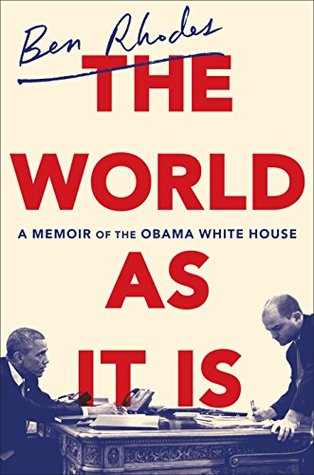
More on this book
Community


Kindle Notes & Highlights

by
Ben Rhodes
Read between
November 17 - November 21, 2018

As a former spy, Putin surely understood the gravity of someone making off with the blueprints for how a nation conducts surveillance. In response, Obama canceled a planned state visit to Moscow. He didn’t want to navigate the sideshow of Snowden being in the same city, but he also saw no point in attending a summit where nothing was going to be accomplished. I also noticed an unusual coziness among the Russians, Snowden, and Wikileaks—the way in which Wikileaks connected with Snowden, who was clearly being monitored by the Russians; the way in which the disclosures coincided largely with
...more
Our response went far beyond anything that the Bush administration had done to Russia after it invaded Georgia in 2008, but Republicans still castigated Obama as weak. Some even praised Putin as a strong leader, someone to be admired. Watching this, Obama told me that it represented something of a turning point for a Republican Party that had been rooted in opposition to Russia for decades. In Obama’s view, the praise for Putin that you could see on Fox News went beyond partisanship, though that was part of it; Putin was a white man standing up for a politics rooted in patriarchy, tribe, and
...more
In late March, we set out for emergency summits on Ukraine. Working hand in glove with Merkel, Obama kept Europe together behind sanctions and secured a multi-billion-dollar IMF package that ended up saving the Ukrainian economy. Instead of sending weapons to Ukraine, he focused on deploying troops and military assets to the NATO members that bordered Russia. He started talking more and more about how he wanted to hand things off to the next president. “I don’t want to leave the next president in a position where there’s not some kind of trip wires in the Baltics and those NATO front line
...more
Many of the people who work in American foreign policy today were shaped by the experience of the 1990s, when the United States was ascendant. The Berlin Wall had come down. Democracy was spreading across Eastern Europe, Latin America, and East Asia. Russia was on its back foot, and China had not yet risen. We really could shape events in much of the world. NATO could expand into the former Soviet Union without fear that Russia would invade one of those countries. We could bring together the whole world to kick Saddam Hussein out of Kuwait. Obama occasionally pointed out that the post–Cold War
...more
The Iraq War disturbed other countries—including U.S. allies—in its illogic and destruction, and accelerated a realignment of power and influence that was further advanced by the global financial crisis. By the time Obama took office, a global correction had already taken place. Russia was resisting American influence. China was throwing its weight around. Europeans were untangling a crisis in the Eurozone.
OBAMA’S FRUSTRATION WITH HIS critics boiled over during a lengthy trip to Asia in the spring of 2014. In the region, the trip was seen as another carefully designed U.S. effort to counter China. We’d go to Japan, to bring them into the Trans-Pacific Partnership (TPP)—weaving together twelve Asia Pacific economies into one framework of trade rules, environmental protections, and labor rights. We’d go to South Korea and discuss ways to increase pressure on North Korea. We’d go to Malaysia, something of a swing state in Southeast Asia, which we were bringing closer through TPP. And we’d end in
...more
“After I was reelected,” he said, “I pulled together a group of presidential historians that I have in from time to time.” People like Doris Kearns Goodwin, David McCullough, Douglas Brinkley. “It’s interesting: They made the point that the most important thing a president can do on foreign policy is avoid a costly error.” He ticked through the list of presidents who had seen their tenures defined by such mistakes: Johnson in Vietnam, Carter with Desert One, Bush in Iraq. The lesson? “Don’t do stupid shit,” he told us, tapping on the table in front of him.
“What’s the Obama doctrine?” he asked aloud. The silence was charged, as we’d always avoided that label. He answered his own question: “Don’t do stupid shit.” There were some chuckles. Then, to be sure that he got his point across, he asked the press to repeat after him: “Don’t do stupid shit.” At the press conference wrapping up his last stop in the Philippines, one reporter asked about “the Obama doctrine,” trying to elicit some less vulgar version. Obama didn’t bite. Instead, he gave a measured description, saying that we needed to avoid errors, and that in foreign policy, “you hit singles,
...more
In the context of September 14, 2012, the email I’d written was not remarkable. That day, protests were erupting across the Arab world that were rooted in an anti-Muslim Internet video. In the context of April 2014, however, the email was explosive. Nineteen months of investigations, hundreds of segments on Fox News, and thousands of talk radio rants had established the idea that something nefarious had taken place after the attacks in Benghazi. The talking points embedded in the document headed PREP CALL WITH SUSAN had already been litigated in public by multiple congressional investigations.
...more
The destruction of any objective truth over those previous nineteen months was one of the strangest aspects of my experience. Toward the end of 2013, a reporter who was deeply sourced in Libya reached out to me. He was writing a long reconstruction of the events in Benghazi, including documenting the ebb and flow of the crowd, the way in which a large, angry mob ultimately turned into a smaller group of heavily armed men waging a military-style assault. People he’d spoken to—people who had been there in Benghazi that night—said that some people had gone to the American facility out of anger
...more
Around the same time, John Boehner announced a new select committee to investigate Benghazi, and my email was cited as a leading justification. There was a video that went along with the announcement. It resembled a slick but cheap movie trailer, with each Republican member of the committee announced like a professional wrestler. “Trey Gowdy…Mike Pompeo…” Republicans sent out fundraising appeals citing the new committee. It was clear that the goal was to extend this charade into the presidential election in order to damage Hillary. It was the most politically motivated rollout imaginable, all
...more
When we walked into the lobby, we noticed a conspicuous couple sitting at the center of the bar area staring at us—a tattooed man and a woman dressed like an extra in a 1980s Madonna music video. As we checked in, they walked over to where we were standing and stopped a few feet away; the man took out an iPhone, held it out in front of him, and took pictures of us. Then they walked off toward the elevators without saying a word. “Russians,” Ricardo said. “Why would they do that?” I asked. “They want us to know they’re watching,” he said. “They don’t like this.”
The conversation gradually drifted to other things—baseball, Hemingway, Cuban music. Ricardo went into the other room, where we had left our phones for security reasons, and came back with his iPhone playing his favorite Cuban songs. The Cubans reacted excitedly, dancing in place at the table. Politics felt far away.
On the day he took office, there were roughly 180,000 troops in Iraq and Afghanistan. By late 2014, the number of troops in Afghanistan was down to 15,000. All U.S. troops were out of Iraq. These were meaningful achievements; they saved American lives, as casualty numbers fell from nearly a hundred Americans killed each month to nearly zero, and the cost of war shrank by tens of billions of dollars. Most controversially, he had kept the U.S. military out of Syria.
By 2014, just about every negative force in the Middle East had converged in Syria: a murderous autocrat backed by Russia and Iran; al Qaeda–affiliated extremists; sectarian conflict and a Saudi-Iranian proxy war; and ISIL, the rebranded version of al Qaeda in Iraq. As Iraq’s Shia prime minister, Nouri al-Maliki, isolated Iraq’s Sunnis—and as the civil war in Syria left huge swaths of territory across Iraq’s western border ungovernable—ISIL had turned into a mix of terrorist group, insurgency, and local government. In January, ISIL declared the Syrian city of Raqqa as its capital and started a
...more
Obama was more sanguine about the forces at play in the world not because he was late in recognizing them, but because he’d seen them earlier. As an African American, he had an ingrained skepticism about powerful structural forces that I lacked when I went to work for him. After years of Mitch McConnell’s obstructionism, Fox News’s vilification, and growing tribalism at home and abroad, he had priced in the shortcomings of the world as it is, picking the issues and moments when he could press for the world that ought to be. This illuminated for me his almost monkish, and at times frustrating,
...more
Finally, we found a place near the river, with a table in the back, where we had buffalo mozzarella, prosciutto, artichokes drenched in olive oil, pasta with ragout, and a bottle of Chianti. For once, Ricardo didn’t have his spiral notebook out. “For someone like me,” he said, “this is as good as it gets.” Sitting there, I felt a thousand years removed from the anxieties that awaited me back in Washington. We had done something big and right for its own reasons. I had never felt so at home so far away from where I lived.
