
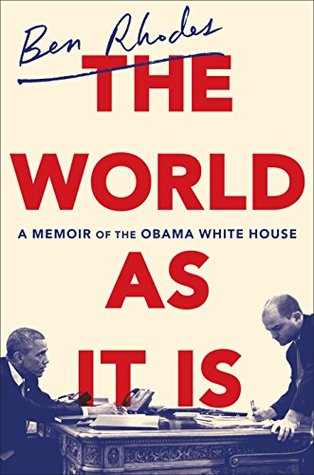
More on this book
Community


Kindle Notes & Highlights

by
Ben Rhodes
Read between
November 17 - November 21, 2018

Obama went around the table to get everyone’s views. Biden said that intervention was, essentially, madness—why should we get involved in another war in a Muslim-majority country? Gates and Mullen also argued against doing anything—the military already had its hands full in Iraq and Afghanistan. Bill Daley, a bald, Chicago-accented centrist who’d recently been hired as chief of staff to make deals with Republicans and stabilize relations between Obama and the business community—seemed incredulous that we were debating the issue at all, given everything we had to do at home. Susan Rice argued
...more
We moved on to a luncheon for prominent Americans and Brazilians that was being hosted at the Foreign Ministry. I sat nervously eyeing my BlackBerry for news reports while the man next to me, a Brazilian businessman, quizzed me on the positions that Obama had taken on ethanol subsidies during the 2008 campaign. The whole scene spoke to an absurdity in the office of the American presidency—Obama sat at the head table, carrying out his duties, promoting American business in a country of more than two hundred million people, while the vast machinery of the U.S. government, on Obama’s order, was
...more
When we got back to D.C., it was apparent—in a way that you miss when you’re traveling—that we were not receiving the same benefit of the doubt that had greeted Reagan’s “kinetic military action” twenty-five years earlier. The Republicans who had demanded that we put a no-fly zone in place now shifted the goalposts, demanding that we do more to “win” in Libya. The left was nervous about another war in the Middle East. Critics on both sides were bemoaning the fact that we weren’t seeking congressional authorization, even though there was no way that a Republican House would pass it if we did.
...more
This hit home for me one night when I was sitting on the couch watching Jon Stewart, the ubiquitous comic voice of authority for my demographic. He was running a series of segments on The Daily Show titled “America at Not-War.” He started to mock my phrase—“kinetic military action”—while a photo of me looking about twelve years old flashed on the screen. My stomach started to churn and I turned the television off. My own worldview had been shaped, in part, by reading books like Samantha’s and watching liberals go on shows like Stewart’s to promote movies like Hotel Rwanda. Sure, I’d said
...more
In just two months, the world had turned upside down. We’d seen a regime fall in Tunisia, broken from a longtime U.S. ally in Egypt, and intervened in Libya. History, it seemed, was turning in the direction of young people in the streets, and we had placed the United States of America on their side. Where this drama would turn next was uncertain—protests were already rattling a monarch in Bahrain, a corrupt leader in Yemen, a strongman in Syria.
I HAD NEVER HEARD the phrase “lead from behind” until it appeared in a New Yorker article about Obama’s foreign policy in April 2011. The article was typical of a Washington genre: the step-back review of a particular policy—in this case, foreign policy—in which a writer interviews a mix of administration officials and outside critics to make sense of things. Most of these pieces disappear without much notice, adding to an accumulating conventional wisdom. But on occasion, a particular turn of phrase can become a bumper sticker that is affixed to a presidency. I knew we might be faced with
...more
Predictably, there was an explosion of criticism on the right, which branded “leading from behind” as “the Obama doctrine” and used it to cast him as weak, indecisive, and un-American. The more mainstream response concerned why Obama had chosen “leading from behind” as a doctrine, even though he hadn’t. It was all nonsense—Obama had never uttered the phrase, and he wouldn’t have used it to describe his own foreign policy; it was a show, designed to distill complicated international issues into a debate that could take place on cable news.
“In a world which will only grow smaller and more interconnected,” he said, “the example of our two nations says it is possible for people to be united by their ideals instead of divided by their differences; that it’s possible for hearts to change and old hatreds to pass; that it’s possible for the sons and daughters of former colonies to sit here as members of this great Parliament, and for the grandson of a Kenyan who served as a cook in the British Army to stand before you as president of the United States.”
WE FLEW TO POLAND and I shuddered a bit while they played “Taps” at the memorial for the Warsaw Ghetto. Part of my family had been Polish Jews. During my first trip to Poland in 2001, just a few months before 9/11, I’d come to Warsaw as a twenty-three-year-old backpacker and took a bus out to the town where they’d been from. Working off a guide book, I found a boarded-up synagogue and then a Jewish cemetery. Some of the headstones had been defaced with swastikas and excrement, along with the names of death camps. A few empty vodka bottles were smashed, suggesting it was the kind of place where
...more
I felt a sense of emptiness and detachment from the events that had taken place over the last several months; it was as if another person had lived that experience—arguing with people in meetings, writing speeches whose every word would be scrutinized, delivering the views of the United States government in front of cameras. I looked out the window at the cathedral, with its soaring spires and perching gargoyles built by generations of workers who never saw the end result of their labors. I lay down on the bed, feeling like a character in a Cold War movie hiding out in a safe house, and
...more
Without putting a single soldier on the ground or suffering a single American casualty, we’d helped save thousands of lives, and now Gaddafi’s government was collapsing. It felt as though maybe, just maybe, the tide was turning against the strongmen of the Middle East. A friend of mine on the NSC sent me her favorite Gandhi quote: “In the end, tyrants fall. Think of it. Always.” It seemed possible to believe that.
Life at UNGA revolved around the Waldorf-Astoria, a grand old hotel on Park Avenue that seemed to revel in the fact that its best days were in the past—the hallway carpets slightly stained and faded; the walls filled with black-and-white photos of celebrities hanging out with one another in the 1950s, portraits of Harry Truman and Dwight Eisenhower. Every year around UNGA, the hotel would fill with diplomats, African and Middle Eastern delegations, journalists, spies, and a gigantic American contingent. The whole thing was tinged with nostalgia, including for another time in American foreign
...more
While the Middle East represented the past—its religious wars, American-backed autocrats, Iranian revolutionaries, terrorist threats—Asia seemed to represent the future. It helped that the people and governments in Asia wanted to deepen relations with the United States, in part because of their concerns about the largest emerging power in their neighborhood: China. Our November trip would be pivotal, shaping our Asia policy for the rest of the administration.
We started in Hawaii, where the United States would be hosting APEC, a summit of Pacific countries. We spent two days there, signaling a tougher stance on China and a more assertive posture in Asia. With a nod from Obama, we took the ongoing negotiations over a trade agreement with a large bloc of Pacific nations—the Trans-Pacific Partnership, or TPP—and played it up as the centerpiece of our broader regional strategy, one in which the United States, and not China, would write the rules of international trade. We were preparing to announce a deployment of Marines to a new base in Australia.
...more
Then he started talking about Asia more broadly—the mix of cultures, religions, and races he found so familiar. “Hawaii has a lot in common with Jakarta,” he said. “There’s a certain communal spirit. Americans are more individualistic.” He sipped his drink and looked out at the endless ocean. “When you spend time growing up in Jakarta like I did, and see the masses of humanity in a place like that, it makes it harder for you to think purely of yourself.”
Then Obama started to complain that people in Washington liked to say that he was aloof. “Few things irritate me more,” he said, mimicking the line of criticism. “ ‘He’s aloof, he doesn’t have friends.’ That could not be more wrong. I’m almost always around people. I just have a different group of friends than people who’ve been running for office since they were twenty-two.”
Obama recalled how he’d finished Dreams from My Father in Bali, writing in longhand because it helped him think. I looked around at this terrace, with its endless view of the Pacific, and it occurred to me how far away this suite was from some backpacking destination in Bali. This part of the world, which had shaped Obama, was going to be more important to the future than the familiar battlefields of the Middle East, but it was distant from the debates that dominated in Washington. “This really is a great view,” he said. Obama got up to go to bed, and I walked down a flight of stairs to my
...more
What does it mean to invade a country, topple its leader, face a raging insurgency, open a Pandora’s box of sectarian conflict across a region, spend trillions of dollars, kill hundreds of thousands of people, and permanently alter hundreds of thousands of American lives? Something in the character of post-9/11 America seemed unable, or unwilling, to process the scale of the catastrophic decision, and the spillover effects it had—an emboldened Iran, embattled Gulf states, a Syrian dictator who didn’t want to be next, a Russian strongman who resented American dominance, a terrorist organization
...more
Around midnight, I saw a statement that had been put out by Mitt Romney: “It’s disgraceful that the Obama administration’s first response was not to condemn the attacks on our diplomatic missions, but to sympathize with those who waged the attacks.” I stood in my bedroom processing the words as waves of anger washed over me. For a moment, I couldn’t even understand which statement Romney meant; then I realized that he was referring to the statement that the embassy in Cairo put out earlier in the day, before anything had happened in Benghazi. I had grown accustomed to ugly Republican attacks,
...more
We were now in some new, uglier reality. I could never have guessed just how ugly it would become: that for the next four years, “Benghazi” would be transformed from the name of a city in Libya where American intervention had saved tens of thousands of lives into something entirely different: a word that represented the sentiment in that statement of Romney’s, an expression of an ugly conspiracy theory to delegitimize Obama and Clinton, destroy any concern for facts that didn’t fit the theory, and dehumanize a small group of people, including me. Benghazi.
At home, the right-wing outrage about our criticism of the Internet video continued to build as Republicans worked hard to make Benghazi into a political problem for Obama. It was as though I was inhabiting two entirely different worlds: I’d spend most of my day trying to convey messages to people outside the United States who were offended by the video; then I’d spend an hour or two helping Jay Carney prepare for questions about whether we were apologizing for the video, or whether Obama’s foreign policy was a failure. When I focused on the audience outside the United States, I opened myself
...more
“I’m telling you, it’s all over Fox,” I said. I explained how he’d called it an act of terror the day after the attack, then Susan Rice had said the attack developed out of protests over the video, then the director of the National Counter-Terrorism Center had testified that it was carried out by al Qaeda–affiliated extremists. Susan’s reference to protests, which had been a part of the intelligence community’s talking points, had been seized on by the right. “How exactly is it a cover-up if we’re the ones who told people that it was terrorism?” he asked. “Just explain that to me. And what
...more
As the debate got under way, Obama was clearly stronger. About halfway through, the Benghazi question came, and Obama launched into a version of the answer he’d practiced. Romney pounced: “I think it’s interesting the president just said something which is that on the day after the attack he went into the Rose Garden and said that this was an act of terror.” “That’s what I said,” Obama responded. Romney looked surprised, even shocked, at his good fortune. “You said in the Rose Garden the day after the attack, it was an act of terror? It was not a spontaneous demonstration, is that what you’re
...more
This highlight has been truncated due to consecutive passage length restrictions.
Romney refused to call and concede, even though it was obvious that he had lost badly. Finally, as it was getting closer to midnight, Obama stepped out of the room to take the call. When he came back in, he had a look of both amusement and surprise. “He kept talking about how many urban voters turned out,” he told us. “Urban voters.”
Al Nusrah was probably the strongest fighting force within the opposition, and while there were extremist elements in the group, it was also clear that the more moderate opposition was fighting side by side with al Nusrah. I argued that labeling al Nusrah as terrorists would alienate the same people we wanted to help, while giving al Nusrah less incentive to avoid extremist affiliations. It spoke to the schizophrenia in American foreign policy that we were simultaneously debating whether to designate the Syrian opposition as terrorists and whether to provide military support to the Syrian
...more
“Sir,” I continued, with unusual formality, “this is a seismic geopolitical shift and social movement. It’s taking place up here”—I held my hand up by my head—“but our actions are down here.” I lowered my hand to my waist. “Maybe that’s right,” he said, “but we can’t fool ourselves into thinking that we can fix the Middle East.” He paused, chewing. “I love that you care this much. But what’s the line from Lawrence of Arabia?” he said. It was a movie we frequently quoted to each other. “ ‘Young men make wars….Then old men make the peace.’ ”
He told me a story that the former Palestinian prime minister Salman Fayad had told him, about how the Israelis parked a car in front of his office every few days and sat there, watching him. “It’s not about security,” Fayad had said. “It’s about power.” “Well,” I said, “that makes our theory more necessary: Show the Israelis you love them but also challenge them.” “That’s your theory,” he said. “The Ben Rhodes theory.” Obama—who was often accused of putting too much stock in speeches—was more cynical than I about the capacity for a speech to change entrenched attitudes, particularly a
...more
“I’m going off script here for a second,” he said, “but before I came here I met with a group of young Palestinians from the age of fifteen to twenty-two. And talking to them, they weren’t that different from my daughters. They weren’t that different from your daughters or sons. I honestly believe that if any Israeli parent sat down with those kids, they’d say, I want these kids to succeed; I want them to prosper. I want them to have opportunities just like my kids do. I believe that’s what Israeli parents would want for these kids if they had a chance to listen to them and talk to them. I
...more
“You know,” he said, “I just left South Africa, where Nelson Mandela is in the hospital and is very sick. You know when he came to power he could have gone to the white minority in South Africa and said, ‘We are now the majority and we’re going to do what we want. We’ll follow the rules but you are a small minority in this country.’ But he didn’t do this. He went out of his way to reach out to the minority. He even put his former prison guard, the man who had been the warden of the prison where he had been held, in charge of the security services. It was those gestures that showed he was about
...more
This highlight has been truncated due to consecutive passage length restrictions.
Obama was the most powerful man in the world, but that didn’t mean he could control the forces at play in the Middle East. There was no Nelson Mandela who could lead a country to absolution for its sins and ours. Extremist forces were exploiting the Arab Spring. Reactionary forces—with deep reservoirs of political support in the United States—were intent on clinging to power. Bashar al-Assad was going to fight to the death, backed by his Russian and Iranian sponsors. Factions were going to fight it out in the streets of Libya. The Saudis and Emiratis were going to stamp out political dissent
...more
Every time we traveled to Latin America, our summits were dominated by complaints about our Cuba policy. There was zero evidence that our hard-line approach was doing anything to advance human rights. Obama himself told me repeatedly that he was unhappy with our Cuba policy and wanted to change it. U.S. interests, common sense, and honesty suggested this was something we should change. In Obama’s first inaugural address, he had said, “To those who cling to power through corruption and deceit and the silencing of dissent, know that you are on the wrong side of history, but that we will extend a
...more
The Burmese denied that the Rohingya were a distinct ethnic group, referring to them as Bengalis—illegal immigrants from neighboring Bangladesh.
I encouraged her to support efforts to promote reconciliation with Burma’s ethnic groups and better conditions for the Rohingya. “We will get to those things,” she said. “But first must come constitutional reform. The military could change the constitution in a moment.” Everything she said indicated that she cared mostly about the upcoming 2015 election, in which she was barred from seeking the presidency by a provision that disqualified people with foreign-born children—known informally as the Aung San Suu Kyi provision. “It won’t be a free and fair election without constitutional reform.”
The next day, Derek arranged for me to see a sampling of the many different facets of Yangon society adapting to change. Former political prisoners ate sparingly at a luncheon and spoke with single-minded focus about their efforts to free the remaining prisoners. One writer told me in a matter-of-fact way that she had nearly died in prison because she shrank to under eighty pounds. Rohingya brought me large volumes of documentation proving that they had lived in Burma for generations, as if I were the one who would judge this fact. Rakhine Buddhists were unabashed in their bigotry, speaking of
...more
The women took out flashlights and pointed them down to the floors where, under layers of dust, you could see Art Deco tiles from the 1920s. The tour ended at an old movie theater. We entered by walking across wooden doors that covered open sewage drains, then climbed a flight of musty stairs. A kitschy soap-opera-style Burmese film was playing on an enormous curved screen. A handful of people were sitting in the darkness. The women lit their flashlights to reveal an impossible glamour—balcony seats like an aged opera house, empty of human beings. It was like standing in some forgotten past.
...more
In August 2012, Obama was asked about what could lead him to use military force in Syria: “We have been very clear to the Assad regime,” he said, “that a red line for us is we start seeing a whole bunch of chemical weapons moving around or being utilized. That would change my calculus.” In the course of a presidency, a U.S. president says millions of words in public. You never know which of those words end up cementing a certain impression. For Obama, one of those phrases would be “red line.”
I listened as it was reported that there was a “high confidence assessment” that a sarin gas attack had killed more than a thousand people in a suburb of Damascus, and that the Assad regime was responsible.
Obama laid out his thinking: He had decided to seek congressional authorization for strikes on Syria. At some point, he said, a president alone couldn’t keep the United States on a perpetual war footing, moving from one Middle Eastern conflict to the next. In the decade since 9/11, we’d gone to war in Afghanistan, Iraq, Yemen, Somalia, and Libya. Now there was a demand that we go into Syria; next it would be Iran. “It is too easy for a president to go to war,” he said. “That quote from me in 2007—I agree with that guy. That’s who I am. And sometimes the least obvious thing to do is the right
...more
I saw what he had been doing—testing Congress, testing public opinion, to see what the real maneuvering room was for his office when it came to intervention in Syria. It was the same thing he’d done in Situation Room meetings on Syria and in his mind, testing whether anything we did could make things better there or whether it would turn out to be like Afghanistan and Iraq, if not worse. It wasn’t just politics he was wrestling with. It was something more fundamental about America, our willingness to take on another war, a war whose primary justification would be humanitarian, a war likely to
...more
“The thing is,” he said, “if we lose this vote, it will drive a stake through the heart of neoconservatism—everyone will see they have no votes.” I realized then that he was comfortable with either outcome. If we won authorization, he’d be in a strong position to act in Syria. If we didn’t, then we would potentially end the cycle of American wars of regime change in the Middle East.
Kerry worked quickly to turn Putin’s overture into an agreement that could be implemented in a country—Syria—that had never even acknowledged having chemical weapons. Four days after we got back to Washington, the Syrian government announced they would give them up. Five days later, on September 10, Obama addressed the nation and announced that we would pursue this diplomatic opportunity. The congressional vote never took place. Thousands of tons of chemical weapons would be removed from Syria and destroyed, far more than could have been destroyed through military action. The war would
...more
ON JUNE 14, 2013, Hassan Rouhani was elected president of the Islamic Republic of Iran, representing the more moderate faction of Iranian politics. He was not the preferred candidate of Iran’s hard-line Supreme Leader, Ayatollah Ali Khamenei. This fact alone was an extraordinary contrast to the 2009 election, when Khamenei had thrown his support behind the incumbent, Mahmoud Ahmadinejad, placing opposition leaders under house arrest and launching a sustained crackdown on the opposition. Rouhani had campaigned on a platform of seeking improved relations with the West, linking progress on the
...more
At Obama’s direction, a letter was drafted to Rouhani proposing discussions on the nuclear issue. Within weeks, we received a positive response—the Iranians wanted to get a diplomatic process under way.
I knew this debate was going to be rough, and that it was a dress rehearsal for a longer, harder fight to come if we reached a comprehensive nuclear deal. I started to host regular meetings of staffers from across the government who worked on the Iran negotiations as well as public affairs and congressional relations. Our approach was to produce a steady flow of facts about what was in the potential deal, to arm supporters with the case for diplomacy, and to pre-rebut the barrage of criticism that was going to come. I threw myself into this mission, meeting with anyone who wanted to be
...more
“What do you want to say about Mandela?” I asked. He looked up at me. “What about him?” “You haven’t seen?” I said. I suddenly felt unequal to the task of telling him this news. “He’s passed. Zuma is making a statement.” The fact of reporting that Jacob Zuma, the South African president, was making a statement seemed insignificant, the type of detail that would occur to a White House communications official already calculating how long Obama’s statement would come after Zuma’s, how soon his words would appear in the obituaries—the quotable line, the voice for the rest of us. Behind me, a bust
...more
Our tour guide, a former prisoner, was an older man with an elegant manner and a belly protruding over his belt. He referred to himself as being from “the rank and file” of the African National Congress. He described fourteen years of work that he did in the same sunshine that beat down on us, how Mandela would set the pace for the other prisoners. Then he pointed to a small, dark cave on the other end of the quarry where they were allowed to eat lunch and occasionally use the toilet. “That,” he said, “was the best university in the world. That is where Mandela and others would debate
...more
I read the words of the young man who had been sentenced to live the rest of his life in prison in 1964: “I have fought against white domination, and I have fought against black domination. I have cherished the ideal of a democratic and free society in which all persons live together in harmony and with equal opportunities. It is an ideal which I hope to live for and to achieve. But if needs be, it is an ideal for which I am prepared to die.”
The last person who ever thought that Barack Obama’s election was going to bring racial reconciliation and some “end of race” in America was Barack Obama. That was a white person’s concept imposed upon his campaign. I know because I was once one of them, taking delight in writing words about American progress, concluding in the applause line “And that is why I can stand before you as president of the United States.” But he couldn’t offer up absolution for America’s racial sins, or transform American society in four or eight years.
In small, careful script, he had written: “We know that, like South Africa, the United States had to overcome centuries of racial subjugation. As was true here, it took sacrifice—the sacrifice of countless people, known and unknown, to see the dawn of a new day. Michelle and I are beneficiaries of that struggle….Over 30 years ago, while still a student, I learned of Nelson Mandela and the struggles taking place in this beautiful land, and it stirred something in me. It woke me up to my responsibilities to others and to myself, and it set me on an improbable journey that finds me here today.
...more
Obama replied. “The Cubans were on the right side of apartheid. We were on the wrong side.” In the 1980s, while Reagan was backing the apartheid government in South Africa, Cuba was fighting a war against its right-wing proxies in Angola. Their decisive 1988 victory in a battle against that racist government at Cuito Cuanavale was, in the words of Mandela, a “turning point for the liberation of our continent—and of my people—from the scourge of apartheid.”
