
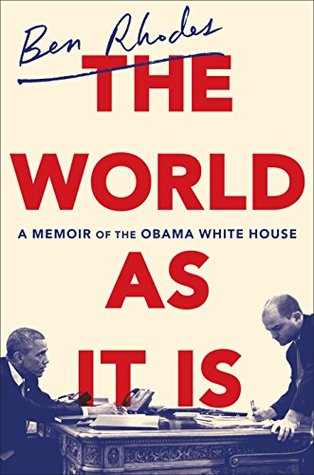
More on this book
Community


Kindle Notes & Highlights

by
Ben Rhodes
Read between
August 7, 2023 - January 7, 2024

Taken together, the Israeli and Gulf advocacy ensured a steady flood of well-funded commentary advocating a harsh stance against Iran and, ultimately, the Obama foreign policy.
That fall, these governments knew that an interim agreement would increase the odds of a more comprehensive long-term deal; and if there was a comprehensive long-term deal, the odds of the United States going to war with Iran would plummet. Obama’s phone calls with Netanyahu became more acrimonious, as Netanyahu’s objections to an agreement became more strident, even as Israeli technical experts were in constant contact with our negotiating team so that we could prioritize their concerns. AIPAC became more unsubtle in raising questions about the agreement before it was even reached. Criticisms
...more
Running past memorials to white men, some of them slave owners, I began to see glimpses of something more clearly—not the saint played by Morgan Freeman in the movies and celebrated in Western capitals, but the man who struggled, who turned to violence, who was labeled a terrorist by large swaths of white society, the man who was willing to die for what he believed with no idea that he would become a global icon for happy endings.
Racism was a constant presence and absence in the Obama White House. We didn’t talk about it much. We didn’t need to—it was always there, everywhere, like white noise.
It was there in the way Obama was talked about in the right-wing media, which spent eight years insisting that he hated America, disparaging his every move, inventing scandals where there were none, attacking him for any time that he took off from work.
One time, Obama invited congressional Republicans to attend a screening of Lincoln in the White House movie theater—a Steven Spielberg film about how Abraham Lincoln worked with Congress to pass the Thirteenth Amendment abolishing slavery. Not one of them came.
Every now and then, he’d show flashes of dark humor in practicing the answer he could give on a particular topic. What do you think it will take for these protests to stop? “Cops need to stop shooting unarmed black folks.” Why do you think you have failed to bring the country together? “Because my being president appears to have literally driven some white people insane.” Do you think some of the opposition you face is about race? “Yes! Of course! Next question.” But he was guarded in public. When he was asked if racism informed the strident opposition to his presidency, he’d carefully ascribe
...more
The last person who ever thought that Barack Obama’s election was going to bring racial reconciliation and some “end of race” in America was Barack Obama. That was a white person’s concept imposed upon his campaign.
I was one of those well-meaning white people looking forward to seeing Barack Obama eulogize Nelson Mandela so that I could feel better about the world, only I was the person tasked with writing the eulogy.
“I forgot to go over one thing,” I said. “Raúl Castro is going to be up there on the dais with you.” “So?” he asked. “So the question is, what do you do if you see him?” Some press had started asking about this—no U.S. president had greeted a Cuban president since the revolution. Their interaction would be a matter of intense scrutiny. “I’ll shake his hand, of course,” Obama replied. “The Cubans were on the right side of apartheid. We were on the wrong side.”
In the 1980s, while Reagan was backing the apartheid government in South Africa, Cuba was fighting a war against its right-wing proxies in Angola. Their decisive 1988 victory in a battle against that racist government at Cuito Cuanavale was, in the words of Mandela, a “turning point for the liberation of our continent—and of my people—from the scourge of apartheid.” With his short reply, Obama had casually recognized a history that no other president before would have dared to speak aloud.
After trying on the bulletproof vest, Obama refused to wear it—its bulk would be obvious under his suit and the message would be disrespectful. No one in t...
This highlight has been truncated due to consecutive passage length restrictions.
On the flight home, I scanned the American press. There was almost no coverage of the first African American president eulogizing the most iconic African of the last century. Instead, the lead story back home was a selfie that the Danish prime minister had taken with Obama. Everywhere, the picture was splashed across websites, on social media, on cable news: Obama grinning next to an attractive blond woman. The thought and care Obama had put into honoring Mandela, and his efforts to reveal himself in doing so, were subsumed by the opportunity to talk about this photograph. Before we landed,
...more
His own election in 2012 was marked by large street demonstrations and a healthy opposition. Once he was restored to power, the momentum in the U.S.-Russia relationship ground to a halt.
The first time Obama met with Putin after he became president again, Putin showed up forty-five minutes late. Putin rebuffed further discussions on arms control and missile defense. Russia continued its blank check of support for Assad. In August of 2013, Russia granted Edward Snowden asylum in Moscow.
The Russians no longer bothered to calibrate their denials about what they were doing, they just lied about it.
These calls would last more than an hour, and Putin would always steer the conversation back to what he saw as the original sin—in his view, the protests that overthrew Yanukovych were initiated by the United States because some of its leaders received grants from U.S. democracy promotion programs. The people who took power, he told Obama on March 6, made a coup d’état.
Our response went far beyond anything that the Bush administration had done to Russia after it invaded Georgia in 2008, but Republicans still castigated Obama as weak. Some even praised Putin as a strong leader, someone to be admired. Watching this, Obama told me that it represented something of a turning point for a Republican Party that had been rooted in opposition to Russia for decades. In Obama’s view, the praise for Putin that you could see on Fox News went beyond partisanship, though that was part of it; Putin was a white man standing up for a politics rooted in patriarchy, tribe, and
...more
He started talking more and more about how he wanted to hand things off to the next president. “I don’t want to leave the next president in a position where there’s not some kind of trip wires in the Baltics and those NATO front line states,” he told us. “Putin needs to understand that even if we won’t go to war in Ukraine, we will if it’s NATO.”
There was something awkward about sitting in the Oval Office for these sessions. One leader, Putin, was lying about what he was doing and flouting international law; the other leader, Obama, was imposing sweeping sanctions on Russia. It never felt like a conversation.
By his sixth year in office, he had used military force in Iraq, Afghanistan, Yemen, Somalia, and Libya while escalating our use of armed drones against al Qaeda. He saw the necessity of drones, but he spent an extraordinary amount of time trying to impose restrictions on when they could be used, setting standards for whom we could target and how to avoid civilian casualties.
Obama once spoke to this mixture of support and ambivalence: “If someone wrote a novel about us,” he told me in the Oval Office, “it’d be about two guys who got into this to end a misguided war in Iraq, right about the time that the U.S. government was perfecting the technology to use drones.”
What bothered both of us the most about the debates in Washington was the sense that there had been no correction after Iraq—no acknowledgment of the limits to what the United States could achieve militarily inside other countries.
In one session that I went to with a group of foreign policy experts, we faced a litany of criticism for not doing more in the Middle East. After I patiently explained our approach, one of the participants—who’d been silent up to that point—interjected with an edge in his voice, “You have to bomb something.” “What?” I asked, taken aback. “It does...
This highlight has been truncated due to consecutive passage length restrictions.
Obama occasionally pointed out that the post–Cold War moment was always going to be transitory. The rest of the world will accede to American leadership, but not dominance.
remember a snippet from a column around 9/11: America bestrides the world like a colossus. Did we? It was a story we told ourselves. Shock and awe. Regime change. Freedom on the march. A trillion dollars later, we couldn’t keep the electricity running in Baghdad.
By the time Obama took office, a global correction had already taken place. Russia was resisting American influence. China was throwing its weight around. Europeans were untangling a crisis in the Eurozone.
Yet American politics pushes military interventionism, even as public opinion is wary. In the aftermath of 9/11, it became an imperative for politicians to demonstrate that they were tough on terrorism, with the measure of toughness being a willingness to use military force or flout the rule of law. Democrats were deeply scarred by elections in 2002 and 2004, when they were tarred as weak, untrustworthy, or even unpatriotic if they dared question the so-called Global War on Terror. With the public turning against the Iraq War and the election of Barack Obama, it seemed that this dynamic might
...more
In early 2014, with the recent example of the Iraq War still shaping the world in which we operated, Obama was already being roundly accused of “overlearning the lessons of Iraq.” So even as the Syria red line episode demonstrated that public opinion was skeptical of war, the political frame for national security debates remained the same: Doing more was tough, anything else was weak.
Obama leaned forward in agreement. “After I was reelected,” he said, “I pulled together a group of presidential historians that I have in from time to time.” People like Doris Kearns Goodwin, David McCullough, Douglas Brinkley. “It’s interesting: They made the point that the most important thing a president can do on foreign policy is avoid a costly error.” He ticked through the list of presidents who had seen their tenures defined by such mistakes: Johnson in Vietnam, Carter with Desert One, Bush in Iraq. The lesson? “Don’t do stupid shit,” he told us, tapping on the table in front of him.
Finally, he reached the end of his lecture. “What’s the Obama doctrine?” he asked aloud. The silence was charged, as we’d always avoided that label. He answered his own question: “Don’t do stupid shit.” There were some chuckles. Then, to be sure that he got his point across, he asked the press to repeat after him: “Don’t do stupid shit.”
“Don’t do stupid shit” would be panned, held up as a sign of negligence, but who is for doing stupid shit? “Singles and doubles” would be similarly derided, but what is wrong with hitting singles and doubles? And, as Obama complained to me, “they keep forgetting that I said we’re also going to hit some home runs.”
The destruction of any objective truth over those previous nineteen months was one of the strangest aspects of my experience.
felt I was living in an alternate reality that was in some way insane, unable to recognize hypocrisy or to separate facts from politics. The world around me seemed to have come unmoored. The truth had become irrelevant.
“Papa Francisco is a son of Latin America,” Alejandro explained. He was therefore viewed differently in Cuba from other popes, just as Obama was viewed differently from other presidents. With his involvement, they were open to it.
“The Republicans won’t go after a prisoner of war, will they?” I said. Podesta grimaced. “I don’t share your optimism.” I had rarely been more wrong. I knew that Bergdahl had walked off his base, but I didn’t know about the allegations that members of his unit had been killed looking for him. In the high of the moment, I’d failed to do my homework. Hostility toward Bergdahl from fellow servicemembers boiled over, and there were days of heated criticism of the swap, and of our decision to celebrate Bergdahl’s release. The Cubans read the Bergdahl episode the wrong way. “We have noted Obama’s
...more
A FEW DAYS LATER, Ricardo and I flew up to Toronto to meet the Cubans at an airport hotel. When we walked into the lobby, we noticed a conspicuous couple sitting at the center of the bar area staring at us—a tattooed man and a woman dressed like an extra in a 1980s Madonna music video. As we checked in, they walked over to where we were standing and stopped a few feet away; the man took out an iPhone, held it out in front of him, and took pictures of us. Then they walked off toward the elevators without saying a word. “Russians,” Ricardo said.
We argued around several issues. But the Cubans agreed to release almost all of the political prisoners, or—in the language they preferred—“individuals who had been arrested for nonviolent political offenses.”
By 2014, just about every negative force in the Middle East had converged in Syria: a murderous autocrat backed by Russia and Iran; al Qaeda–affiliated extremists; sectarian conflict and a Saudi-Iranian proxy war; and ISIL, the rebranded version of al Qaeda in Iraq.
There I’d sit on the couch, eating lo mein out of a plastic container and watching cable news split-screen the unraveling of two of the loftier aspirations of the 2008 campaign—an end to the permanent war, and a bridging of the racial divide.
In a meeting, the Estonian president, Toomas Ilves, insisted to Obama that we had to take Putin at his word if he said he would take Kiev. Ilves had an academic manner, and he described methodically how Russia was using fake news and disinformation to turn Estonia’s Russian-speaking minority against Europe.
Speaking in paragraphs, he tied together Putin, the emergence of right-wing political parties in Europe, and ISIL. These are people, he said, who fundamentally reject the legitimacy of the liberal order. They are looking for another form of legitimacy—one that is counter to our notion of progress.
After the meeting, I joined Obama for lunch and told him I thought Ilves did the best job I’d heard of tying these disparate threads together, explaining a theory of the forces at work in the world without having to rely on...
This highlight has been truncated due to consecutive passage length restrictions.
Without missing a beat, Obama said, “That’s the same dynamic as with the Tea Party. I know those forces because my presidency has bumped up against them.” He paused. “It’s obviously manifest in different ways, but people always look to tear down an ‘other’ when...
This highlight has been truncated due to consecutive passage length restrictions.
I answered and it was Obama’s voice on the phone, the first I’d heard from outside the hospital. “She looks like you,” he said. “Hopefully she’ll end up looking more like Ann.” I laughed. “Your life will never be the same.” Ann asked who it was, and when I said, “The president,” it seemed almost normal.
The day before the announcement, I came in to join Obama’s phone call with Raúl Castro—the first such communication between U.S. and Cuban leaders since the Cuban Revolution. As we sat in the Oval Office waiting for the call to be connected, Obama looked at me, Susan, and Ricardo. “As Joe Biden would say, this is a big fucking deal,” he said.
Castro started reviewing the commitments of both sides. Then he went on a long tangent about efforts to sabotage the Cuban government over the years. As I sat on the couch, my forehead began to sweat as I watched the hands on the antique grandfather clock mark time—ten minutes, twenty minutes, thirty minutes. I passed Obama a note saying that he could cut this off. He shook his head, covering the receiver with his hand. “It’s been a long time since they’ve talked to a U.S. president,” he told me. “He’s got a lot to say.” The call wrapped up with Castro inviting Obama to come to Cuba to go
...more
There was one final thing that could have derailed what we were doing. The communications team had been planning to set up a lectern in the Roosevelt Room—a location that would put Obama in front of a giant portrait of Teddy Roosevelt charging up San Juan Hill—the moment, symbolically, when the United States initiated its de facto colonization of Cuba. We had them move it instead to the Cabinet Room.
Toward the end of 2014, the Senate Intelligence Committee released the summary of a 6,700-page report on the Bush administration’s use of torture and rendition, detailing in stark terms the moral collapse of the United States government after 9/11. There had been a lengthy period of declassification, with our White House put in the position of mediating between a CIA reluctant to see information go public and a Senate committee that wanted as few redactions as possible.
“You know,” Obama said, “I think it’s a chance for all of us to reflect on what fear can do to this place. We’re not so different from the people who came before us, though I think we’re right about more things.” His tone was unusually formal. “If you want to know why sometimes I tap the brakes, that’s why. We can’t make decisions based on fear.” “You’re goddamn right,” Biden said. “And we’re lucky to have you.” He reached out like an old pol and grabbed Obama’s wrist.
