
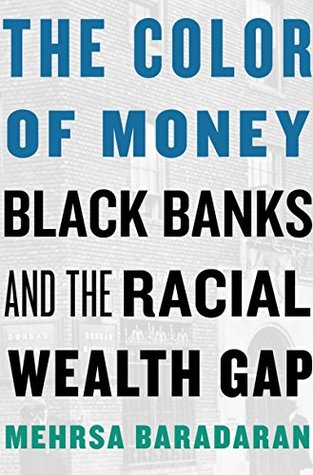
More on this book
Community


Kindle Notes & Highlights

Read between
December 31, 2022 - March 28, 2023

repayment periods than blacks.
A 1991 study by the Federal Reserve of 6.4 million home mortgage applications found that there was widespread and institutionalized racial di...
This highlight has been truncated due to consecutive passage length restrictions.
Blacks who qualified for prime mortgages were being disproportionately sold subprime loans. A HUD study found that subprime loans were five times more likely in black neighborhoods than in white ones between 1993 and 1998. In other words, “high-cost subprime lending accounted for 51% of home loans” in black neighborhoods, versus only 9 percent in white ones. Moreover, “homeowners in high income black neighborhoods [were] twice as likely as homeowners in low income white neighborhoods to have subprime loans.”11...
This highlight has been truncated due to consecutive passage length restrictions.
According to their data, “the most profitable group to lend to, if a bank were maximizing finance charges, would be black Americans,” because blacks were three times as likely as whites to revolve their debts.
Senator Donald Riegle of Michigan called it “reverse redlining.” One attorney claimed, “This is a system of segregation, really. We don’t have separate water fountains, but we have separate lending institutions.”
this atmosphere, community banks either merged or died. Many died.120 More banks merged between 1980 and 1990 than in any preceding decade in U.S. history. In just ten years, from 1982 to 1992, 1,500 banks failed—three-quarters of all U.S. bank failures since the Great Depression.121 The least able to compete were banks in rural areas or inner-city ghettos.122
The largest black bank to fail was Jackie Robinson’s Freedom National Bank of Harlem.123 The bank’s 1990 failure was a devastating blow to Harlem and sent a shock wave through the entire black banking industry, especially because there were cries of discrimination and a double standard by the federal regulators that administered its liquidation. The “kid gloves” that Jackie Robinson had complained about were off now in the new hypercompetitive banking world. Not only did the bank’s regulator, the FDIC, not follow the FIRREA mandate to preserve the minority bank; it did not even use its
...more
However, when Freedom National Bank of Harlem failed in 1990, the FDIC chose the unusual method of paying off insured depositors only up to the $100,000 maximum. In fact, the FDIC made the even more unusual decision to combine all accounts of a given depositor into one account and then applying the cap, which left many more depositors exposed to losses. Many depositors had purposefully opened several accounts in order to gain the protection of the FDIC, but the FDIC refused to insure those accounts, even though that had been their typical practice. This decision by the FDIC meant that the many
...more
“There’s not a black America and white America and Latino America and Asian America,” he said, “there’s the United States of America.” Here was the human bridge across the racial chasm. “Yes, we can,” he promised, and the majority of the country fervently believed in Obama’s hope.1 And yet eight years could not uproot three centuries of racism that
has sustained the social and economic segregation of African Americans.
Trump’s electoral upset was due to many factors, but undeniably, part of Trump’s appeal was rooted in a racist backlash to Obama’s presidency.
White Americans expressed a feeling of having been betrayed by their government, believing that the government was helping blacks and other minorities at their expense. They blamed the “special status of blacks” as a “serious obstacle to their personal achievement.”
By 2016 almost half of whites surveyed believed that discrimination against whites was just as bad or an even bigger problem than discrimination against blacks.5 Once racial tribalism was used to justify political actions, it remained a potent political weapon.6
King as an “incredible example [who] is unique in American history” and then quickly shifted to his repeated campaign promise to strengthen law and order by increasing the presence of law enforcement in black communities.
Ferguson’s population was two-thirds black and predominantly low-income, with more than one-fifth of the residents living below the poverty level.
The subpar schools were almost completely segregated, and 26 percent of blacks there were unemployed compared to 6 percent of whites.
The financial crisis of 2008 disproportionately affected segregated black communities and turned the persistent racial wealth gap into a chasm. The financial crisis wiped out 53 percent of total black wealth.
The wealth gap exists at every income and education level. On average, white families with college degrees have over $300,000 more wealth than black families with college degrees. A third of black families have no assets at all.21 Moreover, studies reveal that the gap is accelerating—over the last thirty years, the average wealth of white families has grown at three times the rate for average black families.22 This growing divide perpetuates injustices hard to capture behind the latest news of riots and protests.
Nevertheless, because of the prevalent belief that the wealth gap is a
natural result of market forces, many Americans continue to blame the poor for their own predicament, an idea described by Lawrence Bobo as “laissez faire racism.”
29 In fact, it is more likely that a family’s wealth determines a family member’s ability to get an education or a high-paying job.30 Those without wealth often live in resource-poor communities with subpar schools and restricted social networks.31 More directly, a family’s assets strongly predict whether and where a child can secure higher education.
Crime also grows where opportunities are few, and crime in turn tends to diminish opportunity. It is therefore unlikely that the education gap between blacks and whites was caused by inherent biological differences between the races, as Charles Murray and Richard Herrnstein explained in their much-discussed 1994 book, The Bell Curve.
It is also unlikely that black poverty is caused by a lack of “family values” or of broken families.33 It is true that single-parent homes perpetuate the cycle of poverty and that p...
This highlight has been truncated due to consecutive passage length restrictions.
But which came first, the “lack of fathers” or the lack...
This highlight has been truncated due to consecutive passage length restrictions.
Poverty also causes stress, depression, and poor heath, all of which threaten family stability. Not surprisingly, the level of asset ownership is a much more significant determinant of stable marriages within the black, no less than the white, community.
Children who grow up in an environment of scarcity, fear, or social disorder are exposed to stress that significantly hinders their social and academic capacity.
Today, one in three black children grows up in poverty compared to one out of ten white children. One out of five black children under the age of five grow up in extreme poverty.
of five black children under the age of five grow up in extreme poverty.39
Those operating under the pressure of scarcity have been shown to eat poorly, parent poorly, make bad decisions, and even wash their hands less often.
Even a small buffer of savings can shield a person from the immense psychological toll of a scarcity mind-set. Can it be that what Moynihan called the “tangle of pathology”
Even though segregation remains a primary driver of racial inequality, virtually no one is fighting it. Blacks are still the most segregated group in the country, and the poorest neighborhoods in America are still usually the blackest.
Even the black middle class lives in neighborhoods that are more disadvantaged than the white middle class. For example, black families earning $75,000 a year typically live in poorer neighborhoods than white Americans earning $40,000.50
It is likely that at least some part of the public still believes blacks and other minorities are undeserving of government benefits and that they take more than their share.
Like President Reagan’s “welfare queen” story, this narrative paints low-income subprime borrowers as exploiters of taxpayer money and government largesse.69 It is a convenient fiction that protects banks from appropriate regulation and ignores a history of injustice.
Subprime mortgage lending took over the market not because borrower demand increased, but because banker and investor demand did.
It is a simple story of profits. Wall Street banks had previously stayed away from this market because there was no profit in it, but they became hungry for subprime loans once they became profitable.
The story of the MBS and the transformation of the mortgage market has already been discussed in Chapter 7, but in the years preceding the crisis, the subprime market began overheating due to increased demand for investments by what economists have labeled a “savings glut.” Foreign investors flooded U.S. markets with money. This oversupply of cheap cash lowered U.S. treasury note yields...
This highlight has been truncated due to consecutive passage length restrictions.
This demand created the subprime mortgage market—a new supply of loans that produced even higher yields for investors. The crisis was
not created by poor minorities demanding housing loans, but by Wall Street demanding more loans and then lobbying for government policies that lowered underwriting standards.
At the peak of the subprime market in 2006, 61 percent of borrowers were steered toward subprime, which meant that “a significant number of borrowers with
top-notch credit signed up for expensive subprime loans.”74 Mortgage brokers made more money for convincing—duping—borrowers into taking out costlier subprime loans than the prime loans that they were eligible for and could more easily afford. The higher the interest paid by borrowers, the bigger the bonus received by the mortgage broker.
It was revealed after the crisis that banks were specifically targeting black borrowers for their worst loan products even when they qualified for prime loans.
The Department of Justice sued Wells Fargo in 2010 for intentionally and systematically targeting minority borrowers and pushing them toward subprime loans.
The DOJ claimed that Wells Fargo and Bank of America, two of the largest mortgage lenders, steered thousands of minority borrowers into costlier subprime loans when whites with a similar credit score were given prime loans.83
The DOJ unearthed signs of explicit discrimination at Wells Fargo, with loan officers referring to black borrowers as “mud people” an...
This highlight has been truncated due to consecutive passage length restrictions.
That the black community was exploited in both situations speaks to their lack of wealth, political power, and their exclusion from the main channels of economic power.
Without structural changes, the urban ghetto would never be a lure for wealth-building capital, only a magnet for exploitation.
There are two banking systems in America. One is the regulated and heavily subsidized mainstream banking industry;
the other is the unregulated, costly, and often predatory fringe industry. The black community has historically been under the latter system, having been left out of the former. ...
This highlight has been truncated due to consecutive passage length restrictions.
The FDIC’s surveys on the “unbanked and underbanked” reveal that 60 percent of blacks are either unbanked or underbanked.
