
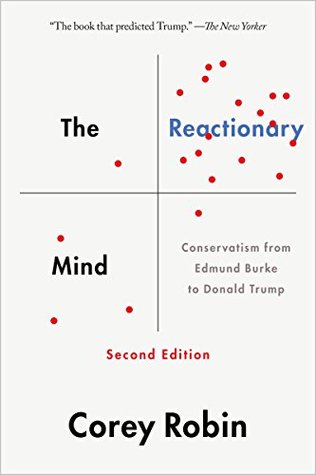
More on this book
Community


Kindle Notes & Highlights
by
Corey Robin
Read between
November 25 - December 27, 2024

The Reactionary Mind argued, among other things, that many of the characteristics we have come to associate with contemporary conservatism—racism, populism, violence, and a pervasive contempt for custom, convention, law, institutions, and established elites—are not recent or eccentric developments of the American right. They are instead constitutive elements of conservatism, dating back to its origins in the European reaction against the French Revolution. From its inception, conservatism has relied upon some mix of these elements to build a broad-based movement of elites and masses against
...more
Having watched Trump consistently accede to the party and the establishment he once threatened to remake—on trade, China, building a wall along the US-Mexico border, infrastructure, entitlements, and a host of other matters—and having seen the Republican Party, despite its control of all three elected branches of the federal government, consistently fail—at least thus far—to advance its agenda with regard to healthcare, taxes, and spending, I believe that my original claim about the weakness and incoherence of the conservative movement still holds.1
Its failure to govern, to enact the most basic parts of its platform, at least thus far, is not a sign of incompetence but incoherence. (Asked in May 2017 what the Republican Party stands for, Nebraska GOP Senator Ben Sasse, replied, “I don’t know.” Asked to describe the Republican Party in one word, Sasse, who has a doctorate in history from Yale, said, “Question mark.” After Senate Republicans failed to deliver on their repeal of Obamacare before the Fourth of July recess in 2017, House Republican Steve Womack of Arkansas was equally blunt and unsparing: “We’ve been given this opportunity to
...more
I argue that much of the Trump phenomenon that is most unsettling and upsetting—particularly the racism, lawlessness, and violence—is not new, but that there are elements of his rise and rule that are new.
The tensions between the political and the economic, between an aristocratic conception of politics and the realities of modern capitalism, are a leitmotif of the conservative tradition, in Europe and the United States, and thus comprise a leitmotif of this book.
of chapters can also be read as a stand-alone essay about a particular figure, theme, or moment. With one exception: chapter 11. My case for what is new and what is old in the case of Donald Trump, which I set out in the concluding
These ideas, which occupy the right side of the political spectrum, are forged in battle. They always have been, at least since they first emerged as formal ideologies during the French Revolution, battles between social groups rather than nations; roughly speaking, between those with more power and those with less. To understand these ideas, we have to understand that story. For that is what conservatism is: a meditation on—and theoretical rendition of—the felt experience of having power, seeing it threatened, and trying to win it back.
Despite the very real differences between them, workers in a factory are like secretaries in an office, peasants on a manor, slaves on a plantation—even wives in a marriage—in that they live and labor in conditions of unequal power. They submit and obey, heeding the demands of their managers and masters, husbands and lords. They are disciplined and punished. They do much and receive little. Sometimes their lot is freely chosen—workers contract with their employers, wives with their husbands—but its entailments seldom are.
Every once in a while, however, the subordinates of this world contest their fates. They protest their conditions, write letters and petitions, join movements, and make demands. Their goals may be minimal and discrete—better safety guards on factory machines, an end to marital rape—but in voicing them, they raise the specter of a more fundamental change in power. They cease to be servants or supplicants and become agents, speaking and acting on their own behalf. More than the reforms themselves, it is this assertion of agency by the subject class—the appearance of an insistent and independent
...more
In his last major address to the Senate, John C. Calhoun, former vice president and chief spokesman of the Southern cause, identified the decision by Congress in the mid-1830s to receive abolitionist petitions as the moment when the nation set itself on an irreversible course of confrontation over slavery. In a four-decade career that had seen such defeats to the slaveholder position as the Tariff of Abominations, the Nullification Crisis, and the Force Bill, the mere appearance of slave speech in the nation’s capital stood out for the dying Calhoun as the sign that the revolution had begun.6
...more
During the Seattle general strike of 1919, workers went to great lengths to provide basic government services, including law and order. So successful were they that the mayor concluded it was the workers’ independent capacity to limit violence and anarchy that posed the greatest threat. The so-called sympathetic Seattle strike was an attempted revolution. That there was no violence does not alter the fact. . . . True, there were no flashing guns, no bombs, no killings. Revolution, I repeat, doesn’t need violence. The general strike, as practiced in Seattle, is of itself the weapon of
...more
Conservatism is the theoretical voice of this animus against the agency of the subordinate classes. It provides the most consistent and profound argument as to why the lower orders should not be allowed to exercise their independent will, why they should not be allowed to govern themselves or the polity. Submission is their first duty, and agency the prerogative of the elite. Though it is often claimed that the left stands for equality while the right stands for freedom, this notion misstates the actual disagreement between right and left. Historically, the conservative has favored liberty for
...more
Such was the threat Edmund Burke saw in the French Revolution: not merely an expropriation of property or explosion of violence but an inversion of the obligations of deference and command. “The levellers,” he claimed, “only change and pervert the natural order of things.” The occupation of an hair-dresser, or of a working tallow-chandler, cannot be a matter of honour to any person—to say nothing of a number of other more servile employments. Such descriptions of men ought not to suffer oppression from the state; but the state suffers oppression, if such as they, either individually or
...more
Even when the left’s demands shift to the economic realm, the threat of freedom’s extension looms large. If women and workers are provided with the economic resources to make independent choices, they will be free not to obey their husbands and employers. That is why Lawrence Mead, one of the leading intellectual opponents of the welfare state in the 1980s and 1990s, declared that the welfare recipient “must be made less free in certain senses rather than more.”13 For the conservative, equality portends more than a redistribution of resources, opportunities, and outcomes—though he certainly
...more
And, indeed, the great modern movements of emancipation—from abolition to feminism to the struggle for workers’ rights and civil rights—have always posited a nexus between freedom and equality. Marching out of the family, the factory, and the field, where unfreedom and inequality are the flip sides of the same coin, they have made freedom and equality the irreducible yet mutually reinforcing parts of a single whole. The link between freedom and equality has not made the argument for redistribution any more palatable to the right. As one conservative wag complained of John Dewey’s vision of
...more
Politicians and parties talk of constitution and amendment, natural rights and inherited privileges. But the real subject of their deliberations is the private life of power. “Here is the secret of the opposition to woman’s equality in the state,” Elizabeth Cady Stanton wrote. “Men are not ready to recognize it in the home.”17 Behind the riot in the street or debate in Parliament is the maid talking back to her mistress, the worker disobeying her boss. That is why our political arguments—not only about the family but also the welfare state, civil rights, and much else—can be so explosive: they
...more
Most of this talk was propaganda and self-delusion, of course, but in one respect it was not: the nearness of master to slave did make for an exceptionally personal mode of rule. Masters devised and enforced “unusually detailed” rules for their slaves, dictating when they had to get up, eat, work, sleep, garden, visit, and pray. Masters decided upon their slaves’ mates and marriages. They named their children, and when the market dictated, separated those children from their parents. And while masters—as well as their sons and overseers—availed themselves of the bodies of their female slaves
...more
Outside the South, wrote C. Vann Woodward, the end of slavery was “the liquidation of an investment.” Inside, it was “the death of a society.”
As Henry McNeal Turner, a black Republican in Georgia, put it in 1871: “They do not care so much about Congress admitting Negroes to their halls . . . but they do not want the negroes over them at home.” One hundred years later, a black sharecropper in Mississippi would still resort to the most domestic of idioms to describe relations between blacks and whites: “We had to mind them as our children mind us.”26
“The real object” of the French Revolution, Burke told Parliament in 1790, is “to break all those connexions, natural and civil, that regulate and hold together the community by a chain of subordination; to raise soldiers against their officers; servants against their masters; tradesmen against their customers; artificers against their employers; tenants against their landlords; curates against their bishops; and children against their parents.”
In another speech before Parliament in 1791, he declared that “a constitution founded on what was called the rights of man” opened “Pandora’s box” throughout the world, including Haiti: “Blacks rose against whites, whites against blacks, and each against one another in murderous hostility; subordination was destroyed.”30 Nothing to the Jacobins, he declared at the end of his life, was worthy “of the name of the publick virtue, unless it indicates violence on the private.”
Adams was clearly rattled by this appearance of democracy in the private sphere.

That quote doesn’t support this proposition of “ rattled”.
No matter how democratic the state, it was imperative that society remain a federation of private dominions, where husbands ruled over wives, masters governed apprentices, and each “should know his place and be made to keep it.”36
Historically, the conservative has sought to forestall the march of democracy in both the public and the private spheres, on the assumption that advances in the one necessarily spur advances in the other. “In order to keep the state out of the hands of the people,” wrote the French monarchist Louis de Bonald, “it is necessary to keep the family out of the hands of women and children.”
Still, the more profound and prophetic stance on the right has been Adams’s: cede the field of the public, if you must, but stand fast in the private. Allow men and women to become democratic citizens of the state; make sure they remain feudal subjects in the family, the factory, and the field. The priority of conservative political argument has been the maintenance of private regimes of power—even at the cost of the strength and integrity of the state.
Conservatism, then, is not a commitment to limited government and liberty—or a wariness of change, a belief in evolutionary reform, or a politics of virtue. These may be the byproducts of conservatism, one or more of its historically specific and ever-changing modes of expression. But they are not its animating purpose. Neither is conservatism a makeshift fusion of capitalists, Christians, and warriors, for that fusion is impelled by a more elemental force—the opposition to the liberation of men and women from the fetters of their superiors, particularly in the private sphere.
No simple defense of one’s own place and privileges—the conservative, as I’ve said, may or may not be directly involved in or benefit from the practices of rule he defends; many, as we’ll see, are not—the conservative position stems from a genuine conviction that a world thus emancipated will be ugly, brutish, base, and dull. It will lack the excellence of a world where the better man commands the worse.
If the power goes, the distinction goes with it.
Does it have to? Would be awful hard to make that distinction btwn power and rank stick though
This vision of the connection between excellence and rule is what brings together in postwar America that unlikely alliance of the libertarian, with his vision of the employer’s untrammeled power in the workplace; the traditionalist, with his vision of the father’s rule at home; and the statist, with his vision of a heroic leader pressing his hand upon the face of the earth. Each in his way subscribes to this typical statement, from the nineteenth century, of the conservative creed: “To obey a real superior . . . is one of the most important of all virtues—a virtue absolutely essential to the
...more
Three times prime minister of Britain, Salisbury wrote in 1859 that “hostility to Radicalism, incessant, implacable hostility, is the essential definition of Conservatism. The fear that the Radicals may triumph is the only final cause that the Conservative Party can plead for its own existence.”53
Conservatism, he said, is defined by “resistance to certain forces perceived to be leftist, revolutionary, and profoundly subversive of what conservatives at the time deemed worth cherishing, defending, and perhaps dying for.”56
As Karl Mannheim argued, what distinguishes conservatism from traditionalism—the universal “vegetative” tendency to remain attached to things as they are, which is manifested in nonpolitical behaviors such as a refusal to buy a new pair of pants until the current pair is shredded beyond repair—is that conservatism is a deliberate, conscious effort to preserve or recall “those forms of experience which can no longer be had in an authentic way.” Conservatism “becomes conscious and reflective when other ways of life and thought appear on the scene, against which it is compelled to take up arms in
...more
it is important that we be clear about what the conservative is and is not opposing in the left. It is not change in the abstract. No conservative opposes change as such or defends order as such. The conservative defends particular orders—hierarchical, often private regimes of rule—on the assumption, in part, that hierarchy is order. “Order cannot be had,” declared Johnson, “but by subordination.”63 For Burke, it was axiomatic that “when the multitude are not under this discipline” of “the wiser, the more expert, and the more opulent,” “they can scarcely be said to be in civil society.”64
To preserve the regime, the conservative must reconstruct the regime. This program entails far more than clichés about “preservation through renovation” would suggest: often, it can require the conservative to take the most radical measures on the regime’s behalf.
Some of the stuffiest partisans of order on the right have been more than happy, when it has suited their purposes, to indulge in a little bit of mayhem and madness. Kirk, the self-styled Burkean, wished to “espouse conservatism with the vehemence of a radical. The thinking conservative, in truth, must take on some of the outward characteristics of the radical, today: he must poke about the roots of society, in the hope of restoring vigor to an old tree strangled in the rank undergrowth of modern passions.” That was in 1954.
The conservative not only opposes the left; he also believes that the left has been in the driver’s seat since, depending on who’s counting, the French Revolution or the Reformation.68 If he is to preserve what he values, the conservative must declare war against the culture as it is. Though the spirit of militant opposition pervades the entirety of conservative discourse, Dinesh D’Souza has put the case most clearly. Typically, the conservative attempts to conserve, to hold on to the values of the existing society. But . . . what if the existing society is inherently hostile to conservative
...more
Conversely, as Abraham Lincoln pointed out, it’s just as easy for the left to claim the mantle of preservation as it is for the right. “You say you are conservative,” he declared to the slaveholders. Eminently conservative—while we are revolutionary, destructive, or something of the sort. What is conservatism? Is it not adherence to the old and tried, against the new and untried? We stick to, contend for, the identical old policy on the point in controversy which was adopted by “our fathers who framed the Government under which we live”; while you with one accord reject, and scout, and spit
...more
(Indeed, with the exception of Peel and Baldwin, no Tory leader has ever pursued a consistent program of preservation through reform, and even Peel could not persuade his party to follow him.
Other conservatives have argued that any demand from or on behalf of the lower orders, no matter how tepid or tardy, is too much, too soon, too fast. Reform is revolution, improvement insurrection. “It may be good or bad,” a gloomy Lord Carnarvon wrote of the Second Reform Act of 1867—a bill twenty years in the making that tripled the size of the British electorate—“but it is a revolution.”
Today’s conservative may have made his peace with some emancipations past; others, like labor unions and reproductive freedom, he still contests. But that does not alter the fact that when those emancipations first arose as a question, whether in the context of revolution or reform, his predecessor was in all likelihood against them.
Michael Gerson, former speechwriter for George W. Bush, is one of the few contemporary conservatives who acknowledge the history of conservative opposition to emancipation. Where other conservatives like to lay claim to the abolitionist or civil rights mantle, Gerson admits that “honesty requires the recognition that many conservatives, in other times, have been hostile to religiously motivated reform” and that “the conservative habit of mind once opposed most of these changes.”79 Indeed, as Samuel Huntington suggested a half-century ago, saying no to such movements in real time may be what
...more
Beyond these contingent changes, we can also trace a longer structural change in the imagination of the right: namely, the gradual acceptance of the entrance of the masses onto the political stage. From Hobbes to the slaveholders to the neoconservatives, the right has grown increasingly aware that any successful defense of the old regime must incorporate the lower orders in some capacity other than as underlings or starstruck fans. The masses must either be able to locate themselves symbolically in the ruling class or be provided with real opportunities to become faux aristocrats in the
...more
Forged in response to challenges from below, conservatism has none of the calm or composure that attends an enduring inheritance of power. One will look in vain throughout the canon of the right for steady assurances of a Great Chain of Being. Conservative statements of organic unity, such as they are, either have an air of quiet—and not so quiet—desperation about them or, as in the case of Kirk, lack the texture, the knowing feel, of a longstanding witness to power.
Conservatism is about power besieged and power protected. It is an activist doctrine for an activist time. It waxes in response to movements from below and wanes in response to their disappearance, as Hayek and other conservatives admit.
To the conservative, power in repose is power in decline. The “mere husbanding of already existing resources,” wrote Joseph Schumpeter, “no matter how painstaking, is always characteristic of a declining position.”99 If power is to achieve the distinction the conservative associates with it, it must be exercised, and there is no better way to exercise power than to defend it against an enemy from below.100 Counterrevolution, in other words, is one of the ways in which the conservative makes feudalism fresh and medievalism modern.
This is some Shao Khan shit, some “empires must conquer and expand or die” bullshit. I guess nonetheless consistent with conservative thinking
Unlike the feudal past, where power was presumed and privilege inherited, the conservative future envisions a world where power is demonstrated and privilege earned: not in the antiseptic and anodyne halls of the meritocracy, where admission is readily secured—“the road to eminence and power, from obscure condition, ought not to be made too easy, nor a thing too much of course”101—but in the arduous struggle for supremacy. In that struggle, nothing matters: not inheritance, social connections, or economic resources, but rather one’s native intelligence and innate strength. Genuine excellence
...more
With time, however, the conservative would find another proving ground in the marketplace. Though most early conservatives were ambivalent about capitalism,104 their successors would come to believe that warriors of a different kind can prove their mettle in the manufacture and trade of commodities. Such men wrestle the earth’s resources to and from the ground, taking for themselves what they want and thereby establishing their superiority over others. The great men of money are not born with privilege or right; they seize it for themselves, without let or permission.105 “Liberty is a
...more
Whether in Europe or the United States, in this century or previous ones, conservatism has been a forward movement of restless and relentless change, partial to risk taking and ideological adventurism, militant in its posture and populist in its bearings, friendly to upstarts and insurgents, outsiders and newcomers alike. While the conservative theorist claims for his tradition the mantle of prudence and moderation, there is a not-so-subterranean and counterintuitive strain of imprudence and immoderation running through that tradition.
Far from yielding a knee-jerk defense of an unchanging old regime or a thoughtful traditionalism, the reactionary imperative presses conservatism in two rather different directions: first, to a critique and reconfiguration of the old regime; and second, to an absorption of the ideas and tactics of the very revolution or reform it opposes. What conservatism seeks to accomplish through that reconfiguration of the old and absorption of the new is to make privilege popular, to transform a tottering old regime into a dynamic, ideologically coherent movement of the masses. A new old regime, one
...more
Conservatism has always been a wilder and more extravagant movement than many realize—and it is precisely this wildness and extravagance that has been one of the sources of its continuing appeal.
