
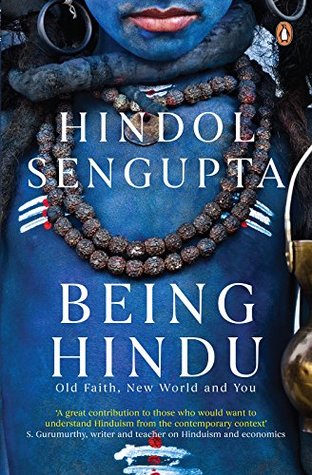
More on this book


Kindle Notes & Highlights

Read between
January 10 - January 18, 2019

‘Reduced to its elements, Vedanta philosophy consists of three propositions. First, man’s real nature is divine. Second, the aim of human life is to realize this divine nature. And finally, all religions are essentially in agreement.’
faith that sees itself as the vessel of eternal truth has been mostly caricaturized as worshippers of cows, monkeys and snakes. Its are virtues isolated and commercialized; its vices red-flagged.
Curiously, the more the core beliefs of Hinduism left almost all decisions to the individual—after all, even atheists could technically be Hindu—the more many people found their understanding to be hazy and undefined. Instead of seeing the undefined as liberty, we had begun to see it as faith unresolved and unsubstantial. It was almost like we were asking for the responsibility of spiritual choice to be taken away from us, or at least not left to us to this vague extent.
ekam sat viprah bahuda vedanti
‘In my speeches and writings, I have always advocated that the religious and communal consideration should be entirely eschewed in the public affairs of the country; at elections, inside and outside the legislatures and in the making and unmaking of Cabinets. I have throughout stood for a secular state with joint electorates. To my mind this is the only sensible thing to do.’3
Hinduism teaches that there are really only three questions that deserve an answer—who am I, what do I want and what is my purpose? And of these, the one that is most important is: who am I? It is said that it takes a lifetime to even understand the questions properly, far less find the answer(s).
dancing Shiva in which I tried to explain to him the philosophy of the Natraj: the representation of the constant chain of creation and destruction in the universe.
dance represents the god Shiva’s five activities—creation and evolution; preservation; destruction and further evolution; illusion and rest; and release, salvation and grace2
The caricatures, it seemed to me, had hardened into prejudices that blurred the core philosophies. It occurred to
D.R. Bhandarkar was one of the finest Indian archeologists and a lecturer of great repute.
Now, Agastya is mentioned in the Ramayana as among the first to have crossed the Vindhya mountains and is admitted by all Tamil grammarians as the founder of the Tamil language, the great Tamirmuni, or sage of the Tamils.
‘I am not unaware that these are legends. It is however a mistake to suppose that legends teach us nothing historical.’
I found that Brahmagupta was one of the greatest mathematicians of all time, being the first to introduce in India the concept of negative numbers and spell out all theirs rules of operation. His two seminal books are Brāhmasphuṭasiddhānta and Khaṇḍakhādyaka.
And since India was producing few experts who were experienced in the practice of faith, some of these inaccurate notions tended to swiftly become the ‘truth’, not just for Westerners but for everyone. What ought to be a debate leapfrogged into a monologue. At
Sanskrit to be ‘more perfect that Greek, more copious than Latin, and more exquisitely refined than either.’
‘Bharata is not merely a convenient designation for a conglomerate of cultures, such as Europe has been for so much of its history or such as Indonesia has become in modern times. Nor was Bharata ever the name of a political entity like a nation-state, at least until 1947, when it became the proper name of independent India. And yet it is arresting to consider a sense of unity construed in and through the diverse imagined landscape . . . a sense of connectedness that seems to have flourished for many centuries without the need for overarching political expression or embodiment.’
‘When the ancient Brahmanical text Vishnu Purana (3rd century AD) describes the Indians as the children of the land called Bharat, which is then described geographically as the country lying to the north of the ocean and south of the snow-clad mountains,
As R.C. Majumdar explained in the introduction to The History and Culture of the Indian People13, it is pre-Islamic India that laid the philosophical bedrock for the syncretic, composite culture that India has been able to build, therefore to credit this foremost Hindu imagination of a tolerant geography is neither incorrect, nor is it in any manner, shape or form discriminatory.
In 2011, the American Journal of Human Genetics published the findings of a three-year-long research led by a team of international scientists who
proved that Indians have had the same genetic construct for the last 60,000 years.
in The American Journal of Human Genetics in 2006, it shows that, as the writer Sanjeev Sanyal says, ‘India’s population mix has been broadly stable for a very long time and that there has been no major injection of Central Asian genes for over 10,000 years.’
civilization. And if there is one central idea of our civilizational intellect, it is the understanding that inner oneness among human beings lies at the heart of understanding the intelligence of the universe.
how could man understand himself without first understanding God?
The illusion is the division in our minds between the inner and the outer world. The
The idea of being Hindu was far more amorphous, esoteric even.
greatest writers Bankim Chandra Chatterji wrote, ‘With other peoples (sic), religion is only a part of life; there are things religious and things lay and secular. To the Hindu, his relations to God and his relations to man, his spiritual life and his temporal life, are incapable of being so distinguished. They form one compact and harmonious whole, to separate which into components is to break the entire fabric.’
‘He who sees the self in all beings and all beings in the self, henceforth, has no more remorse’, says the Isha Upanishad.
‘Consciousness is never experienced in the plural, only in the singular
That’s why Schroedinger wrote that what seems to us as plurality is ‘merely a series of different aspects’ of the same thing, the same truth. ‘Sensory deception’ or what the Hindus call maya gives us an illusion
‘The manifestion of Brahman in the human soul is called Atman,’
‘The most important characteristic of the Eastern worldview—one could almost say the essence of it—is the awareness of the unity and mutual interrelation of all things and events, the experience of all phenomena in the world as manifestations of a basic oneness,’
Eastern philosophies, said Jung, shifted the ‘centre of gravity from the ego to the self, from man to god.’17
‘What happens after death?’ Yajnavalkya talks neither of heaven nor hell or everlasting life, nor sin or salvation. He says what happens after death is that we become ‘that person which is reflected of us in the eye of another person looking at us’18.
Or, as Vivekananda said, ‘Never forget the glory of human nature! We are the greatest god . . . Christs and Buddhas are but waves on the boundless ocean which I am.’
‘Many people feel small, because they’re small and the universe is big, but I feel big, because my atoms came from those stars. There is a level of connectivity. That’s really what you want in life, you want to feel connected, you want to feel relevant. You want to feel like you’re a participant in the goings on of activities and events around you. That’s precisely what we are, just by being alive.’20
It is the reverence—indeed the meditative reverie—of the believer that constitutes the sanctity of the sacred, not the object per se.
all beings.’ The idea that man can invoke divinity in clay to make it God and then worship it is, to me, the most sublime idea of the potential in each of us;
In her now famous TED talk, the researcher Brene Brown explains how the word ‘courage’ comes from the Latin word ‘cor’, which means heart. It derives from the ability and psychological ability to open your heart and be vulnerable.
To me, it has always seemed that sanatan dharma is telling us to stand up and take some responsibility and not leave (or blame) everything to God.
More and more people around the world are realizing what Vedanta had always known—above all else, one must seek and find a sense of silent centredness.
Sherry Turkle’s
‘Hinduism differs fundamentally from Christianity in this, that for its followers it is not an alternative to the world, but primarily the means of supporting and improving their existence in it.
‘Therefore in Hindu society every worldly activity is under the control of religion, and everything religious is involved in the world.’
Richard Dawkins, perhaps the most well-known gene biologists alive, in his now popular book The God Delusion mentions Hinduism only twice. Only two times in a 460-page book.
It is a belief in one reality that accommodates all manifestations of that reality and does not seek to demarcate.
Surendranath Dasgupta—author of the five-volume A History of Indian Philosophy—
It embraced that even in spiritual evolution, free will played a vital role ‘without which there can be no moral responsibility’.11
‘The Yajurveda Samhita has names of numbers up to even 10 to the power of 12 and the Pancavimsa Brahmana gives an account of numbers in ascending order decimal scale (from 10 to the power of 1 to 10 to the power of 12) .
The oldest among these texts, the Baudhayana Sulvasutra, first mentions the Pythagoras theorem, that is, the square of the hypotenuse is the square of the other two sides in a right triangle (a2 + b2 = c2).
one needs to only look at the writings of the renowned chemist Prafulla Chandra Ray and his History of Hindu Chemistry or the writings of British scientist and historian Joseph Needham to get a sense of breadth of early chemical knowledge in India. Just
