
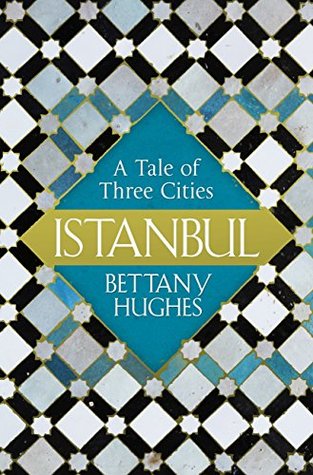
More on this book
Community


Kindle Notes & Highlights
Read between
December 30, 2021 - February 2, 2022

the term lingua franca, the Adoration of the Virgin Mary, the Nicene Creed, the name of the Roma, passports, the fork, jingoism, the fact that some call themselves White Caucasian, the basis of modern Western law – all were forged in Istanbul’s furnace. Greek dramas, Roman philosophy, Christian texts, Islamic poetry – many world-class examples were preserved only thanks to the work of the men (and sometimes the women) in the city’s scriptoria
Istanbul is the longest-lived political entity in Europe. It is a conurbation that over the last 8,000 years has grouted together a mosaic of settlements and micro-cities to form the grand, messy picture that is the modern metropolis. Many districts in the city were once their own cityettes: Chalcedon,
for the man who would join the Red Sea to the Mediterranean by gouging out a canal, and who would institute a universal currency to encourage trade across the known world, to collapse the small, wet gap between continents must have seemed like child’s play – an act that has accumulated legendary proportions but that was, for the most powerful ruler on earth, practicable. And so it is that the textual life-story of Istanbul begins with a bridge. Herodotus’ description of Dareios’ massive, mile-long pontoon, one of the Emperor’s eye-wateringly audacious projects, writes Byzantion into history.
Near to the Church of Peace on what was the original ancient Greek acropolis an orphanage of St Paul and an associated medical centre were also soon established. Poorhouses and additional orphanages were to follow. Constantine supplied rations of bread in the city for 80,000 people every day. Nine hundred and fifty workshops were selected to help fund the free burial of the indigent poor of the city. As Constantinople grew, one of her trademarks was provision for the sick – hospitals specialising in hospice service, infectious diseases and maternal care would come to decorate the city.
...more
Arguably the departure of Rome’s troops from Britain was a by-product of the vicissitudes of Constantinople. Eunuch Eutropios had served under Theodosios I and immediately after the Emperor’s death in AD 395 had persuaded his young son Arkadios to marry, not the daughter of another influential courtier Rufinus, but instead that unknown beauty Aelia Eudoxia. Rufinus was soon afterwards assassinated (some argue with Eutropios’ help), while Eutropios in his turn would be executed four years later possibly at the behest of his own creature, Empress Eudoxia. This was a time when the administration
...more
This highlight has been truncated due to consecutive passage length restrictions.
Herakleios had chosen a complicated ally. The fact that the Great Wall of China had been built higher, longer, stronger in part as a response to the raids of the Turks, 150 years before, should have worried the city of God on the edge of the Bosphorus. The Turks had been quietly getting stronger. Breeding the horses beloved of Indian and Chinese warrior leaders, never allowed to become irrelevant because of the Silk Road trade routes that abutted their territory and connected Constantinople in the West with Xian in the East across 4,000 miles, picking up some of the twenty or so languages
...more
The Sultan had already agreed to take some Jews into his empire from Spain in 1470 (although the city’s resident Jewish community had in large part been enslaved or deported at the time of conquest), but now there was mass immigration. When the Spanish monarchs Ferdinand II and Isabella I took Granada in al-Andalus, Muslims and Jews were killed or expelled. At the beginning of the sixteenth century many, perhaps 30,000, came directly to Istanbul.4 There were now more than 8,070 Jewish households in what was once Constantine’s capital. It was said that Sultan Bayezid II had recognised the
...more

Lewis (1985), 122. Restrictions on non-Muslims: İnalcık (1990),
AD 1493, fifty-odd years after it was invented, the city’s first printing press. The Jewish printers physically carried their printing blocks and equipment with them. The fonts used in Istanbul could be neither Arabic nor Ottoman-Turkish (printing in Arabic script was legalised only in 1727).
With the approach of the Muslim millennium there were sartorial restrictions imposed on Jews (and Christians) and alcohol was banned. When one of the key players in Sultan Murad III’s harem, Safiye, planned her beautiful mosque which still stands overlooking the Bosphorus, synagogues and Jewish residencies were peremptorily cleared to make space. The great fire of AD 1660 was blamed on the Jews, and in retribution many were expelled from Eminönü.
The Ottoman acquisition of Jerusalem, Mecca and Medina, in AD 1517 would prove to be a thorn in Mughal flesh.4 Both Mughal and Ottoman courts were Sunni. In close communication Mughal emperors and Ottoman sultans sent letters, embassies, gifts and spies to one another’s palaces. The two cultures shared a Central Asian heritage (the Taj Mahal was inspired by the tomb of Tamerlane in Samarkand, built for the Turco-Mongol leader who had captured that Ottoman leader Bayezid I at the Battle of Ankara in AD 1402) and a devotion to Allah.
It was Janissaries who had triggered the events that made Istanbul the headquarters of Europe’s longest-lasting Caliphate in AD 1517, and in 1622 they forced Sultan Osman II to the prison at Yedikule Fortress where he was executed. After the so-called New Order army had been rehoused in new barracks in Üsküdar in 1799, Janissaries who opposed the New Order reforms burnt the structure to the ground.7 Rebuilt by Abdülmecid I, this hospital complex was then used by Florence Nightingale during the Crimean War – the Scutari story with which we are familiar.
By the second half of the seventeenth century the Ottoman Empire had reached its greatest extent. But it wanted more. In July AD 1683, 12,000 Janissaries marched, rode and ran towards Vienna.
It was not from Istanbul that reform would come but from Salonica (Thessaloniki), Istanbul’s northern cousin, which through the centuries had shared in Istanbul’s sieges, burnings, revolts, regime-changes. A number of Westward-looking constitutionalists allied themselves with a group of determined, disgruntled military officers stationed in Salonica to form the Unionists (the Committee of Union and Progress, or CUP). Popularly known as the Young Turks, their name was an anglicisation of a Westernisation; some Ottomans called these constitutionalists Jön Türkler – Jeunes Turcs in French – and
...more
This highlight has been truncated due to consecutive passage length restrictions.
