
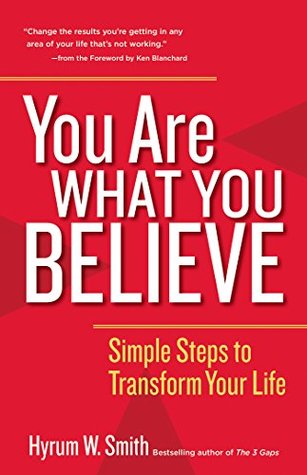
More on this book

Kindle Notes & Highlights


The basic principles that help a human being become more productive and effective have not changed for six thousand years.
the minute you put a principle on your Belief Window, you immediately start to create rules that will govern your behavior based upon that principle.
The first natural law: If the results of your behavior do not meet your needs, there is an incorrect principle or belief on your Belief Window. The second natural law: Results take time to measure.
Before any of my behavior will change, the principle on my Belief Window has to change.
The third natural law: Growth is the process of changing principles on your Belief Window.
The fourth natural law: Addiction is the result of deep, and unmet needs.
The fifth natural law: If your self-worth is dependent on anything external, you are in big trouble.
The sixth natural law: When the results of your behavior meet your needs over time, you experience inner peace.
Find out what matters most to you. Bring the events of your life in line with what matters most to you, and then you will have the right to inner peace.
The seventh natural law: The mind naturally seeks harmony when presented with two opposing principles.
organizations are nothing more than groups of individuals taking things (resources) and focusing them, and their energies, on outcomes that will hopefully meet their needs now and over time.
Organizations don’t eat chicken, mashed potatoes, and peas. What they eat is money, markets, inventory, and all of the other materials that allow them to find, serve, and retain their customers.
Organizations are hungry, and it’s a leader’s job to feed that hunger yet to keep the organization lean (though not too lean), to give it the energy it needs to get through the day, the month, and the years to come.
The need to love and be loved is a profound form of the need for relationships. We all need and want them.
great poet John Donne wrote, “No man is an island.”
Tony Robbins has said, “The quality of your life is in direct proportion to the quali...
This highlight has been truncated due to consecutive passage length restrictions.
Relationships are the foundation of the culture, and the culture in an organization is what holds the strategy and the vision and processes together.
If you want a healthy company with the potential to meet its needs over time, to be here next Friday and twenty years from next Friday, work on the quality of the relationships at the highest levels of leadership.
Covey has written in his book The 8th Habit: From Effectiveness to Greatness, “People make choices. Consciously or subconsciously, people decide how much of themselves they will give to their work depending on how they are treated and on their opportunities to use all four parts of their nature. These choices range from rebelling or quitting to creative excitement.”
Many American business leaders know the Vince Lombardi quote; some have it framed on their office wall: “Winning isn’t everything; it’s the only thing.”
Business isn’t about trying; it’s not about “having a good time.” It’s about winning, because those who win make payroll; those who don’t, don’t. It’s about that simple.
Recognition matters, but it’s a whole new ball game (there’s that sports thing again) when you can recognize an idea and show how that idea got put to work in ways that served customers, grew revenues, created jobs, built communities, and changed the world.
Recognition opens the door; sincerity and implementation seal the deal. Creating organizational cultures that put people and ideas to work on matters of substance in ways that drive results is key.
Get your people raising their hands. Let them all answer. Take it all in. Sort through the answers for quality, of course, but wherever possible, put as much of it to work as you can. Because every idea that goes to work is tied to a person who offered it up in the first place. And, when people see their ideas take flight, they rise up with them. There’s no better example, in leadership, of an organization “rising up on eagle’s wings”—where its people and ideas are important and where ideas take flight.
Variety makes people happy; it makes them smile. In the workplace, variety can make them smile Monday through Friday as much as it does on Saturday, which is why a business leader ought to care. Give your people variety and they’ll smile more, and they’ll work better; they’ll be more hopeful and uplifted and feel less hopeless and downhearted.
one of those things that Apple, Google, Facebook, Twitter, and so many other “top of mind” organizations share is their understanding of the importance of providing variety to their employees.
As a leader of a twenty-first-century organization your job is simple: if you want to attract, engage, and keep talented people you better be bringing a big bowl of variety. How do you do this? You get to know those around you. You ask them questions. You take the time to discover what type of variety they need in order to be wholly and creatively engaged. Ask those around you: • Are there unmet needs and opportunities that we are not pursuing? • What do you think we could do in order to make a greater contribution? • What do you like doing? • What opportunities exist here that you are excited
...more
Pain is inevitable; misery is optional.
What win I, if I gain the thing I seek? —WILLIAM SHAKESPEARE, THE RAPE OF LUCRECE
