
More on this book
Community


Kindle Notes & Highlights

Read between
August 21, 2019 - June 28, 2020

Teaching to who students are requires a recognition of their realities.
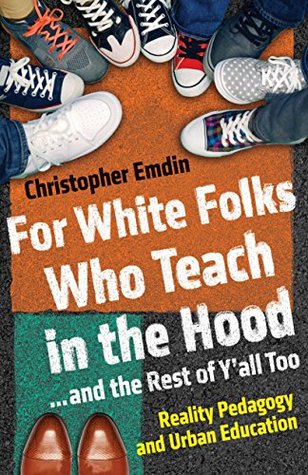
Reality pedagogy is an approach to teaching and learning that has a primary goal of meeting each student on his or her own cultural and emotional turf.
Without teachers recognizing the biases they hold and how these biases impact the ways they see and teach students, there is no starting point to changing the dismal statistics related to the academic underperformance of urban youth.
The first practical tool of cosmopolitanism is the consistent use of language rooted in neoindigenous culture to support and reinforce the notion of a shared community.
completed. The significance of call-and-response to the neoindigenous cannot be understated, since it is rooted in the ways they communicate within their communities. It is a beckoning call in times of war, a means to soothe in times of adversity, and a form of entertainment. By bringing it into the classroom and tying it to cosmopolitanism, it serves as a connector between in-school and out-of-school worlds and activates the students’ connection to the classroom.
classic hip-hop lyric like “Can I proceed?” followed by the response “Yes indeed” can positively transform classrooms. For example, if a teacher is delivering a lesson and stops to say, “Can I proceed?” and then waits for the entire class to respond with, “Yes indeed,” this allows the students to feel a connection to the teacher (because of his or her use of the phrase) and to see that the teacher is concerned with ensuring that all students understand what is being taught. The fact that the phrase is from hip-hop allows youth to see that neoindigenous culture is welcome in the classroom and
...more
Have high-performing students partner up with lower-performing students, and create a space in the classroom where these groups can target their specific strengths and weaknesses.
The teacher can ask who got a certain set of questions correct on a quiz and who didn’t, or who understood a concept that was just taught or who didn’t. Once students have declared what they either know or don’t know to the class, they can then volunteer to match up with each other or be matched by the teacher.
Support students in creating plans of action for maximizing their strengths and teaching the content to each other.
Let students know that those who are strong in content will have their test scores increased by the same number of points as their partner who is weaker in content.
the goal of the cosmo duo is for all students to reach their academic and emotional potential.
also involve establishing new duos based on new needs the students may have. This reconfiguration considers the fact that just because a student is an expert on one topic does not necessarily mean that he or she will be an expert on another one. In addition, it is important for youth to know and see that everyone can be an expert and/or need help as the class moves from one topic to another. In the monthly cosmo duo class meetings, students share ideas, motivate each other, and reestablish action plans as necessary.
Cosmopolitanism, when understood and implemented in the classroom, looks to re-create the family structure one would find in a street gang but in a positive socioemotional context.
The handshakes signaled a greeting, a celebration, an affirmation, and on many occasions, the nonverbal acknowledgment that two people or a group were about to embark on a task together. I argue that if handshakes emerge when solidarity is reached among the neoindigenous, then they can be used to create or spur on moments of solidarity in the classroom.
Given the possibility of touch being either negative or positive, it is important for the teacher to only engage in practices that generate mutually positive emotions.
us.” When he motioned with his hands as if dusting off his shoulders, he was signaling a connection to the rapper Jay-Z and familiarity with the song “Dirt Off Your Shoulder,” making a connection to the neoindigenous youth who know that gesture well.
students are engaging with each other using a nonverbal language that only those who are from the same out-of-school contexts can understand, they are forming what the sociologist James Coleman calls “dense networks.”1 Dense networks are tight-knit and interconnected binds that human beings with shared social capital have to each other.
The first is to learn to welcome nontraditional ways of expressing content knowledge. The second is to create a space in the classroom for youth to post the questions they have that may go beyond the scope of the teacher’s knowledge or what is being taught. The third is to provide extra credit/grades for students’ expression of content in nontraditional ways or for researching questions their peers are posing, and the final one involves creating a space where both the student and the teacher are learning content together.
