
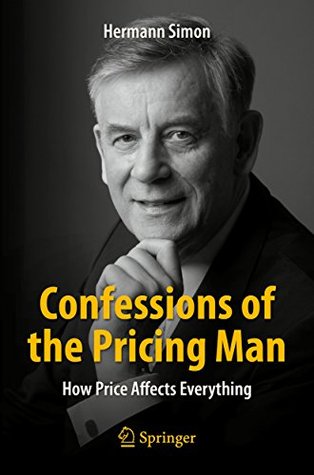
More on this book
Community


Kindle Notes & Highlights
Started reading
January 7, 2017

Professor Reinhard Selten, who would go on to win the Nobel Prize in Economics in 1994 for his work on game theory
They taught me first hand that pricing is about how people divide up value.
Everyone creates and consumes value. We are constantly making decisions about whether something is worth our money, or trying to convince others to part with their money. That is the essence of pricing.
The Russians have a saying which sums this up: “In every market there are two kinds of fools. One charges too much, the other charges too little.”
People have asked me thousands of times to name the most important aspect of pricing. I answer with one word: “value.”
“Perceive” is the operative word.
Create value: The quality of materials, performance, and design all drive the perceived value of customers. This is also where innovation comes into play.
Communicate value: This is how you influence customers’ perception. It includes how you describe the product, your selling proposition, and last but not least the brand . Value communication also covers packaging, product performance, and shelf or online placement.
Retain value: What happens post-purchase is decisive in shaping a lasting, positive perception. Expectations about how the value lasts will have a decisive influence on a customer’s willingness ...
This highlight has been truncated due to consecutive passage length restrictions.
“ le prix s’oublie, la qualité reste .”
“That is the worst and yet easiest error. Better be cheated in the price than in the quality of goods.”
I learned that good advice is not expensive. It is quite affordable, if you can recognize its value.
Consumer research and behavioral studies show time and again that we struggle to remember prices, even for products we just purchased. But quality, good or bad, stays with us.
Managers have become keenly aware that value alone does you little good unless you can communicate it successfully.
Remember, the only fundamental driver of willingness to pay is the perceived value in the eyes of the customer.
second-order effect s and intangible benefit s.
Two of the most powerful intangible benefits we willingly pay for every day are convenience and peace of mind.
Whenever possible, you should try to communicate value using hard data, especially in a business-to-business situation.
Only perceived value creates willingness to pay .
The London ticket team’s work demonstrated that the powerful combination of high perceived value and excellent communication can drive higher willingness to pay .
who considered every agreement on a price, wage, and interest rate to be equivalent to military truce.
Price negotiations are similar to war, eventually ending in a truce.
The peace lasts only until the next round of ...
This highlight has been truncated due to consecutive passage length restrictions.
But price plays a pivotal role in how a pool of money gets divided up between a supplier and a customer.
Pricing power was 35 % higher in companies if top management was involved in setting the framework for pricing decisions instead of delegating that authority. Companies with dedicated pricing departments had 24 % more pricing power than companies without such departments.
This is known as the Veblen or “snob” effect.
A Ferrari wouldn’t be a Ferrari if it costs only $100,000.
That means that a price increase leads to higher sales .
This reinforces a key lesson in this book: you need to know what your demand curve looks like, the more precisely, the better.
It is also often wise—as the cases of Delvaux and Chivas Regal show—to combine the higher price positioning with an enhanced design or a packaging upgrade.
A lower price can prompt a consumer to forgo a purchase, because the price raises concerns about the quality.
But the flipside of that statement is also valid for many customers. For them, the simple equation “higher price = higher quality” becomes a handy rule of thumb.
When do consumers assess a product primarily or solely based on its price? Price is likely to serve as an indicator of quality when buyers are uncertain about a product’s underlying quality. This happens when they are confronted with a product that is entirely new to them or one which they rarely buy. Consumers are also prone to make such price-based judgments when the absolute price of the product is not very high, when they have little transparency on prices for alternatives, or when they are under time pressure.
If prestige, quality, or placebo effect s are present in a market, this has a major impact on both price positioning and price communication.
These effects defuse price as a competitive weapon.
Attempts to win over customers through lower prices don’t work.
These effects also explain why discounts on no-name products or weaker brands also fail to work: customers associate the reduced price with lower quality or with low prestige.
Buyers look for reference points or “anchors.”
The researchers concluded that “anchoring is an exceptionally robust phenomenon that is difficult to avoid.”10
What does this teach us? When buyers know neither the price range of a product category nor have any special requirements (e.g., high quality, low price), they gravitate toward a price in the middle of the range.
The less a buyer knows objectively about the quality of the products and prices in an assortment, the stronger the pull of the “magic of the middle” will be.
These two cases demonstrate clearly that psychological effects are extremely important and relevant for price setting and assortment planning. Small changes in the assortment or price structure can have a dramatic impact on revenue and profit, without any increases in costs.
The most important argument for the existence of odd prices is that customers perceive the digits in a price with decreasing intensity as they read from left to right. The first digit in a price has the strongest influence on perception; that is, a price of $9.99 comes across as $9 plus something rather than $10.
Another hypothesis claims that customers tend to associate prices ending in 9 with promotions or special offers.
In other words, the pain we feel from a loss is greater than the happiness we feel from a gain, even if the magnitude of the loss and gain themselves is equal.

Interesting
