
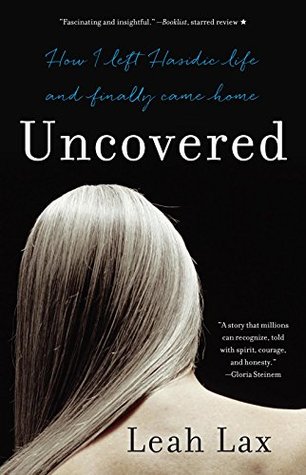
More on this book


Kindle Notes & Highlights

by
Leah Lax
Read between
July 10 - July 13, 2020

“You know,” I tell Mira one mikvah night in the dark car, “we’re good for each other. You’ve got to learn there is a gray, and as a religious woman, I have to remember black and white. We both need a little work.” But it’s ardent, vocal Mira, black-and-white-thinking Mira, whom our community respects. It’s tough, I think, to be the one who remembers gray.
I look down at the long skirt and stockings. Why, we carry shame that isn’t ours. I close the book, shake my head. I can’t do it. I can’t humbly engage in study anymore, no matter how beloved it once was. I can’t go back to where I was.
I am a “we.” The community. We made his tragedy inevitable. He killed himself because he believed what we teach, and so he couldn’t bear his own heartbeat.
I want to tell my children that I don’t believe so much about our life anymore, but I don’t dare. If I could, I’d say, It isn’t important to me whether you recite the right prayer or wear the right clothing. Just know yourself. Don’t go forward without that, like I did. Don’t be dishonest with yourself and with people you love, or with God, like I have been.
IN ROBERT LOWELL’S POETRY, I find he despaired when he lost his faith. I write Rosellen. “Someone should have warned Lowell that developing himself as a writer would demand such brutal self-honesty that he would never be able to embrace religion wholeheartedly again. I wish I could have warned him. I would have told him that the vision writing required of you is going to break down all of your illusions, your props against the wind. Stop! I want to tell him, because faith is our most precious illusion, impossibly fragile when the screen obscuring the world is removed. Stop! Because you can’t
...more
There are children everywhere in this watery world, ours included, playing, jumping, and no one seems to notice that no one can breathe or that the water is contaminated with human waste.
