
Kindle Notes & Highlights

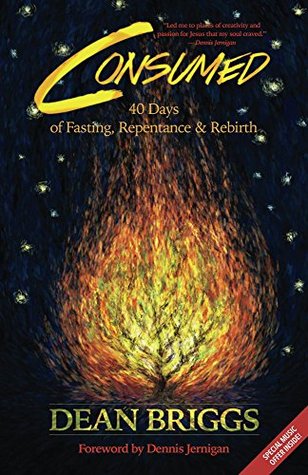
by
Dean Briggs
Read between
April 16 - May 25, 2018

“As you meditate on my Word, I will give you a song a day from your meditations. You are then to record each day’s song that same day. You will find encouragement for your soul in the process. My grace will be more than enough to sustain you. You will find Bread of Life and Living Water enough to fill you to overflowing.”
Food as an idol in my life was replaced by a proper focus on Jesus Christ as the Bread of Life.
The benefits of fullness with God far outweigh a few days’ emptiness in your belly.
“Resolved: that all men should live for the glory of God. Resolved second: that whether others do or not, I will.” — Jonathan Edwards (1703-1758) leader of the First Great Awakening
“Do not neglect the Forty Days; it constitutes an imitation of Christ’s way of life.” — St. Ignatius of Antioch (35-108 A.D.)
fullness is lukewarmness. Hunger is passion. Fullness is dullness. Hunger is vigor. Fullness is sleepy. Hunger is wide awake.
Discipline, restraint, vision, focus, passion, zeal and heightened sensitivity to the Spirit will be increasingly crucial in the final hours of human history. Thus, we simply can no longer afford to ignore the call to fast.
Fasting is no longer optional, it is mission critical.
Forty denotes a period of preparation for unique intervention or some other special action of the Lord; it is thus a time of grace. The test is refining on the one hand, but it can serve as a sort of validation on the other. The grace may serve to close one season and begin another. It is a time of change. The themes shape up thusly: patience, endurance, purification, repentance, grace, rebirth. These threads will form your own story
Fasting was the tradition of the early church and countless notable saints throughout history.
seeking a God who reveals Himself to weak, immature people—people who are far too full of the world, far too empty of Him—yet who desperately want transformation, a living experience with God, a more authentic faith.
We’re cutting loose, getting free. We are going to embrace something lean, mean and hungry. Our prize: a spirit and soul scrubbed fresh for new encounters with Christ; a heart humbled by the pain of the process; a mind renewed with clean revelation from the Spirit and the Word.
Fasting, at heart, is an exercise of patience. It forces us to slow down, to feel the drag of time. When you are hungry, the day seems longer, not shorter. Embrace this. It is by design. You are on a journey into the patient nature of a God who has no regard for time. It is a paradox, in that you must embrace the suffering of fasting and learn patience by it, yet you must not yield the cry of your heart in defeat. Yearn for breakthrough, even when you do not see it. Do both: embrace and yearn. Wait and pray.
Be deliberate to structure your forty days and forty nights with large swathes of time consecrated to the Lord.
He chose a people, invested Himself in our history. He guided, protected, delivered, corrected.
Be assured of being heard. You are noticed by God. Not in some passive way, not with bothered detachment. David says He inclines Himself toward us. It is actually a quite tender image. He leans toward you.
Since it is established that He hears us . . . what will we say to Him? That’s our part. No games. No pretending. Time to get real. What do we need, what do we lack? What burdens do we carry for which there is no comfort or remedy? Where are we stuck, broken, lost, hopeless, failing, flailing or fearful? For what do we cry out?
Bartimaeus may have enjoyed all the pity and attention his blindness afforded him. Sometimes we do that, right? We hate our chains, our weakness, our condition . . . and yet we revel in it.
Matthew 6:18 says that the one who fasts has a “Father who sees.”
When you can’t spend time in focused prayer, create prayer moments wherever you are. Every day is full of time for prayer: waiting in traffic, in line at the grocery store, cleaning dishes, in the shower,
Prayer is not overcoming God’s reluctance, but laying hold of His willingness.” — Martin Luther (1483-1546)
Be assured, desperation is worth it. The pressure that brought you to this place has purpose.
Get comfortable with pressure. It is good to be driven to the Lord. Become more desperate, not less.
He came down to Sinai to elevate a mass of slaves into a nation of conquerors, empowered by the knowledge of the laws of God to triumph in the new land.
When I am in the cellar of affliction, I look for the Lord’s choicest wines.” — Samuel Rutherford (1600-1661)
Sometimes when you are weak, the only remedy is worship.
Eternal, enduring God-life within. Not the puff and pablum and cereal fillers of our modern diet, whether at the buffet line, the movie theater or in vain religious activities.
We choose not be full, than we might know our need.
In the grace of God, when we feel ourselves weakening, we turn to praise. We respond not with complaint or self-focus, but melodies of thanksgiving.
There is a new song the Lord wants to give you—something fresh. It has the power to invigorate and inspire your own spirit even as you offer it to Him.
On your low days, use worship to turn the tables.
Rest in this: He is more involved in this process than you are. He is establishing something new, but it will take time.
When you are weak, it is important to find praise and offer it. Make a routine of praise in the midst of your hunger. Find what He is doing inside and say yes, then exalt Him for it.
Listen carefully, by faith. We are so used to loud noises. Fasting is meant to quiet us enough to hear th...
This highlight has been truncated due to consecutive passage length restrictions.
Be on your guard when you begin to mortify your body by abstinence and fasting—lest you imagine yourself to be perfect and a saint—for perfection does not consist in this virtue. It is only a help, a disposition, a means, though a fitting one, for the attainment of true perfection.” — St. Jerome (340-420 A.D.)
What God intends to reveal through your life is not only for your good, but for the fame of His name and the advance of His kingdom.
a lifestyle of quiet restraint will be the most shocking testimony of all.
Fasting produces a work of art—the tempered, selfless Christian—that can be created through no other process of refinement. — Lee Bueno
Wait, slow down. Take a deep breath. Rise out of your belly and be gripped by the Spirit.
To be established in a discipline like fasting requires our cooperation with the Spirit in developing the fruit of self-control, yet the prevailing power at work is the grace of God.
the nature of persistently denying the flesh forces our personal supply lines to reroute from the outer man to the inner man.
We gain new perspective externally, and peace internally, as we become less dependent on superficial needs.
Trust in the Lord. As often as you think of food, turn to Him. Let Him become your food.
Lean on Him for strength. Feed on Christ. Feed on His Spirit. Cling to the hope of what He is doing inside you, unseen at present, but no less real.
Don’t presume upon the grace of God. Ask Him to supply the strength and resolve you need to complete this journey. The point of your fast is to fellowship with God. Turn thoughts and needs into conversations. Make a habit at the end of each day to ask Him for fresh grace for the next day.
We are easily diluted, spending our strength upon this and that, filled with too much clutter to maintain clarity, focus or impact in our service to the King.
true repentance is not gnashing our teeth in guilt and shame. It is responding to the grace by which the Holy Spirit changes us.
“The world’s a huge stockpile of God-wonders and God-thoughts.”
They are like bonuses: you get to be alive and enjoy those things.
Let wonder whisper God to you. Deepen your appreciation for what you have been given: life, breath, and a mind capable of recognizing divine codes woven into the mundane.
