
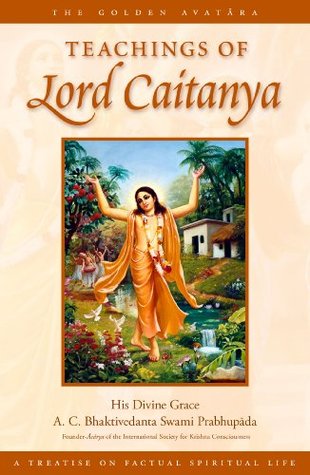
More on this book

Kindle Notes & Highlights


in Bhagavad-gītā is that everyone should surrender unto Him, Lord Kṛṣṇa. Kṛṣṇa promises to take immediate charge of such a surrendered soul. The Lord, the Supreme
for fear of detection, left the boy there and fled. Another miraculous act has been described of the lad’s demanding and getting from Hiraṇya and Jagadīśa all the offerings they had collected for worshiping Kṛṣṇa on the day of Ekādaśī. When only four
material nature is but one display of His inconceivable energies.
Strictly speaking, anyone who accepts the existence of God is situated in devotional service.
pounds-shillings-pence.
Indeed, as long as there is any desire for material perfection at all, one cannot be at peace.
The ninth offense is to preach the glories of the holy name of God to a faithless person.
I offer my respectful obeisances unto Lord Caitanya Mahāprabhu, by whose mercy even a person in the lowest status of life can find direction in transcendental devotional service to the Lord.
The activities of those who are conditioned by material nature are taken into account, and in their next life, according to these activities, they are offered different grades of material bodies. Thus in the material world the conditioned spirit soul is subjected to various rewards and punishments.
principles operating: One principle is the origin or shelter of everything, and all other principles are derived from this original principle.
Lord Caitanya then said that if anyone wants to understand the Supreme Absolute Truth in perfection, he must take to the process of devotional service in full Kṛṣṇa consciousness. Then it will be possible for him to understand the last word of the Absolute Truth.
which Kṛṣṇa can be understood by one who may not understand His other features.
As far as the āveśa-rūpa is concerned, when Kṛṣṇa empowers some suitable living entity to represent Him, that living entity is called āveśa-rūpa or śaktyāveśa-avatāra.
The personal form of Kṛṣṇa can be divided into two: svayaṁ-rūpa and svayaṁ-prakāśa. As far as His svayaṁ-rūpa (or pastime form) is concerned, it is in that form that He remains always in Vṛndāvana with the inhabitants of Vṛndāvana.
These different activities are conducted by the Lord when He is in His “emotional” forms, which are known as vaibhava-prakāśa expansions.
As far as the Vāsudeva form is concerned, the three expansions manifested from Him are Keśava, Nārāyaṇa and Mādhava. The three forms expanded from Saṅkarṣaṇa are known as Govinda, Viṣṇu and Śrī Madhusūdana. (It should be noted that this Govinda is not the same Govinda manifested in Vṛndāvana as the son of Nanda Mahārāja.) Similarly, from Pradyumna expand the three forms known as Trivikrama, Vāmana and Śrīdhara, and the three forms expanded from Aniruddha are known as Hṛṣīkeśa, Padmanābha and Dāmodara.
The first descent of the Supreme Personality of Godhead, from the expansion of Saṅkarṣaṇa, is the first puruṣa incarnation.
After describing the līlā- and guṇa-avatāras to Sanātana Gosvāmī, Lord Caitanya explained the manvantara-avatāras, incarnations associated with the Manus. He first stated that there is no possibility of counting the manvantara-avatāras. Fourteen Manus appear in one kalpa, or day of Brahmā, and for each Manu there is a manvantara-avatāra. It is calculated that each day of Brahmā lasts 4,320,000,000 earth years, and Brahmā lives for one hundred years on this scale. Thus if fourteen Manus appear in one day of Brahmā, there are 420 Manus during one month of Brahmā, and during one year of Brahmā
...more
“The self-realization achieved in the Satya millennium by meditation, in the Tretā millennium by the performance of different sacrifices, and in the Dvāpara millennium by worship of Lord Kṛṣṇa can be achieved in the Age of Kali simply by chanting the holy names, Hare Kṛṣṇa.” This is confirmed in the Viṣṇu Purāṇa (6.2.17):
this age there is no use in meditation, performance of sacrifices or temple worship. Simply by chanting the holy name of Kṛṣṇa – Hare Kṛṣṇa, Hare Kṛṣṇa, Kṛṣṇa Kṛṣṇa, Hare Hare/ Hare Rāma, Hare Rāma, Rāma Rāma, Hare Hare – one can achieve perfect self-realization.”
“This material creation is only one quarter of My creative potency. Three quarters is in the spiritual kingdom.”
His principal abodes – Gokula, Mathurā and Dvārakā.
The Lord said that anyone who understands these beautiful qualities is dipped into an ocean of nectar.
Next Lord Caitanya explained to Sanātana Gosvāmī the process by which one can approach Kṛṣṇa. The only process, said Caitanya Mahāprabhu, is devotional service to Kṛṣṇa. This is the verdict of all Vedic literature.
When the conditioned soul faithfully follows the instructions of a bona fide spiritual master, his material disease is cured,
A conditioned living entity should become aware of his real position and pray to the Lord, “How much longer will I be ruled by all these bodily functions, such as lust and anger?”
When Vyāsadeva was not satisfied even after compiling heaps of books of Vedic knowledge, Nārada Muni, his spiritual master, explained that no path of self-realization can be successful unless it is mixed with devotional service.
Nārada pointed out that the four social divisions of human society, as well as the four orders of life, are born from the gigantic universal form of the Lord, the virāṭ-puruṣa. The brāhmaṇas are born from the mouth of the universal form, the kṣatriyas are born from the arms, the vaiśyas from the waist, and the śūdras from the legs. As such, the members of all these social orders are qualified in the different modes of material nature within the form of the virāṭ-puruṣa.
Caitanya Mahāprabhu explained that Kṛṣṇa is just like the sun and that Māyā, the illusory material energy, is just like darkness. Therefore one who is constantly in the sunshine of Kṛṣṇa cannot possibly be deluded by the darkness of the material energy.
Those who are ambitious to derive material benefit from devotional service are not pure devotees, but because they are engaged in devotional service they are considered fortunate.
Yet although a person may desire material benefits from Kṛṣṇa, the Lord, being all-powerful, considers the person’s position and gradually liberates him from a materially ambitious life and engages him in more devotional service.
There are six qualifications for surrender.
This is confirmed in Śrīmad-Bhāgavatam (11.29.34), where it is said that if a person who is about to die takes full shelter of the Supreme Lord and places himself fully under His care, he actually attains immortality at that time and becomes eligible to associate with the Supreme Lord and enjoy transcendental bliss.
When devotional service is performed with our present senses,
it is called practical devotional service.
(1) to associate with devotees, (2) to chant the holy name of the Lord, (3) to hear Śrīmad-Bhāgavatam, (4) to live in a holy place such as Mathurā or Vṛndāvana and (5) to serve the Deity with great devotion.
When faith and devotion are developed, they become transformed into the worship of the Deity, chanting of the holy name and living in a holy place like Mathurā and Vṛndāvana.
Because all his desires and ambitions were thus engaged in the devotional service of the Lord, Mahārāja Ambarīṣa is considered the leader in discharging devotional service in all kinds of ways.
Developing devotional service and attachment by following in the footsteps of the Vrajavāsīs is called rāga-mārga-bhakti, or devotional service in pursuance of attachment to the Lord.
faith.
faith to the stage of bhāva.
Nor does he waste his time,
The general meaning of this verse is that those who are liberated souls and are fully satisfied within themselves will eventually become devotees of the Lord.
This especially describes the impersonalists, who have no information of the Supreme Personality of Godhead. They try to remain satisfied with the impersonal Brahman, but Kṛṣṇa is so attractive and so strong that He attracts their minds. This is the purport of this verse.
“My Lord, O Supreme, simply by understanding You or seeing You, we derive a pleasure so great that the pleasure of brahmānanda becomes insignificant.” In other words, the pleasure derived by understanding Kṛṣṇa as He is – as the all-attractive reservoir of all pleasures and the reservoir of all pleasure-giving tastes with all transcendental qualifications – attracts one to become His devotee. By virtue of such attraction, one can give up fruitive activities and all endeavors for liberation and can even abandon the intense desire to achieve mystic power through success in yoga.
“O great soul, although there are many flaws within this miserable life, there is yet one glory – the association of pure devotees.
In Śrīmad-Bhāgavatam (10.14.4) it is clearly said that one who engages in spiritual life to understand things as they are but who lacks all intention of engaging in Kṛṣṇa consciousness simply achieves trouble for his undertaking.
The six kinds of transcendentalists are the neophyte transcendentalist, the absorbed transcendentalist, one who is situated in transcendence, one who desires liberation, one who is actually liberated, and one who is engaged in activities in his constitutional position.
“To those who are constantly rendering devotional service to Me with love, I, who am situated in everyone’s heart, give the intelligence by which they can make undeterred progress in devotional activities.”
The Lord then told Sanātana Gosvāmī that the association of good devotees, engagement in the transcendental service of the Lord, the understanding of Śrīmad-Bhāgavatam, the chanting of the holy name of the Lord, and residence in a holy place like Vṛndāvana or Mathurā are all very important for elevation to the transcendental plane.
