
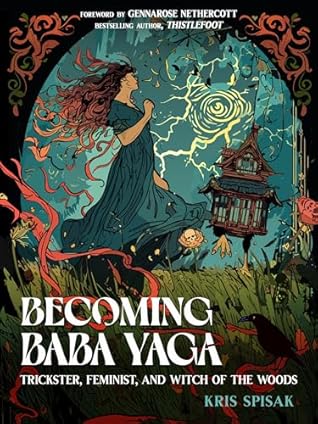
More on this book

Kindle Notes & Highlights

by
Kris Spisak
Read between
September 5 - October 5, 2024

but she has so much to teach us. She's an individual who has harnessed the power of saying no. She takes the idea of being an independent woman to new heights—or new depths, if you consider her stories including holes that plunge into the crevices of the earth. She's also someone who feels wanderlust. She's a tiny house enthusiast, an advocate of herbal remedies, and a woman who is always stronger and more capable than others acknowledge.
The world works in cycles, movements that return again and again. We have been here before, and we will be here in the future.
Annabell Champeaux liked this
In her earliest known written record, Mikhail W. Lomonosov's 1755 Russian Grammar, Baba Yaga was noted in an academically designed table, where gods, goddesses, and other deities of the world were connected with notes on their geography. The ancient Slavic god Perun, for example, was related with the Roman god Jupiter. Yet in this first-known textual documentation, Baba Yaga stood unaccompanied, with no comparisons the world over.
Earlier still, woodblock prints known as lubki, popular in the 1600s and 1700s, are our earliest known confirmed representations of her.
Annabell Champeaux liked this
Baba Yaga was a familiar presence in the lives and memories of Slavic people across the regions of present-day Russia, Ukraine, Poland, Slovakia, Belarus, and beyond.
Annabell Champeaux liked this
“Baba Yaga, the Bony Leg” was the name of the full poem by Nikolay Alexandrovich Nekrasov that first included this devil spit story.
Annabell Champeaux liked this
The devil had never been a part of Baba Yaga's stories in their earliest tellings.
Annabell Champeaux liked this
As Slavic gods, goddesses, and rituals were confronted with a different religion that dared to extricate ancient beliefs and replace them, stories clashed as much as people. The divine feminine was recast as the personification of evil because a patriarchal lens shifted the narrative.
Annabell Champeaux liked this
birds were not the ones who guided souls from one place to the other—for this was Baba Yaga's role—
They were known as the “Mother of Mushrooms” in Baltic mythology and as the source of the earth's creation with the help of a waterbird in Khanty myths.
These mushroom-related tales also build upon myths from western Siberia—both the legacies of wise, elderly female herbalists who practiced in rituals tied to mushrooms as well as the stories of guardian spirits who were half human, half mushroom themselves, who could act as guides to distant realms. Red spotted mushrooms that clumped near birch trees were of particular significance, because birch trees were at times recognized as portals to other worlds for Baba Yaga. This particular fungus was sometime a recognized partner and helper in her movements. The old witch, or wisewoman, or sorceress
...more
