
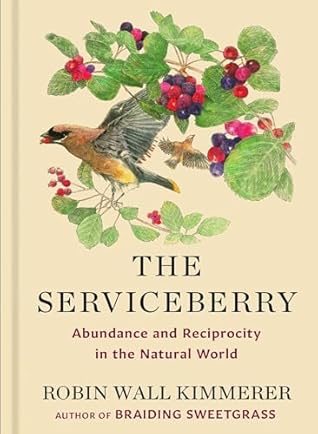
More on this book
Community


Kindle Notes & Highlights

Read between
December 20 - December 31, 2024

Serviceberry is known as a calendar plant, so faithful is it to seasonal weather patterns. Its bloom is a sign that the ground has thawed. In this folklore, this was the time that mountain roads became passable for circuit preachers, who arrived to conduct church services.
Enumerating the gifts you’ve received creates a sense of abundance, the knowing that you already have what you need. Recognizing “enoughness” is a radical act in an economy that is always urging us to consume more.
The juice that bursts from these berries was rain just last week and is already on its way back to the clouds.
Traditional potlatches are gift-giving celebrations, in which possessions are given away with lavish generosity to mark meaningful life events. The ceremonial feasts display the wealth of the givers, enhance their prestige, and affirm connections with a web of relations. The gifts received are likely to be given away at the next ceremony, keeping wealth in motion and cementing mutual bonds. This ritualized redistribution of wealth was banned by colonial governments, under the influence of missionaries in the 1800s. Potlatches were seen as contrary to “the civilized values of accumulation” and
...more
Around here, when late summer heat might bring a new squash every day, finding homes for surplus zukes is no joke. They will grow from cucumber size to baseball bats in a matter of days. People have been known to put them in each other’s mailboxes or surreptitiously place them on the front seat of a parked car.
I learn about active circles of freecycling, repair cafés, donated mugs in the coffee shop replacing disposables, clothing swaps, the Buy Nothing movement, and campus free stores, where dorm room necessities are passed among generations of students without a penny exchanged. They educate each other on the repercussions of their own consumption and waste.
The excess in my life tends to be books, because people are always giving them to me. So, when I turn the last page—or sometimes well before—I might give a book to a friend. You do it, too. That simple act is the atom of a gift economy. No money was exchanged, I have no expectation of compensation in any form. That book was kept from the landfill, and my friend and I have a bond and something to talk about; the act of giving opened a channel of reciprocity.
This Little Free Library movement has spread all over the country to share a love of reading and to bring books to everyone, in a gift economy. That is an incremental step beyond sharing a book with a friend to sharing with your neighborhood.
Libraries are models of gift economies, providing free access not only to books but also music, tools, seeds, and more. We don’t each have to own everything. The books at the library belong to everyone, serving the public with free books (and a wider selection than the corner post!). Take the books, enjoy them, bring them back so someone else can enjoy them, with literary abundance for all. And all you need is a library card, which is a kind of agreement to respect and take care of the common good.
