
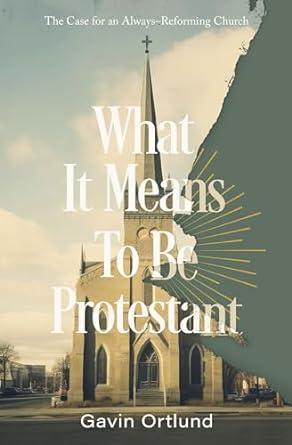
More on this book
Community


Kindle Notes & Highlights

Read between
January 3 - February 22, 2025

The whole appeal of their Eucharistic theology was a return to catholicity, against the changes introduced by the substance-accidents distinction in the medieval development.
The approach I seek in this book and in my YouTube ministry is to encourage candid and robust argumentation about our differences, downplaying or minimizing nothing, while at the same time seeking to maintain a conciliatory relationship.
These differences are important. They matter profoundly—to the gospel, to the church, and to our mission in this world. We must not and cannot shrug them off as irrelevant or avoid them out of a desire to maintain a superficial “unity.” We should pray for unity, to be sure, but never at the cost of glossing over important differences concerning the truth.
Yet critics of Protestantism sometimes allege that there is no such thing as mere Protestantism, since Protestants (it is claimed) agree on nothing except their criticisms of other traditions. Related to this, some fault Protestantism for having a merely negative identity—for being constituted only by what it is against, not what it is for.
effective reformation had to be careful to honor the good in what is being reformed, lest it go too far.
Those traditions are bound to their magisterial pronouncements (and anathemas); thus, only Protestantism even has a shot at catholicity.
Suppose there is a married couple who, after decades of marriage, while the husband and wife are both around sixty, get a divorce. In the following years, both sides are diminished. The wife’s house starts to fall apart slowly. The bushes in the front yard are poking way out into the sidewalk, the air conditioning filters have not been cleaned or replaced in many years, various appliances break down and don’t get fixed, and so forth. Also, her finances are in bad shape. She has no savings. The husband, by contrast, is socially awkward. He is a bad dresser. He has no idea how to get gifts for
...more
This highlight has been truncated due to consecutive passage length restrictions.
If both Protestant and Catholic sides have been diminished from a sixteenth-century division, which side should we join today? Part of the answer results, of course, from which side we think was initially more to blame. But that is not all that is important! The other part of the answer will concern which side we think is best positioned to move forward, to make progress, to seek to heal divisions—or, short of that, to live most peaceably and fruitfully amid divisions.
Protestantism was not consummated in the sixteenth century. It remains incomplete. As he puts it, “The present state of Protestantism is interimistic.”15 In other words, Protestantism does not entail that since the Reformation happened, all is well. On the contrary, the whole idea is continual reform.
sola fide is the “what” of the Reformation; sola Scriptura, the “how.” The first is an object, the second a method. The first is a precious jewel; the second, the safe that protects it.
Roman Catholic position defined at Trent, by placing Scripture and tradition in theoretically parallel placement, and taking unto herself the role of interpretation, has had the overall practical effect of placing the church over Scripture:
By making herself the final arbiter of Scripture and tradition, the Church of Rome not only blocked communion with any and all Christian traditions dissenting from her pronouncements, but also removed the possibility of any meaningful internal reform of her own prior magisterial teaching.
Here we note the Reformers’ recognition of the true church outside of Protestantism even in their own day. Martin Luther, for example, commenting in the 1530s on Paul’s characterization of the Galatian churches as true churches (Gal. 1:2) despite their compromise of the gospel (Gal. 1:6), drew a comparison with the Church of Rome. On the one hand, the Church of Rome was “worse than Sodom and Gomorrah” because of her doctrinal and spiritual corruption. On the other hand, Luther stipulated that “today we still call the Church of Rome holy and all its sees holy, even though they have been
...more
Strikingly, both Calvin and Luther rejected the Roman Catholic claim that the “Greek Church” (as Calvin and Luther called it) had lapsed from the faith and was damned.
Nonetheless, none of the major historical Protestant traditions have claimed to be the only church or the only true church.
Nor are contemporary Protestants compromising in acknowledging true Christians and true churches outside of Protestantism. This is because Protestantism does not restrict the church to one institution.
Essentially, the historic Eastern Orthodox position is that perceived Western innovations such as the filioque are heresy and that heresy places you outside the canonical boundaries of the Orthodox Church. To be outside the church is to be cut off from the grace of the Holy Spirit given in the sacraments and therefore cut off from salvation.
Orthodox ecclesiologists taught that the church is ontologically one such that there are no schisms in the church, only schisms from her.
changes in the “no salvation outside the church” doctrine raise a practical concern about the actual value of an allegedly infallible magisterium. For example, we are often told we need an infallible magisterium to interpret the Bible, but much less appreciated are the intractable problems of interpreting the magisterium itself. Is such an entity really the solution to division and confusion if nearly everyone can misunderstand it for six hundred years? How do we know that current universal understanding of magisterial teaching won’t be similarly overturned in another six hundred years?
John’s rationale for attempting to stop him concerned not the exorcist’s orientation to Christ but his orientation to the disciples: “He was not following us.”
In Roman Catholic theology, an indulgence is the remission of the temporal punishment for sin, given in certain conditions by the Church to Christians.
What must be appreciated is how common it was for indulgences to fund simony (the buying or selling of ecclesiastical privileges), as well as other clerical abuses.
In the early church, various forms of penance developed for dealing with those who had sinned in a particularly serious way (and for those who had renounced the faith under persecution). Standards for readmittance were rigorous. For example, the canons at the Synod of Ancyra in 314 stipulate that someone could be a penitent for twenty or thirty years; in some cases (as with willful murder) they could be readmitted to communion only at the end of their life.10
Nonetheless, late medieval abuses—both financial and physical—help explain why renewal in the church could come only in the form of protest.
From this it is evident how indulgences had commonly come to function as a substitute for repentance.
In my online ministry I encounter people over and over who are drowning in anxiety about their spiritual status before God. My heart aches for them to know the peace and comfort that Parr describes here!
The thief on the cross is paradigmatic, not exceptional.
Part of the progress has resulted from greater clarity that we are using terminology differently. If we don’t understand these differences, it is like an American and Brit arguing whether “football” is the greatest sport, without realizing they are using the same word to refer to different realities.
Protestants distinguish between justification and sanctification, they also insist that they are inseparable.
through union with Christ we receive both justification and sanctification, and these distinct acts must never be confused or separated.”
good works are necessary for salvation as the fruit of a true saving faith.
As Calvin put it, “It is therefore faith alone which justifies, and yet the faith which justifies is not alone: just as it is the heat alone of the sun which warms the earth, and yet in the sun it is not alone, because it is constantly conjoined with light.”10
Protestants have insisted that the formal cause of justification—that is, the intrinsic component of our justification that it essentially consists of—must be identified as the imputed righteousness of Christ, as opposed to infused or inherent righteousness wrought within us. Simply put, our legal standing before God is not ultimately based on anything within us, but on the external, alien, perfect righteousness of Jesus Christ.
What is the role of baptism, penance, and indulgences with respect to justification? On what basis are we accepted as righteous in God’s sight after our initial justification? What about purgatory, after this life is over? These kinds of differences are far from trivial. In Roman Catholic theology, for example, if you commit a mortal sin and die prior to confession, you go to hell. Not just purgatory; hell.
As J. I. Packer emphasizes, we are not justified by our theology of justification, but by genuine trust in Christ and his saving work, which both sides affirm.
And we can rejoice in the progress that has been made, which is considerable. We should also remain open and eager for further progress. At the same time, sober honesty requires us to acknowledge that the remaining differences about justification—especially as they play out concerning assurance of salvation—are poignant, unavoidable, and possibly irresolvable.
Many more such passages could be adduced in John Chrysostom and in other church fathers.22 At the same time, one can find in the early and medieval church many accounts of justification that speak of justification as a process and particularly emphasize the role of works in the process. The pre-Reformation church did not speak with one voice about justification. Thus, both Roman Catholic and Protestant positions can find precedent in the pre-Reformation church.
When the reformers attacked this notion in the name of the doctrine of justification by faith alone—a doctrine also attested to by some medieval theologians and ancient fathers—Rome reacted by canonizing one trend in preference to all the others. What had previously been permitted also (justification by faith alone), now became forbidden. In condemning the Protestant Reformation, the Council of Trent condemned part of its own catholic tradition.23
This is the single greatest contribution of Protestantism to the Christian church: its insight into the gracious heart of God revealed in the gospel, by which God offers to us as a free gift the righteousness we cannot attain through our own efforts.
The core idea is that Scripture is the church’s only infallible rule.
So sola Scriptura is essentially the claim that Scripture is the only authority standing over the church that is incapable of error.
The dispute is over whether Scripture alone is infallible. In other words, the fault line of difference between sola Scriptura and alternative positions is this: Does the church possess any rule other than Scripture that is infallible?
Anthony Lane puts it, “Sola Scriptura is the statement that the church can err.”3
sola Scriptura is often caricatured as the idea that the Bible is the only authority. The error here is confusing the categories of infallibility and authority.
So again, sola Scriptura means Scripture is the only infallible rule, not the only authority in the church, nor the explicit source for all doctrine. Put otherwise: Scripture is the only yardstick that cannot err, not the only norm to which you submit or the location in which you find all truth.
In Roman Catholic theology, Sacred Scripture and Sacred Tradition together constitute the Word of God, but in different ways—Sacred Tradition is not inspired by the Holy Spirit in the way Scripture is.16 Similarly, while the magisterium is entrusted with the role of interpreting the deposit of faith contained in both Scripture and Tradition, the charism of infallibility extended to the church in that capacity is distinguished from divine revelation.17 Thus, when a pope speaks ex cathedra, his words are not the words of God. When an ecumenical council delivers a verdict, its words are not the
...more
The alternative positions, such as those of Roman Catholicism and Eastern Orthodoxy, separate infallibility from inspiration. Those positions have the burden to show why another rule of faith that is not the inspired Word of God should nonetheless be accepted as equal to Scripture with respect to infallibility.
An important example is Jesus placing Scripture over tradition in Matthew 15 and Mark 7.
When this passage is brought into debates, opponents of sola Scriptura will frequently argue it concerns only the “traditions of men,” not divine traditions.20 But here a dilemma emerges: How would anyone at the time have known that they are the traditions of men?
Jesus himself affirmed that the Pharisees had a legitimate, God-given authority to teach God’s people. Since they sit on the seat of Moses, Jesus commanded, “Do and observe whatever they tell you” (Matt. 23:3). The Pharisees themselves most emphatically did not regard their traditions as merely human! On the contrary, they affirmed an oral law from Moses handed down...
This highlight has been truncated due to consecutive passage length restrictions.
