
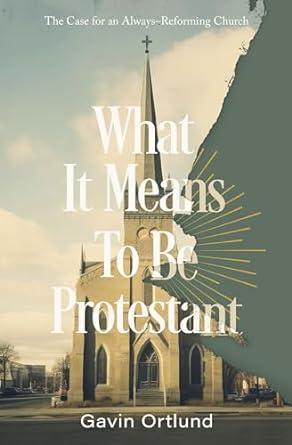
More on this book
Community


Kindle Notes & Highlights

Read between
January 23 - February 8, 2025

Schaff was particularly burdened by the sectarian spirit he detected within American Protestantism. He spent many pages railing against what he called the two primary “diseases” of Protestantism: rationalism and sectarianism.
effective reformation had to be careful to honor the good in what is being reformed, lest it go too far.
Protestantism does not entail that since the Reformation happened, all is well. On the contrary, the whole idea is continual reform.
Imbedded at the very heart of Protestantism lay an instinct toward revitalization and catholicity.
none of the major historical Protestant traditions have claimed to be the only church or the only true church.
What distinguishes the Protestant view of the church is not a denial of the visible church but rather the claim that this visible church coheres within multiple institutions.
Protestantism has a superior orientation toward catholicity than its rivals because it lacks their institutional exclusivism.
But Satan cannot produce virtues. He is incapable of producing joy, peace, goodness, kindness, love for Christ, love for God, love for the Holy Spirit, love for the Scripture, love for truth. Only Christ produces these things. Therefore, such fruit testifies to the genuine work of Christ.
exorcisms generally constitute positive spiritual fruit that reveal the genuine advance of God’s kingdom.
Our Savior commands us to regard those who do mighty works in his name as for us, not against us. This is an exclusivism, but it is a radically Christocentric exclusivism. It is not an institutional exclusivism or an exclusivism based on human distinction or pride.
Sola fide must be understood in historical context. Protestantism was a renewal of the gospel not in recovering a bare doctrinal formula or slogan, but in upturning and opposing the legalism, superstition, and financial abuse of the laity that sadly characterized much of European spirituality in the late medieval era.
The Protestants Reformers, far from being original dissenters, were the inheritors of a long and bloody tradition of protest.
Gentle. Gracious. Pleasant. Sweet. Encouraged. Emboldened. Assured. Comfort. Assurance. These are the words employed by a heart that has been touched by the gospel!
This is the single greatest contribution of Protestantism to the Christian church: its insight into the gracious heart of God revealed in the gospel, by which God offers to us as a free gift the righteousness we cannot attain through our own efforts.
As Anthony Lane puts it, “Sola Scriptura is the statement that the church can err.”
The recognition of real (though fallible) ecclesial authority is a consistent affirmation of historic Protestantism.
sola Scriptura means Scripture is the only infallible rule, not the only authority in the church, nor the explicit source for all doctrine.
It is enough to know that Scripture is the inspired Word of God and oral traditions are not. For this reason, it is only reasonable to measure oral traditions against the inspired Word of God
This error—the usurping of divine authority—is not unique to the Pharisees. It will be a perennial temptation for any group that has historical ties to a genuine work of God. Thus, it is good and appropriate to test claims of divine authority that are uncertain by those that are certain.
At the end of the day, there is simply no good biblical or historical reason to conclude that the post-apostolic church possesses ongoing capacities of infallibility. This does not mean the church died or fell away from God. It simply means the church can err and therefore must continually measure her doctrine and practice by the infallible words of Holy Scripture.
Make the inspired Word of God your ultimate hope and trust. It will never fail you, to all eternity.
part of the implicit goal of this book is to retrieve this more catholic and historical way of envisioning Protestantism.
To any sane historical evaluation, it is overwhelmingly probable that neither the assumption of Mary nor the veneration of images were known to the apostles—or any Christian within several centuries of their lifetimes.
It is clear that idolatry is not the kind of sin that one simply needs to be informed of on one occasion; rather, it appears to be a subtle, constantly encroaching danger.
Protestantism represents the best available pathway to catholicity—not because it does not set boundaries to what the church is, but because those boundaries are not determined institutionally. By defining the church as wherever Christ is present in word and sacrament, Protestantism enables us to recognize true Christians and true churches within multiple institutional expressions of the church. This is not only the more generous position to adopt toward other Christians today, it is also the one that is most faithful to the New Testament’s witness for how we discern Christ’s presence and
...more
if you are going to be a Christian of some kind or another, it makes the most sense to be a Protestant.
