
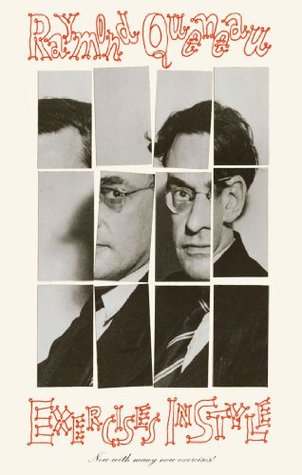
More on this book

Kindle Notes & Highlights


“Oh yes, you know, it’s the story of a chap who gets into a bus and starts a row with another chap who he thinks keeps treading on his toes on purpose, and Queneau repeats the same story 99 times in a different ways—it’s terribly good . . .”
According to the current way of thinking (or not-thinking), it seems that if we are to enjoy anything then we must not have to think about it, and, conversely, if we are to think about anything, then we mustn’t enjoy it. This is a calamitous and idiotic division of functions.
I have analysed the 99 variations into roughly 7 different groups. The first—different types of speech. Next, different types of written prose. These include the style of a publisher’s blurb, of an official letter, the “philosophic” style, and so on. Then there are 5 different poetry styles, and 8 exercises which are character sketches through language—reactionary, biased, abusive, etc. Fifthly there is a large group which experiments with different grammatical and rhetorical forms; sixthly, those which come more or less under the heading of jargon, and lastly, all sorts of odds and ends whose
...more
His purpose here, in the Exercices, is, I think, a profound exploration into the possibilities of language. It is an experiment in the philosophy of language. He pushes language around in a multiplicity of directions to see what will happen.
my intention was merely to produce some exercises; the finished product may possibly act as a kind of rust-remover to literature, help to rid it of some of its scabs.
Queneau’s tour-de-force lies in the fact that the simplicity and banality of the material he starts from gives birth to so much.
Perhaps the book is an exercise in communication patterns, whatever their linguistic sounds.
