
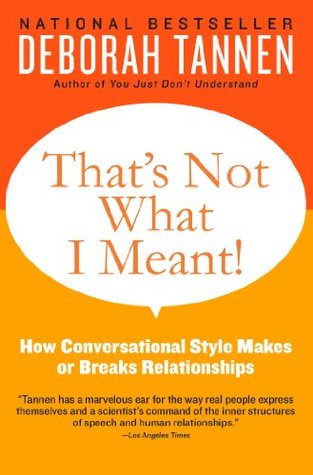
More on this book
Community


Kindle Notes & Highlights
Read between
December 17 - December 18, 2014

guess “Okay” didn’t sound to me like an answer to my question;

oh I've been here - drives my husband batty
People prefer not to say exactly what they mean in so many words because they’re not concerned only with the ideas they’re expressing; they’re also—even more—concerned with the effect their words will have on those they’re talking to. They want to make sure to maintain camaraderie, to avoid imposing, and to give (or at least appear to give) the other person some choice in the matter being discussed. And different people have different ways of honoring these potentially conflicting goals.
And even when you are careful with your words, stating what you want, because of this people don't take you at your word - even after explaining you don't play the hinting game - frustrating as all get out to have these same fights LOL
But the most important thing is to be aware that misunderstandings can arise, and with them tempers, when no one is crazy and no one is mean and no one is intentionally dishonest. We can learn to stop and remind ourselves that others may not mean what we heard them say.
Information conveyed by the meanings of words is the message. What is communicated about relationships—attitudes toward each other, the occasion, and what we are saying—is the metamessage. And it’s metamessages that we react to most strongly.
Whereas words convey information, how we speak those words—how loud, how fast, with what intonation and emphasis—communicates what we think we’re doing when we speak: teasing, flirting, explaining, or chastising; whether we’re feeling friendly, angry, or quizzical; whether we want to get closer or back off. In other words, how we say what we say communicates social meanings.
yep
It’s important to remember that others’ ways of talking to you are partly a reaction to your style, just as your style with them is partly a reaction to their style—with you.
something i need to remember
“You said so.” “I said no such thing!” “You did! I heard you!” “Don’t tell me what I said.” In fact, both parties may be sincere—and both may be right. He recalls what he meant, and she recalls what she heard. But what he intended was not what she understood—which was what she would have meant if she had said what he said in the way he said it.
something else i nedd to keep in mind
Our power to communicate so much by so few words inevitably entails the danger of miscommunication.
Communication is a continuous stream in which everything is simultaneously a reaction and an instigation, an instigation and a reaction.
“If you, to whom I have shown my realest self, don’t like what you see, then my real self must be pretty awful.”
long-term relationships, you start from a position of closeness and are on the lookout for signs that the other person wants to get farther away. By the same process of magnification, you are likely to find what you’re looking for.
The closer you are to someone, and the longer you have been close, the more you have to lose when you open your mouth.
Notice that the difference in how women and men use listening noises is in keeping with their focus in communication.
But if you know about differences in conversational style, you can accept that there are differences in habits and assumptions about how to have conversation, show interest, be considerate, and so on. You may not always correctly interpret your partner’s intentions, but you will know that if you get a negative impression, it may not be what was intended—and neither are your responses unfounded.
Many women (and some men) criticize their partners for using incorrect grammar, and many men (and some women) criticize their partners for not using words precisely, though in both cases this may simply mean using expressions as they are commonly used.
But closeness is blinding in a different way. Intimacy can lead us to see more faults than are really there and make them seem larger than they really are.
This is the idea that language shapes thought. We tend to think in the terms and related concepts our language gives us. It is easier to conceive of something if we have a word for it; we instinctively feel that something for which there is a word really exists. Anything for which there is no word seems somehow to lack substance. In this way, knowing the terms “frame,” “metamessage,” and “conversational style” makes it easier not only to talk about but also to think about how ways of talking shape communication.
