
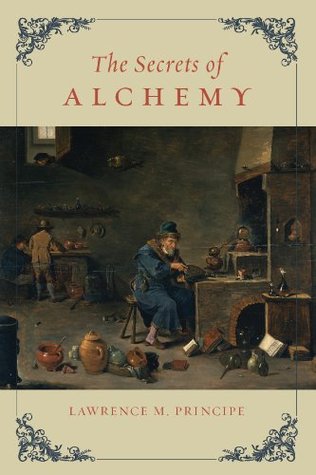
More on this book

Kindle Notes & Highlights


The sixteenth-century Swiss alchemist Theophrastus von Hohenheim, better known as Paracelsus, recently found new life as “Hohenheim of Light” in the Japanese manga and anime series Fullmetal Alchemist, which makes copious if highly sensationalized use of alchemical concepts.
In Egypt, artisans had devised an array of processes for making and working glass, producing artificial gems, compounding cosmetics, and creating many other commercial products in what might be called an ancient chemical industry.
Zosimos is thought to have written twenty-eight books about alchemy; alas, most of what he wrote is now lost. We have only scraps:
Consider first the ratio he gives for the four Galenic degrees of intensity, 1:3:5:8. Where does it come from? The four numbers add up to seventeen. For Jābir, seventeen is the fundamental number for the world—his equivalent, if you will, of what the speed of light or Planck’s constant means for us. He did not pick this number out of a hat. This number recurs throughout the ancient Mediterranean world, beginning with the Pythagoreans, a secretive group founded in the sixth century BC, for whom mathematics was key not only to the material world but to philosophy, religion, and life.
Significantly, it was at this same time—the first decades of the eighteenth century—that the words alchemy and chemistry took on new and more restricted meanings. Previously, the two words had coexisted and remained largely interchangeable. Even when some distinction in their usage from that period is detectable, it is not consistent and only rarely the one automatically made today. For example, Andreas Libavius’s famous 1597 book, titled simply Alchemia, describes how to perform chemical operations, use laboratory equipment, and make an array of chemical preparations—in short, what we would
...more
many historians of science have adopted the practice of using the archaic spelling chymistry to refer to the whole range of practices that nowadays would be classed under chemistry and alchemy.
“Alchemy” became the scapegoat for chymistry’s sins, driven from the respectable quarters where a newly purified chemistry could now reside.
This conflation is clear in the title of a massive seven-volume collection put forth by Johann Christoph Adelung in the 1780s: The History of Human Foolishness; or, Biographies of Renowned Black Magicians, Alchemists, Devil-Conjurers, Expounders of Signs and Figures, Fanatics, Fortunetellers, and other Philosophical Monstrosities.
In the 1970s, Regardie attempted to add the material aspects of alchemy to his synthesis by carrying out practical laboratory alchemy himself, with the result that he permanently damaged his lungs due to poor ventilation of the fumes produced.
Why mercury should be the lone survivor of the planetary nomenclature of metals remains an open question, although the centrality of this anomalous liquid metal to so many chymical theories may be part of the answer.
It was probably while trying to make the Philosophers’ Stone that Hennig Brand discovered the element phosphorus in the 1660s by strongly distilling residues from human urine.
The battle in France came to an end only after 1658, when Louis XIV, having fallen ill during a military campaign and not responding to traditional treatments by the royal physicians, was cured by a vomit induced with a dose of antimony administered in wine by a local physician. The Parisian medical faculty, the corporate body which had previously condemned the use of antimony, then had little recourse but to vote in favor of legalizing the use of this Paracelsian vin émetique.
News of transmutations performed in Berlin in 1701 by an apothecary’s apprentice named Johann Friedrich Böttger (1682–1719) not only drew the mathematician and philosopher Gottfried Wilhelm Leibniz (1646–1716) to the scene but also led to Böttger’s arrest by soldiers of Duke August the Strong of Saxony. Böttger spent the rest of his life in confinement, where, although he did not satisfy August’s demands to make gold, he did help discover the secret to making porcelain, a commercial product that proved nearly as lucrative.
Under the usual understanding of contractual obligations—at least in the German lands, where most such contracts were made—this failure was considered Betrügerei, a word usually translated as “fraud.” But these practitioners were not necessarily dishonest. This category of crime referred generally to promising anything that could not be delivered—in short, defrauding the ruler—and such a crime was punishable by death. The execution of failed chymists is a predominantly German phenomenon; we have but few records of such executions in France or England.
Thus, an analogical likeness was not the product of a poetical human mind but a line in the blueprint of creation.
