
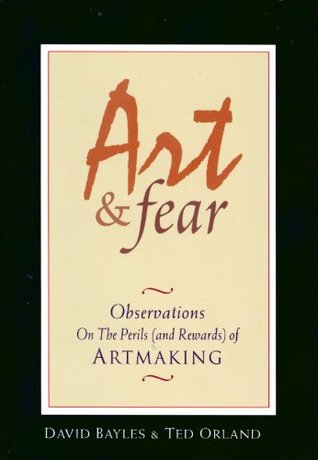
More on this book
Community


Kindle Notes & Highlights
by
David Bayles
Read between
January 19 - February 4, 2021

FEW ASSUMPTIONS ARTMAKING INVOLVES SKILLS THAT CAN BE LEARNED. The conventional wisdom here is that while “craft” can be taught, “art” remains a magical gift bestowed only by the gods. Not so. In large measure becoming an artist consists of learning to accept yourself, which makes your work personal, and in following your own voice, which makes your work distinctive.
ART IS MADE BY ORDINARY PEOPLE. Creatures having only virtues can hardly be imagined making art. It’s difficult to picture the Virgin Mary painting landscapes. Or Batman throwing pots. The flawless creature wouldn’t need to make art. And so, ironically, the ideal artist is scarcely a theoretical figure at all. If art is made by ordinary people, then you’d have to allow that the ideal artist would be an ordinary person too, with the whole usual mixed bag of traits that real human beings possess.
Making art provides uncomfortably accurate feedback about the gap that inevitably exists between what you intended to do, and what you did. In fact, if artmaking did not tell you (the maker) so enormously much about yourself, then making art that matters to you would be impossible. To all viewers but yourself, what matters is the product: the finished artwork. To you, and you alone, what matters is the process: the experience of shaping that artwork.
The point is that you learn how to make your work by making your work, and a great many of the pieces you make along the way will never stand out as finished art. The best you can do is make art you care about — and lots of it!
“Artist” has gradually become a form of identity which (as every artist knows) often carries with it as many drawbacks as benefits. Consider that if artist equals self, then when (inevitably) you make flawed art, you are a flawed person, and when (worse yet) you make no art, you are no person at all! It seems far healthier to sidestep that vicious spiral by accepting many paths to successful artmaking — from reclusive to flamboyant, intuitive to intellectual, folk art to fine art. One of those paths is yours.
Fear that your next work will fail is a normal, recurring and generally healthy part of the artmaking cycle.
Quitting is fundamentally different from stopping. The latter happens all the time. Quitting happens once. Quitting means not starting again — and art is all about starting again.
Make friends with others who make art, and share your in-progress work with each other frequently. b. Learn to think of [A], rather than the Museum of Modern Art, as the destination of your work. (Look at it this way: If all goes well, MOMA will eventually come to you.)
your desire to make art — beautiful or meaningful or emotive art — is integral to your sense of who you are. Life and Art, once entwined, can quickly become inseparable; at age ninety Frank Lloyd Wright was still designing, Imogen Cunning-ham still photographing, Stravinsky still composing, Picasso still painting.
But if making art gives substance to your sense of self, the corresponding fear is that you’re not up to the task — that you can’t do it, or can’t do it well, or can’t do it again; or that you’re not a real artist, or not a good artist, or have no talent, or have nothing to say. The line between the artist and his / her work is a fine one at best, and for the artist it feels (quite naturally) like there is no such line. Making art can feel dangerous and revealing. Making art is dangerous and revealing.
Doubts, in fact, soon rise in swarms: I’m not an artist - I’m a phony I have nothing worth saying I’m not sure what I’m doing Other people are better than I am I’m only a [student/physicist/mother/whatever] I’ve never had a real exhibit No one understands my work No one likes my work I’m no good Yet viewed objectively, these fears obviously have less to do with art than they do with the artist. And even less to do with individual artworks.
As Stanley Kunitz once commented, “The poem in the head is always perfect. Resistance begins when you try to convert it into language.”
Your materials are, in fact, one of the few elements of artmaking you can reasonably hope to control. As for everything else — well, conditions are never perfect, sufficient knowledge rarely at hand, key evidence always missing, and support notoriously fickle. All that you do will inevitably be flavored with uncertainty — uncertainty about what you have to say, about whether the materials are right, about whether the piece should be long or short, indeed about whether you’ll ever be satisfied with anything you make.
Simply put, making art is chancy — it doesn’t mix well with predictability. Uncertainty is the essential, inevitable and all-pervasive companion to your desire to make art. And tolerance for uncertainty is the prerequisite to succeeding.
You make good work by (among other things) making lots of work that isn’t very good, and gradually weeding out the parts that aren’t
good, the parts that aren’t yours. It’s called feedback, and it’s the most direct route to learning about your own vision. It’s also called doing your work. After all, someone has to do your work, and you’re the closest person around.
Indeed, it seems vastly more plausible to advance the counter-principle, namely that imperfection is not only a common ingredient in art, but very likely an essential ingredient. Ansel Adams, never one to mistake precision for perfection, often recalled the old adage that “the perfect is the enemy of the good”, his point being that if he waited for everything in the scene to be exactly right, he’d probably never make a photograph.

Perfect is the enemy of the good! And case of ceramics class divided into quality and quantity, both from this book!
Put simply, your work is your guide: a complete, comprehensive, limitless reference book on your work. There is no other such book, and it is yours alone. It functions this way for no one else. Your fingerprints are all over your work, and you alone know how they got there. Your work tells you about your working methods, your discipline, your strengths and weaknesses, your habitual gestures, your willingness to embrace. The lessons you are meant to learn are in your work. To see them, you need only look at the work clearly — without judgement, without need or fear, without wishes or hopes.
...more
Recently, out of pleasure alone, an accomplished visual artist took up dance. Never before experiencing an artform so purely physical, she threw herself into it. Her involvement became intense: more classes, more practice, more commitment, longer hours. She excelled. Then one day several months into it, her instructor asked her to consider joining a performing troupe. She froze. Her dancing fell apart. She became stiff and self-conscious. She got serious, or serious in a different way. She didn’t feel she was good enough, and her dancing promptly was not good enough. She got frustrated and
...more
The e-myth, cupcakes and coffee shops you enjoy as a patron and not 24/7
Your reach as a viewer is vastly greater than your reach as a maker. The art you can experience may have originated a thousand miles away or a thousand years ago, but the art you can make is irrevocably bound to the times and places of your life. Limited by the very ground on which you stand.
If, indeed, for any given time only a certain sort of work resonates with life, then that is the work you need to be doing in that moment. If you try to do some other work, you will miss your moment. Indeed, our own work is so inextricably tied to time and place that we cannot recapture even our own aesthetic ground of past times. Try, if you can, to reoccupy your own aesthetic space of a few years back, or even a few months. There is no way. You can only plunge ahead, even when that carries with it the bittersweet realization that you have already done your very best work.
If you’re like most artists we know, you’re probably accustomed to watching your work unfold smoothly enough for long stretches of time, until one day — for no immediately apparent reason — it doesn’t. Hitting that unexpected rift is commonplace to the point of cliche, yet artists commonly treat each recurring instance as somber evidence of their own personal failure. Nominees for Leading Role in a Continuing Artists’ Funk are: (1) you’ve entirely run out of new ideas forever, or (2) you’ve been following a worthless deadend path the whole time. And the winner is: (fortunately) neither.
That’s also to say that usually — but not always — the piece you produce tomorrow will be shaped, purely and simply, by the tools you hold in your hand today. In that sense the history of art is also the history of technology. The frescoes of pre-Renaissance Italy, the tempera paintings of Flanders, the plein aire oils of southern France, the acrylics of New York City — each successive technology imparted characteristic color and saturation, brushstroke and texture, sensuality or formality to the art piece. Simply put, certain tools make certain results possible.
The hardest part of artmaking is living your life in such a way that your work gets done, over and over — and that means, among other things, finding a host of practices that are just plain useful. A piece of art is the surface expression of a life lived within productive patterns. Over time, the life of a productive artist becomes filled with useful conventions and practical methods, so that a string of finished pieces continues to appear at the surface. And in truly happy moments those artistic gestures move beyond simple procedure, and acquire an inherent aesthetic all their own. They are
...more
It goes without saying that censorship is debilitating to the artist. It’s a little less obvious (at least to artists) that censorship is an entirely natural state of affairs. Nature places a simple constraint on those who leave the flock to go their own way: they get eaten. In society it’s a bit more complicated. Nonetheless the admonition stands: avoiding the unknown has considerable survival value. Society, nature and artmaking tend to produce guarded creatures. The dilemma here is that for the artist, contact with subject and materials must always remain unguarded. In making art you court
...more
Each new piece of your art enlarges our reality. The world is not yet done.
the tricky part is finding the right yardstick for measuring your accomplishments. What makes competition in the arts a slippery issue is simply that there’s rarely any consensus about what your best work is.
The art critic faces a more vexing dilemma: in a nutshell, he cannot explain the finished art piece from looking at the artist, and he cannot explain the artist by viewing the finished art piece. And so art is treated like some foreign object, analyzed from afar for its relationship to politics and culture and history and (incestuously) to other art movements.
The answers you get depend upon the questions you ask. — Thomas Kuhn
The underlying problem with this is not that the pursuit of technical excellence is wrong, exactly, but simply that making it the primary goal puts the cart before the horse. We do not long remember those artists who followed the rules more diligently than anyone else. We remember those who made the art from which the “rules” inevitably follow.
But while mastering technique is difficult and time-consuming, it’s still inherently easier to reach an already defined goal — a “right answer” — than to give form to a new idea.
In essence, art lies embedded in the conceptual leap between pieces, not in the pieces themselves. And simply put, there’s a greater conceptual jump from one work of art to the next than from one work of craft to the next. The net result is that art is less polished — but more innovative — than craft. The differences between five Steinway grand pianos — demonstrably works of consummate craftsmanship — are small compared to the differences between the five Beethoven Piano concerti you might perform on those instruments.
A work of craft is typically made to fit a specific template, sometimes a painstakingly difficult template requiring years of hands-on apprenticeship to master. It’s staggering to realize that nearly all the truly great violins ever produced were made in the course of a few years by a few artisans living within a few blocks of each other. All this in a remote Italian village, three centuries ago. The accomplishments of Antonio Stradivari and his fellow craftsmen point up one real difference between art and craft: with craft, perfection is possible. In that sense the Western definition of craft
...more
To see things is to enhance your sense of wonder both for the singular pattern of your own experience, and for the meta-patterns that shape all experience. All this suggests a useful working approach to making art: notice the objects you notice.
Many people first respond deeply to art — indeed, respond deeply to the world — upon finding works of art that seem to speak directly to them. Small surprise, then, if upon setting out to make art themselves, they begin by emulating the art or artist that brought this revelation. Beethoven’s early compositions, for instance, show the unmistakable influence of his teacher, Franz Joseph Haydn. Most early work, in fact, only hints at the themes and gestures that will — if the potential isn’t squandered — emerge as the artist’s characteristic signature in later, mature work. At the outset,
...more
What is natural and what is beautiful are, in their purest state, indistinguishable. Could you improve upon the Circle? In the day-to-day world, however, improving the circle is different from, say, improving the wheel. Science advances at the rate that technology provides tools of greater precision, while art advances at the pace that evolution provides minds with greater insight — a pace that is, for better or worse, glacially slow. Thus while the stone tools fashioned by cave dwellers an Ice Age ago are hopelessly primitive by current technological standards, their wall paintings remain as
...more
“The main thing to keep in mind,” as Douglas Hofstadter noted, “is that science is about classes of events, not particular instances.” Art is just the opposite. Art deals in any one particular rock, with its welcome vagaries, its peculiarities of shape, its unevenness, its noise. The truths of life as we experience them — and as art expresses them — include random and distracting influences as essential parts of their nature. Theoretical rocks are the province of science; particular rocks are the province of art.
This sense of interior stability is consistent with one widely observable truth: the arc to any individual life is uniform over long periods of time. Subjects that draw us in will continue to draw us in. Patterns we respond to we will continue to respond to. We are compelled by forces that, like the ocean current, are so subtle and pervasive we take them utterly for granted. Those odd moments when we notice the sea we swim in leave us as surprised as the discovery by Moliere’s character that he was speaking prose, that indeed he had always spoken prose.
In the end it all comes down to this: you have a choice (or more accurately a rolling tangle of choices) between giving your work your best shot and risking that it will not make you happy, or not giving it your best shot — and thereby guaranteeing that it will not make you happy. It becomes a choice between certainty and uncertainty. And curiously, uncertainty is the comforting choice.
