
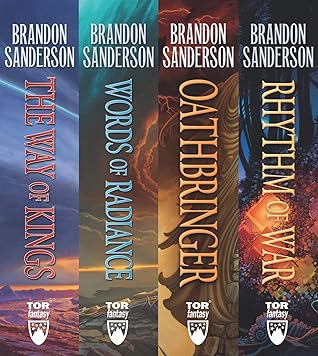
More on this book
Community


Kindle Notes & Highlights

Read between
September 8 - November 30, 2024

“The purpose of a storyteller is not to tell you how to think, but to give you questions to think upon. Too often, we forget that.”
“Hush,” she said. “I’m talking.” “Sorry.”
‘Honor’ is a word applied to the actions of men from the past who have had their lives scrubbed clean by historians.”
“Have you ever considered, bridgeman, that bad art does more for the world than good art? Artists spend more of their lives making bad practice pieces than they do masterworks, particularly at the start. And even when an artist becomes a master, some pieces don’t work out. Still others are somehow just wrong until the last stroke. “You learn more from bad art than you do from good art, as your mistakes are more important than your successes. Plus, good art usually evokes the same emotions in people—most good art is the same kind of good. But bad pieces can each be bad in their own unique way.
...more
“Yes, yes. Aim for the sun. That way if you miss, at least your arrow will fall far away, and the person it kills will likely be someone you don’t know.”
The longer you live, the more you fail. Failure is the mark of a life well lived. In turn, the only way to live without failure is to be of no use to anyone. Trust me, I’ve practiced.”
You can. Find the balance. Accept the pain, but don’t accept that you deserved it.”
The most important step a man can take. It’s not the first one, is it? It’s the next one. Always the next step, Dalinar.
“Journey before destination,” Dalinar said. “It cannot be a journey if it doesn’t have a beginning.”
She pulled him tight. “Maybe you don’t have to save anyone, Kaladin. Maybe it’s time for someone to save you.”
“I will protect those I hate. Even … even if the one I hate most … is … myself.”
Dalinar rubbed his chin. Most words in the script were the same as the ones from spoken conversation, but small additions—that you wouldn’t read out loud—changed the context. And that didn’t even count the undertext—the writer’s hidden commentary. Navani had explained, with some embarrassment, that that was never read to a man requesting a reading. We took Shardblades from the women, he thought, glancing at the one hung on the wall above his desk. And they seized literacy from us. Who got the better deal, I wonder?
The ancient code of the Knights Radiant says “journey before destination.” Some may call it a simple platitude, but it is far more. A journey will have pain and failure. It is not only the steps forward that we must accept. It is the stumbles. The trials. The knowledge that we will fail. That we will hurt those around us. But if we stop, if we accept the person we are when we fall, the journey ends. That failure becomes our destination. To love the journey is to accept no such end. I have found, through painful experience, that the most important step a person can take is always the next one.
“or you accept the better path: that your actions define you more than your intentions. That your goals and the journey used to attain them must align.
“You know better than I what your limits are,” Wit said. “It’s not such a terrible thing, to be too weak. Makes us need one another.
“As any problem to overcome is merely a set of smaller problems to overcome in a sequence,
“I would say,” Yanagawn said, leaning forward, “that hope defines us, Jasnah. Without it, we are not human.”
I accept that there will be those I cannot protect!”
