

What do you think?

Poor Fool
Published in 1930, Poor Fool was Erskine Caldwell's second novel. Like most of his fiction, it revolves around a gallery of grotesque characters motivated by the basest urges. The novel's central figure is Blondy Niles, a down-and-out boxer who exists at the very fringes of society. The garish nighttime world of bars and prostitutes, con men and petty crimes is the milieu in which he moves. When he is approached by Salty Banks to be an unwitting fall guy in a rigged boxing scheme, a calamitous chain of events is set in motion, and death is the inevitable result.
Blondy is befriended by a good-hearted prostitute, Louise, but then comes under the powerful, mysterious spell of the gruesome Mrs. Boxx, an enormous, soulless woman who lures him to her house, which has been converted into the most primitive of abortion mills. Despite the terrible acts Mrs. Boxx oversees and that Blondy is compelled to participate in, he inexplicably finds himself unable - or unwilling - to leave this chamber of horror. Only with the help of Dorothy, Mrs. Boxx's younger, daughter, does he finally free himself from the clutches of this demonic, madwoman. Yet freedom proves elusive, for by the end of this surreal, phantasmagoric adventure, Blondy and everyone he cares for have come to a bloody end.
Caldwell himself likened Poor Fool to a "diabolical dream." Written early in his career, it foreshadows many of the themes that were to characterize his later novels.
Blondy is befriended by a good-hearted prostitute, Louise, but then comes under the powerful, mysterious spell of the gruesome Mrs. Boxx, an enormous, soulless woman who lures him to her house, which has been converted into the most primitive of abortion mills. Despite the terrible acts Mrs. Boxx oversees and that Blondy is compelled to participate in, he inexplicably finds himself unable - or unwilling - to leave this chamber of horror. Only with the help of Dorothy, Mrs. Boxx's younger, daughter, does he finally free himself from the clutches of this demonic, madwoman. Yet freedom proves elusive, for by the end of this surreal, phantasmagoric adventure, Blondy and everyone he cares for have come to a bloody end.
Caldwell himself likened Poor Fool to a "diabolical dream." Written early in his career, it foreshadows many of the themes that were to characterize his later novels.
- GenresFictionUnited States
131 pages, Paperback
First published January 1, 1930
About the author
Erskine Caldwell
302 books243 followersErskine Preston Caldwell was an American author. His writings about poverty, racism and social problems in his native South won him critical acclaim, but they also made him controversial among fellow Southerners of the time who felt he was holding the region up to ridicule.
http://en.wikipedia.org/wiki/Erskine_...
http://en.wikipedia.org/wiki/Erskine_...
Ratings & Reviews
Friends & Following
Create a free account to discover what your friends think of this book!
Community Reviews
Displaying 1 - 18 of 18 reviews

July 30, 2026
Erskine Caldwell throws a wild swing in 1930 and connects square on the jaw of American decency. Blondy Niles opens the book already counted out, a boxer sold for scrap by his own manager, doped before a bout and knocked cold by the very man training him. The fix leaves him broke and punch drunk, spitting into coffee cups at an all night cafe until a bouncer's lead pipe finishes the job the fixer started.
A second bell rings soon enough. Salty Banks dangles a rigged bout disguised as a second chance, and Blondy climbs into the ring one more time out of habit, since hope left him rounds ago.
Louise, a prostitute with a tenderness bruised into shape, patches his skull and asks questions everybody else stopped bothering to ask. Her care is the closest thing to a corner man he gets, and for a few pages the book allows a small mercy.
Mercy is short lived in Caldwell territory. The story drops Blondy into the house of Mrs. Boxx, a woman built with the girth and menace of a heavyweight champion gone to seed. Behind a chambermaid's apron, her house runs an abortion mill. Blondy scrubs blood off oilcloth tables, burns rags in a kitchen stove, and hauls burlap bundles down cellar stairs. Secrets serve as his wages.
Boxx, the husband, drifts through scenes cracking a macabre pun about a corpse, a marble rattling loose in an old belt buckle standing in for whatever affection the marriage still owns.
Every character in this house absorbs a beating from something, a fist, a needle, a blade meant for peeling potatoes pressed into darker service. Caldwell writes with a steady hand, and the prose keeps its footing even when the subject matter hits the canvas.
The title throws a one-two combination. Blondy is a poor fool for trusting a manager, a promoter, a smiling woman with ruin already planned. He is also poor in the plainest sense, broke, homeless, and clean out of luck the moment the book opens. Readers root for Blondy the same way Blondy trusts strangers, and all end up sucker punched.
For a book with the frame of a novella, the body count fights well above its weight class. Caldwell strips his prose down to the bone the same way a boxer cuts weight before a bout, and every sentence throws a jab. Dialogue snaps like a glove against a heavy bag. Description stays lean, ribs showing, every sentence trimmed to fighting weight.
The book belongs beside the grimmer corners of hardboiled fiction, though Caldwell's Southern Gothic instincts give the violence a sweat soaked texture all its own.
This is a book about a fighter denied a fair fight, in the ring or out of it, every blow delivered somewhere below the belt.
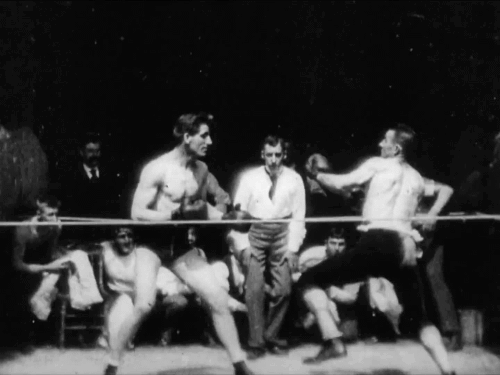
[image error]
❤️ 🇮🇱
A second bell rings soon enough. Salty Banks dangles a rigged bout disguised as a second chance, and Blondy climbs into the ring one more time out of habit, since hope left him rounds ago.
Louise, a prostitute with a tenderness bruised into shape, patches his skull and asks questions everybody else stopped bothering to ask. Her care is the closest thing to a corner man he gets, and for a few pages the book allows a small mercy.
Mercy is short lived in Caldwell territory. The story drops Blondy into the house of Mrs. Boxx, a woman built with the girth and menace of a heavyweight champion gone to seed. Behind a chambermaid's apron, her house runs an abortion mill. Blondy scrubs blood off oilcloth tables, burns rags in a kitchen stove, and hauls burlap bundles down cellar stairs. Secrets serve as his wages.
Boxx, the husband, drifts through scenes cracking a macabre pun about a corpse, a marble rattling loose in an old belt buckle standing in for whatever affection the marriage still owns.
Every character in this house absorbs a beating from something, a fist, a needle, a blade meant for peeling potatoes pressed into darker service. Caldwell writes with a steady hand, and the prose keeps its footing even when the subject matter hits the canvas.
The title throws a one-two combination. Blondy is a poor fool for trusting a manager, a promoter, a smiling woman with ruin already planned. He is also poor in the plainest sense, broke, homeless, and clean out of luck the moment the book opens. Readers root for Blondy the same way Blondy trusts strangers, and all end up sucker punched.
For a book with the frame of a novella, the body count fights well above its weight class. Caldwell strips his prose down to the bone the same way a boxer cuts weight before a bout, and every sentence throws a jab. Dialogue snaps like a glove against a heavy bag. Description stays lean, ribs showing, every sentence trimmed to fighting weight.
The book belongs beside the grimmer corners of hardboiled fiction, though Caldwell's Southern Gothic instincts give the violence a sweat soaked texture all its own.
This is a book about a fighter denied a fair fight, in the ring or out of it, every blow delivered somewhere below the belt.
[image error]
❤️ 🇮🇱

March 11, 2021
Erskine Caldwell's second novel is a minor masterpiece of the kind of bleak American realism that started with writers such as Dreiser, Crane and Norris that would set the stage for 2oth century literature. Poor Fool<\i> is the story of Prizefighter Blondy Niles, not unlike the character of Terry Malloy three decades later in On the Waterfront—taking a dive for the short-end money.

September 10, 2019
Un libro fantastico, decisamente pazzerello e fuori dagli schemi Mi sento di consigliarlo:
https://www.mattatoio5.com/non-classi...
https://www.mattatoio5.com/non-classi...

August 15, 2017
Un altro memorabile personaggio del profondo sud degli USA, come tanti altri creati dalla penna di Erskine Caldwell, feccia della società ed emarginato, eppure intriso di non trascurabile umanità

August 8, 2021
The “poor fool” of the book title is Blondy Niles, a boxer by profession. His career has seen better days, but now, he is down on his luck enough that he is willing to take a get-rich-quick risk. In boxing, this can only mean one thing—corruption.
In Poor Fool, Erskine Caldwell has written a gripping, two-dimensional novel of repugnant—almost repulsive—characters on the one hand, and a surreal account of what it’s possible for humans to perpetrate on their fellow-men on the other.
Once Blondy Niles falls in with boxing manager Salty Banks, he is easily talked into throwing a fight against Knockout Harris, the third participant in the scheme of corruption. Inevitably, there is a double-cross, with Blondy as the victim, and Salty and Knockout as the unscrupulous betrayers.
Almost destitute, Blondy meets Gertie, who takes him home, where he falls under the hypnotic spell of Gertie’s mother, Mrs Boxx. Mrs. Boxx certainly runs a boarding house, but of a special nature catering to young women who have fallen afoul of the most evil and perverted of men. For these women, Mrs. Boxx’s “clinic” offers services that might give them a second chance at life. The medical procedure is performed by a doctor who probably wouldn’t recognize the Hippocratic Oath if it hit him in the face.
But young women, alone and ostracized by their families, have little choice. The majority of them don’t survive and are dispensed with as cadavers for a few dollars by the shameless and unconscionable Mrs. Boxx. And it is in this capacity—a cross between an orderly and an undertaker—that she uses Blondy. Try as he might to escape, since he is not particularly restrained, Mrs. Boxx exerts a preternatural, mesmerizing power over him, rendering him docile and fearful.
It is only when he encounters Mrs. Boxx’s other daughter, Dorothy, that Blondy clutches at an opportunity for redemption and a better life. But is it too late? When Blondy learns of other heinous crimes committed by Salty and Knockout, he is consumed with vengeance. Will the power of Dorothy’s love be strong enough to hold him, or has the trajectory of Blondy’s life inexorably taken him beyond a point of no return?
Poor Fool, Caldwell’s second novel after The Bastard, seems slightly experimental in nature. He juxtaposes the worst and the best of humanity, writing of these extremes in punchy prose and stripped-down dialogue. In pugilistic terms, he seems to deliver repeatedly a right to the jaw and a left to the gut of readers. Though amateurish and heavily clichéd at times, Poor Fool is also an illustration of a writer learning his craft, which is quickly honed to produce two consecutive masterpieces, Tobacco Road and God’s Little Acre.
In Poor Fool, Erskine Caldwell has written a gripping, two-dimensional novel of repugnant—almost repulsive—characters on the one hand, and a surreal account of what it’s possible for humans to perpetrate on their fellow-men on the other.
Once Blondy Niles falls in with boxing manager Salty Banks, he is easily talked into throwing a fight against Knockout Harris, the third participant in the scheme of corruption. Inevitably, there is a double-cross, with Blondy as the victim, and Salty and Knockout as the unscrupulous betrayers.
Almost destitute, Blondy meets Gertie, who takes him home, where he falls under the hypnotic spell of Gertie’s mother, Mrs Boxx. Mrs. Boxx certainly runs a boarding house, but of a special nature catering to young women who have fallen afoul of the most evil and perverted of men. For these women, Mrs. Boxx’s “clinic” offers services that might give them a second chance at life. The medical procedure is performed by a doctor who probably wouldn’t recognize the Hippocratic Oath if it hit him in the face.
But young women, alone and ostracized by their families, have little choice. The majority of them don’t survive and are dispensed with as cadavers for a few dollars by the shameless and unconscionable Mrs. Boxx. And it is in this capacity—a cross between an orderly and an undertaker—that she uses Blondy. Try as he might to escape, since he is not particularly restrained, Mrs. Boxx exerts a preternatural, mesmerizing power over him, rendering him docile and fearful.
It is only when he encounters Mrs. Boxx’s other daughter, Dorothy, that Blondy clutches at an opportunity for redemption and a better life. But is it too late? When Blondy learns of other heinous crimes committed by Salty and Knockout, he is consumed with vengeance. Will the power of Dorothy’s love be strong enough to hold him, or has the trajectory of Blondy’s life inexorably taken him beyond a point of no return?
Poor Fool, Caldwell’s second novel after The Bastard, seems slightly experimental in nature. He juxtaposes the worst and the best of humanity, writing of these extremes in punchy prose and stripped-down dialogue. In pugilistic terms, he seems to deliver repeatedly a right to the jaw and a left to the gut of readers. Though amateurish and heavily clichéd at times, Poor Fool is also an illustration of a writer learning his craft, which is quickly honed to produce two consecutive masterpieces, Tobacco Road and God’s Little Acre.

July 5, 2021
One house of horrors follows another, in this purple prose dramatization of lurid newspaper headlines: prizefighter takes a fall! Hooker with a heart of gold meets a violent end! Abortion mill madame mesmerizes castrated men!

December 31, 2017
I don’t really know what to say about this second short novel (in the Signet Book collection of one novella and two short novels) I’ve just finished. If I weren’t already familiar with Erskine Caldwell’s later work, I’d probably have to conclude that this was the work of an amateur writer.
Truth is, the story is way over the top. Caldwell’s genius is in writing about the underclass in the American South—and no one does it better. What’s more, and given that Poor Fool was only his second entrée into the world of literature, I’m more inclined to give him his due.
But while Caldwell succeeds in establishing his writer’s stripes (or at least a private’s single stripe) with this one, the writing leaves a lot to be desired. It’s full of errors—grammatical, syntactical and stylistic. From a thematic standpoint, however, it also establishes the Caldwell I’ve come to cherish over the years as one of the best in American letters.
Read it if you’re at all curious to learn how a writer starts out—before (it would appear) he learns to slow down and carefully edit himself. Then, compare it with God’s Little Acre, Tobacco Road or Gretta … and marvel at how far one writer can come when he has his material firmly in hand.
RRB
Brooklyn, NY
31 December 2017
Truth is, the story is way over the top. Caldwell’s genius is in writing about the underclass in the American South—and no one does it better. What’s more, and given that Poor Fool was only his second entrée into the world of literature, I’m more inclined to give him his due.
But while Caldwell succeeds in establishing his writer’s stripes (or at least a private’s single stripe) with this one, the writing leaves a lot to be desired. It’s full of errors—grammatical, syntactical and stylistic. From a thematic standpoint, however, it also establishes the Caldwell I’ve come to cherish over the years as one of the best in American letters.
Read it if you’re at all curious to learn how a writer starts out—before (it would appear) he learns to slow down and carefully edit himself. Then, compare it with God’s Little Acre, Tobacco Road or Gretta … and marvel at how far one writer can come when he has his material firmly in hand.
RRB
Brooklyn, NY
31 December 2017

September 23, 2019
An interesting book by Caldwell. You can tell that it is one of his early works. This book focuses on a washed up boxer by the name of Blondy. No prospects, nothing to do until an offer comes his way to get back in the ring again.
Having read numerous Caldwell works, you can see the beginnings of what Caldwell becomes synonymous with. In this case, the hard up poor worker of the 1930’s. We also have within this story sex, prostitution and depravity.
The story is split into three parts. It was an ok story, however, I am lost by the middle/ second part of the story of Blondy in a house of ill repute. By itself, this story would be quite a phenomenal horror story. Within this book it was a random tangent.
Quite a dark story, disturbing in parts, not his best work, but well written.
Having read numerous Caldwell works, you can see the beginnings of what Caldwell becomes synonymous with. In this case, the hard up poor worker of the 1930’s. We also have within this story sex, prostitution and depravity.
The story is split into three parts. It was an ok story, however, I am lost by the middle/ second part of the story of Blondy in a house of ill repute. By itself, this story would be quite a phenomenal horror story. Within this book it was a random tangent.
Quite a dark story, disturbing in parts, not his best work, but well written.

May 22, 2022
Erskine Caldwell's Poor Fool is a better read than his first, The Bastard. Still finding his way as a writer of length, Caldwell's second novel Poor Fool is a more skillfully crafted work, with a faster pace and a modicum of plot, but its characters are sketchily drawn in grotesque caricatures. While brutality was ever central to The Bastard, here it is tempered in quantity and more focused, with an oppressiveness that lends a proto noirish feel. The bizarre second section is a real grand guignol in its unrelenting depiction of Mrs. Boxx's depraved hotel for unfortunate women, whose abortions provide a lucrative business for the repulsive proprietor. There are many poor fools in this novel and no salvation for them.

December 5, 2018
Of all Erskine Caldwell's black comedies about white trash, Poor Fool is the most grotesque and absurd. There may never have been a popular author more cruel to his own characters than Caldwell, and that comes into play with bludgeoning insistence in this story. And yet, there's an undeniable "can't look away from the flaming car wreck" quality to it that makes me keep turning the page. I don't know that I've ever read anything weirder than the scenes in Mr's Boxx's abortion mill and the emasculating power she exerts over Blondy Niles, the (for lack of a better word) protagonist. It's something you can't unsee, and it leaves you looking for a bit of brain bleach.

July 19, 2024
I would say between 3 and 4 stars. I literally could not put it down. He is a great writer, or should I say "storyteller". I don't want to write a spoiler, but there are some things that I think could be better. But with these type of characters, there is not many paths it could have traveled.

September 23, 2017
Such a great story teller. I love Erskine Caldwell's writings.

August 6, 2026
complètement flopesque

December 3, 2014
Erskine Caldwell's second novel is a step above THE BASTARD. Here the violence and depravity is tempered by a savage wit. Blondy, the Poor Fool of the title, is so alienated that he won't even defend himself from a beating. A drunken, washed-up boxer, Blondy is at the end of his rope. Then fortune smiles upon him in the form of Louise, a prostitute who loves him, and Salty, a boxing promoter with a get-rich-quick scheme. In Caldwell's world, Happy Endings are few and far between. The rise and fall of Blondy Niles is a grotesque, neo-gothic tale of lost dreams and half-redeemed souls. It is both nightmarish and sickly comic. Accent on the sickly.

January 25, 2009
This is one of the craziest little books I have read. I can't believe it was written in 1930. I guess people were just as messed up back then as they are now. It was kind of like a really bizarre version of On the Waterfront.

November 6, 2009
Wow, what a dark and crazy book. One of the characters, Mrs. Boxx, is one of the scariest villains I've ever seen in literature.

January 9, 2014
Gruesome, ungraceful prose masquerading as expressionism.

December 26, 2014
Reads like a pulp potboiler outline; devoid of character development; unlikely plot.
Displaying 1 - 18 of 18 reviews