De gebeurtenissen rond Jezus’ leven vanaf de Boodschap van de Engel aan Maria tot de terugkeer naar Nazareth, worden overgeplaatst naar het Vlaanderen uit het begin van deze eeuw. Timmermans houdt zich aan de feiten uit het evangelie, maar aangevuld met zijn eigen beleving. Hij voelt zich als een ooggetuige die zijn stemmingen en fantasie zintuiglijk vertaalt naar de lezer toe. Deze laatste ziet en hoort Jezus bij monde van de auteur. Daarbij heeft Timmermans vooral oog voor de zuiver menselijke kant van het verhaal.
Het verhaal van Maria, Jozef en het kindje overgezet naar 19de-eeuws Vlaanderen. Ik dacht dat het aangename lectuur zou zijn met de kerst in aantocht maar het viel tegen. De taal van Felix Timmermans is wel sprankelend - zoals in Pallieter - maar de inhoud is in dit geval vlak en afgezaagd. En het nationalisme stoort: uiteraard zijn zowat alle Vlamingen goed en de vreemde overheersers slecht (Timmermans doet zijn best om in Bethlehem toch een paar mensen te vinden die hun huis of herberg gesloten willen houden). Hier en daar wat stuitend antisemitisme: ook dat zullen we dan maar aan de tijd van ontstaan wijten, ruim honderd jaar geleden.
Before I can write this review, I have to familiarize my readers (both of you-ha) with a term. And that term is "Forgotten Gems of the 800s." It could also be termed "Lost Gems of the 800s." Or for a slightly different feel you could also go with "Hidden Gems of the 800s." I created the concept, and use all three pretty much interchangeably, so you can use whichever one you feel most comfortable with.
So what is a "Forgotten Gem of the 800s," you ask? Well, as many of my library-related friends already know the "800s" is the class of the Dewey Decimal System that contains "literature." Literature is defined here very broadly and can include all kinds of stuff such as poetry, essays, criticism, and rhetoric. You'll also find Shakespeare there. Anyway, "the Forgotten Gems of the 800s" are just what they sound like: books that slip through the cracks of the good librarian's deselection policy. Generally these books are really old; many date from the early part of the 20th century, but this is not always the case. They often are rebound, and have hideous covers as a result, but again this is not necessary. In fact, there are only two main criteria that every single Forgotten Gem of the 800s" must have. 1.) It must be located in the 800s (although this is actually debatable). 2.) It must be really strange.
Do not bring me a mid-century book of Shakespearian criticism and try to pass it off as a Hidden Gem of the 800s. I don't care if it is from 1953 and smells like Cherry Black & Milds. I don't even care if Harold Bloom edited it when he was a young scamp of 74; that's not weird enough. Now, if it was a "reimagining" of Merchant of Venice, with all the characters being recreated as cats, then we might be talking!
Okay, now that I think you are starting to get a handle on the terminology, it is time to follow through with the task at hand: reviewing the marvelous The Christ Child in Flanders.
First things first. I think I am probably the only person in the entire world who has read this book in the past thirty years or so. It may have once been a "classic" as the description claims, but I think it fell out of fashion around the same time that people stopped building bomb shelters in their backyards. To add to this theory, I'll have you know that I added it to Goodreads myself. And while this kicky new English edition dates from 1960, the original Flemish Felix Timmermans version dates all the way to 1916!
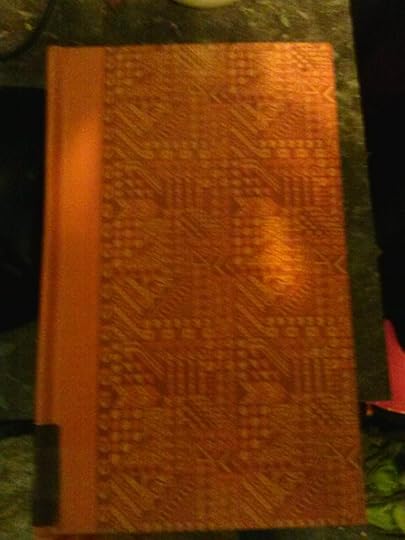
Additionally, I happen to work at the only public library in the state of Michigan that owns a copy. And while it hadn't been checked out in ages, how could I resist with a cover like this:
And look at the book label:
Perfection!!
So anyway, here's the gist of things. Basically, Timmermans was this Flemish dude who created a novelization of the Gospel story of the nativity/flight from Herod. But he decided to "reimagine" things a bit, which he referred to as "poetic license." So instead of taking place in first century Israel, the story is moved to Flanders in the middle ages. At first I was like, what the hell Timmermans? But then I read that it was supposed to sort of echo the old paintings of the Nativity, which clearly used medieval/Renaissance clothing and themes as opposed to more historically accurate depictions. Interesting, right?
But then things got weird.
Because on page 4, Mary is daydreaming at her window about one day having fat, blonde children with milky colored skin, and crying because the village priest has told her to join a convent (I think because he thinks she's going to be ruined otherwise, but I couldn't quite understand all the euphemisms), and the next second we are being told that she is extremely pious and likes nothing better to "work and pray;[and] to live in Christ."
Wait.
What?!
How can she live in Christ if Christ hasn't even been born yet, because she is his mother who is yet childless?! And now that I think about it, how can there be village priests, and mass, and vespers if there is no Jesus?
Despite this very confusing turn of events, the book isn't so bad. It does follow the Gospel in the broad events, but Timmermans wasn't kidding around when he talked about "poetic license." In fact, he might even be taking poetic license with the term "poetic license." For example, I'll be the first to admit I'm a bit rusty on my Gospels, but I don't remember a trouble-making tree-trimmer named Sander, with a penchant for exaggeration and tall-tales, anywhere in Matthew, Mark, Luke, or John.
But Sander's really not so bad. It's the canonical characters that are super boring. Jesus is just a baby, so he can't really help that he comes off as lame, even if constantly reading about his mesmerizing blue eyes is equal parts annoying and historically inaccurate. Mary and Joseph, on the other hand, are pretty much pills. Mary is always just standing around looking pale and childlike, with tear-filled eyes the color of oak leaves. Then she will silently say her prayers, and be comforted by her own pious thoughts. I get that she is the Holy Virgin Mother, so she's not going to be plucky or anything, but she reminded me a bit too much of Emily St. Aubert from the worst book ever written (Mysteries of Udolpho.) Joseph, for his part, is a little more interesting, but mostly he just kisses Mary's brow and fills with delight when he gazes upon her and the babe. Yawn.
Anyway, the side characters save things. The shepherds keeping watch over their sheep by night are a ragtag group, and Timmermans has such colorful ways of describing them. (He insists on referring to one of them as "the hunchback" and another as "the fatty.")
But the best parts of all are those that involve Herod I. Herod is described as being more disgusting than Satan in The Inferno. He has a naturally purple face, he is extremely fat, and best of all he is covered in boils. Seriously, Timmerman brings up the boils over several pages at at least two different parts of the book. And this guy is ridiculous, even for Herod. At one part one of his conniving courtiers makes the infamous suggestion that Herod put to death all the male children of Bethlehem (which is also located in Flanders) under the age of two. Herod of course agrees that it is a great idea and something like this happens: Herod clapped his hands and chins, "Tonight there will be an orgy in your honor!" Indeed, Herod is constantly having orgies in this book.
And yet even Herod has an almost "deep" side. After all of the male children under two are slain, he has a prickling of conscious, although he quickly smites this insight. You see, Herod has not been able to produce a heir of his own. And while he tends to blame his wife, when he thinks of her strong, white form, and her flowing hair and almond eyes, he cannot help but to feel his own impotence and cry.
For real.
All of this greatness is accompanied by Timmermans' pen and ink drawings, that are only marginally related to what is going on in the story, and sometimes have nothing to do with it all! Like the one with the child upside down in the bucket, what the hell was that about?
It all makes me wish that Timmermans had only thought to write the sequel. The Christ's Ministry in Flanders or something like that. Just think how wonderful his descriptions of the Pharisees would have been. But alas, it was not to be, and the world will be poorer for it.
Het kerstverhaal is iedereen wel bekend. De originaliteit schuilt echter in de beeldrijke, haast picturale taal. Soms lijkt het of Timmermans je naar een doek van Breughel laat kijken, of naar een Hiëronymus Bosch.
Het zal misschien aan mij liggen, maar dit bekoorde me niet: nogal saai, te beschrijvend. De enige originaliteit is dat het Kerstverhaal in Vlaanderen gesitueerd is.
The blurb promised a story written in the style of the Flemish painters, who painted the Christmas story in medieval scenery, and indeed Timmermans does this and it works beautifully! Mary and Joseph come to life wonderfully, as do many minor characters both Biblical and imaginative. One moving scene was Zachariah´s organ playing during Mary and Joseph´s wedding! The only thing to watch out for, if you want to read the story aloud with children, is the chapter about the massacre of the innocents - very moving for adults, possibly too terrifying for children. A Christmas classic!
This entire review has been hidden because of spoilers.
A forgotten classic by Felix Timmermans (an artist and author who was nominated for the Nobel Prize in Literature three times). This book is the literary equivalent of Pieter Bruegel the Elder’s paintings which depict the story of Christ’s birth and the subsequent flight from King Herod’s soldiers.
This account of the Biblical stories set in Flanders not only provides beautiful and vivid descriptions of the landscapes that were so familiar to Bruegel, but also penetrates into the minds of Mary and Joseph. The reader is left with a better impression of the joys and anxieties that would have been experienced by the two unknown peasants who were chosen to help fulfill Christ’s mission.
*I should add that it was not easy to find an English translation of this book, but it was ultimately worth the effort.