

What do you think?

Tales of Prison Life
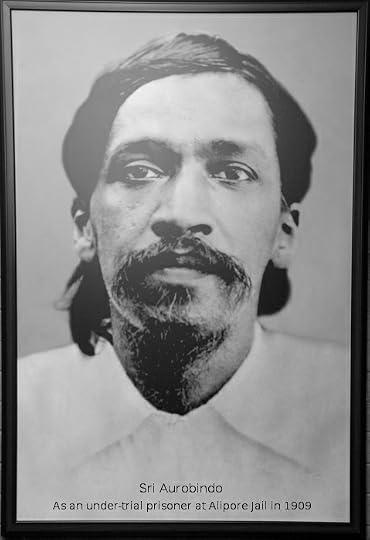
Sri Aurobindo's account of his experiences as an undertrial prisoner in Alipore Jail, Calcutta. Arrested for conspiracy in May 1908, Sri Aurobindo spent one full year in jail while the British Government, in a protracted trial, tried to implicate him in various revolutionary activities. Acquitted and released in May 1909, he wrote a series of articles in Bengali in the journal Suprabhat describing his life in prison and the courtroom. Translated by late professor Sisir Kumar Ghosh of Santiniketan, these articles form the main text of this book.
Several briefer pieces are also included in the three essays in which Sri Aurobindo discusses the noble character of the young revolutionaries imprisoned with a poem, "Invitation", which he wrote in Alipore Jail, and a speech at Uttarpara in which he disclosed for the first time some of the spiritual experiences he had in jail.
Several briefer pieces are also included in the three essays in which Sri Aurobindo discusses the noble character of the young revolutionaries imprisoned with a poem, "Invitation", which he wrote in Alipore Jail, and a speech at Uttarpara in which he disclosed for the first time some of the spiritual experiences he had in jail.
- GenresNonfiction
Paperback
First published January 1, 1997
About the author
Sri Aurobindo
1,188 books433 followersSri Aurobindo (Bengali: শ্রী অরবিন্দ Sri Ôrobindo) was an Indian nationalist and freedom fighter, major Indian English poet, philosopher, and yogi. He joined the movement for India's freedom from British rule and for a duration (1905–10), became one of its most important leaders, before turning to developing his own vision and philosophy of human progress and spiritual evolution.
The central theme of Sri Aurobindo's vision is the evolution of life into a "life divine". In his own words: "Man is a transitional being. He is not final. The step from man to superman is the next approaching achievement in the earth evolution. It is inevitable because it is at once the intention of the inner spirit and the logic of Nature's process."
The principal writings of Sri Aurobindo include, in prose, The Life Divine, considered his single great work of metaphysics,The Synthesis of Yoga, Secrets of the Vedas, Essays on the Gita, The Human Cycle, The Ideal of Human Unity, Renaissance in India and other essays, Supramental Manifestation upon Earth, The Future Poetry, Thoughts and Aphorisms and several volumes of letters. In poetry, his principal work is Savitri: a Legend and a Symbol in blank verse.
The central theme of Sri Aurobindo's vision is the evolution of life into a "life divine". In his own words: "Man is a transitional being. He is not final. The step from man to superman is the next approaching achievement in the earth evolution. It is inevitable because it is at once the intention of the inner spirit and the logic of Nature's process."
The principal writings of Sri Aurobindo include, in prose, The Life Divine, considered his single great work of metaphysics,The Synthesis of Yoga, Secrets of the Vedas, Essays on the Gita, The Human Cycle, The Ideal of Human Unity, Renaissance in India and other essays, Supramental Manifestation upon Earth, The Future Poetry, Thoughts and Aphorisms and several volumes of letters. In poetry, his principal work is Savitri: a Legend and a Symbol in blank verse.
Ratings & Reviews
Friends & Following
Create a free account to discover what your friends think of this book!
Community Reviews
Displaying 1 - 12 of 12 reviews

March 15, 2018
Originally published as a series of articles in the Bangla weekly, Suprabhat (সুপ্রভাত), under the title Karakahini (কারাকাহিনী) more than a hundred years ago. This book is a brief but captivating illustration of Aurobindo Ghosh’s imprisonment along with his comrades during the "Alipore Bomb Case".
The English translation is exceptionally replete with the charm (presumably) possessed by the original Bangla text. The time spent in the prison and the proceedings of the court is reminisced, not bitterly, but with hindsight – of a spiritual realization – and expressed with jovial satire.
These men were the members of one of the first revolutionary nationalist organizations: the Anushilan Samiti. They were brave men, who sacrificed their lives for a united India, even before the break out of The First Great War in Europe. They challenged the mighty Empire in an era of its ascendancy. Their ideology and organization later evolved into a plethora of forces that shaped the polity of this subcontinent.

They find minuscule to no mention in the history of India’s struggle for independence. They are mostly forgotten outside Bengal. On the rare occasion when such revolutionaries are summoned up, it is almost always as a sly to Gandhi/Congress. They are not recollected in their own right. Sadly, they are collectively lost to us, and the loss is entirely ours.
The English translation is exceptionally replete with the charm (presumably) possessed by the original Bangla text. The time spent in the prison and the proceedings of the court is reminisced, not bitterly, but with hindsight – of a spiritual realization – and expressed with jovial satire.
These men were the members of one of the first revolutionary nationalist organizations: the Anushilan Samiti. They were brave men, who sacrificed their lives for a united India, even before the break out of The First Great War in Europe. They challenged the mighty Empire in an era of its ascendancy. Their ideology and organization later evolved into a plethora of forces that shaped the polity of this subcontinent.
They find minuscule to no mention in the history of India’s struggle for independence. They are mostly forgotten outside Bengal. On the rare occasion when such revolutionaries are summoned up, it is almost always as a sly to Gandhi/Congress. They are not recollected in their own right. Sadly, they are collectively lost to us, and the loss is entirely ours.

March 4, 2014
A humorous and thought provoking journey into the prison days of Sri Aurobindo. One will understand that commendable traits of Indian Judicial/Policing system today like false charging or case framing etc., were actually proud inheritances from our old British Masters....!!!
In all ways, we are imposing slavery on us..
Even after masters left us long back..
In all ways, we are imposing slavery on us..
Even after masters left us long back..

October 7, 2017
Inspiring read! Sri aurobindo's positive outlook towards life is refreshing and shines through the memoirs of his struggles, filled with snarky and sarcastic comments on the British system and western thinking. His writing is impeccable, simplistic, moving and highly persuasive. An enlightening experience I might say.

October 23, 2016
This book is actually a combination of the book "tales of prison life" with a few more essays of Sri Aurobindo Ghosh. The part that covers the prison life itself is simple to read and I enjoyed the mild references to the divine in the context of the solitude and harship in the prison. Ghosh also neatly places his analysis of different characters and their attitudes. Its only after this part that the essays which are largely spiritual/ religious in nature begins. I found many parts hard to comprehend, but whatever made sense are good pointers about character development with an aim of social welfare. Ghosh has been able to keep at least some part of his advices clear of blatant religious assumptions and has used logic, psychology, good common sense and some optimism. I liked those parts.
So unless you are a devout follower of Ghosh's teachings or are generally in the spiritual lane, you would find the later part of the book a bit bore. Leaving that minor inconvenience out, I found the book to be an interesting short read.
So unless you are a devout follower of Ghosh's teachings or are generally in the spiritual lane, you would find the later part of the book a bit bore. Leaving that minor inconvenience out, I found the book to be an interesting short read.

April 20, 2019
I stumbled upon this gem in Sri Aurobindo ashram in Pondicherry. In it contains words that only a seeker could cherish. Sri Aurobindo words it perfectly when he said "When I was asleep in Ignorance, I came to a place of meditation full of holy men and I found their company wearisome and the place a prison; when I awoke, God took me to a prison and turned it into a place of meditation and His trysting-ground. ". This book is a collection of newspaper column relieving Aurobindo's life in prison and his transformation. Solitary confinement would have drove any normal man to madness but in his case, he found his Beloved. Read with a open mind.

September 19, 2022
I am sitting in Pondicherry as I write this. And reading this and visiting his shrine on the very same day is a surreal experience.
Understanding sri aurobindo's philosophical explanation of world events in light of Hinduism is much above my pay grade, but his take on the prison experience in colonial India is something drew me to this book. Also another thing that clearly stood out was Sri Aurobindo's sense of humor. Even when he wrote about his experience in jail, he was able to conjure up bouts of laughter. But make no mistake this is a deeply philosophical book with autobiographical elements acting as a facade.
Also Uttarpara speech of Sri Aurobindo was clubbed in my version of the text, the speech requires a detailed discussion of it's own. But it is defines the ethos of India's Hindu nationalism.
Understanding sri aurobindo's philosophical explanation of world events in light of Hinduism is much above my pay grade, but his take on the prison experience in colonial India is something drew me to this book. Also another thing that clearly stood out was Sri Aurobindo's sense of humor. Even when he wrote about his experience in jail, he was able to conjure up bouts of laughter. But make no mistake this is a deeply philosophical book with autobiographical elements acting as a facade.
Also Uttarpara speech of Sri Aurobindo was clubbed in my version of the text, the speech requires a detailed discussion of it's own. But it is defines the ethos of India's Hindu nationalism.

November 7, 2022
A very noble man, Sri Aurobindo expresses his experience in jail. He was locked up in confinement which transformed him into a new spiritual person walking the path set forward by the almighty. His takes on spiritualism and human psychology in such dark places such as jail is good. A tinge of sarcasm and more on his spiritual calling make this book a good read.

March 5, 2022
Discernment in the lives of prisoner

June 25, 2023
As far as I understand, this little book was written in Bengali. The English translation was first published in August 1974.
I had no previous knowledge of the author, Sri Aurobindo, before reading the book, though I had heard of him.
As the translator, Sisirkumar Ghose, points out, the book has an importance as a historical document “showing the evils of the prison system under the British Raj”.
He also states “rarely --- has Sri Aurobindo --- written with such irony, sarcasm, invective and humour”.
In 1908 two European ladies were killed in a “bomb outrage” and Aurobindo eventually found out that he himself was the main target of suspicion and regarded by the police as the “”chief killer”, ”the instigator and secret leader of the young terrorists and revolutionaries”.
He was arrested in the middle of the night by armed policemen, he was handcuffed and a rope tied round his middle.
The book is an account of the author’s imprisonment in Alipore jail in India, which imprisonment lasted a year.
The author had long wanted to have “a direct vision of the Lord of my Heart”, of ”knowing the Preserver of the World, the Supreme Person” but had not succeeded in that effort.
The British Government had wanted to do him “an ill turn” but the only result of its “wrath” was that he found God.
The police had searched his house but found no bombs or explosives and he had been arrested “in the absence of a body warrant”, whatever that might be, which was apparently mandatory.
A month and a half before Aurobindo’s arrest he had been visited by an unknown gentleman who had warned him that some wicked people were conspiring against him and his brother.
He informed the person “I have complete faith in God. He will always protect me.”
It is ironic, or rather, ridiculous, that Aurobindo was arrested for being a terrorist and murderer when in fact he was a highly spiritual person. However, he tells us that his imprisonment actually helped him in his endeavour to find God.
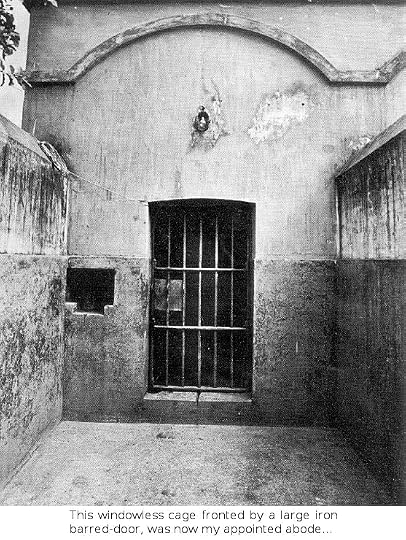
At least in part, he lived in solitary confinement. He was grateful for it.
He talks of an Italian who had been sentenced to seven years’ solitary imprisonment; within a year he had gone mad.
He had two prison blankets as a bed.
He says his diet was unfit for animals. The rice was spiked with pebbles, insects, hair, dirt, etc. The lentil soup was heavily watered. He never before knew how food could be so tasteless and with no nutritional value.
He tells us that he and the other inmates, rich and poor, all slept and ate together with a ”wonderful feeling of brotherhood”.
He states that he lived for a year like an animal in a cage.
He comments on the English people (I expect he meant “British”) that having studied their history he had already found out their “strange and mysterious character”, so he was not at all “astonished or unhappy” at their behaviour towards him.
Prisoners were not even allowed to sleep properly since every time sentries were changed the former were noisily disturbed with no respite until they responded.
I did not find the book to be easy reading. There were pages and pages with no chapters, nor even paragraphs.
I was completely unfamiliar with the many (Indian) personages referred to by the author, which didn’t help matters.
The book will have a limited appeal, but has a certain interest, particularly for those interested in spirituality.
It ends with a poem written by the author in Alipore Jail, 1908-09.
I had no previous knowledge of the author, Sri Aurobindo, before reading the book, though I had heard of him.
As the translator, Sisirkumar Ghose, points out, the book has an importance as a historical document “showing the evils of the prison system under the British Raj”.
He also states “rarely --- has Sri Aurobindo --- written with such irony, sarcasm, invective and humour”.
In 1908 two European ladies were killed in a “bomb outrage” and Aurobindo eventually found out that he himself was the main target of suspicion and regarded by the police as the “”chief killer”, ”the instigator and secret leader of the young terrorists and revolutionaries”.
He was arrested in the middle of the night by armed policemen, he was handcuffed and a rope tied round his middle.
The book is an account of the author’s imprisonment in Alipore jail in India, which imprisonment lasted a year.
The author had long wanted to have “a direct vision of the Lord of my Heart”, of ”knowing the Preserver of the World, the Supreme Person” but had not succeeded in that effort.
The British Government had wanted to do him “an ill turn” but the only result of its “wrath” was that he found God.
The police had searched his house but found no bombs or explosives and he had been arrested “in the absence of a body warrant”, whatever that might be, which was apparently mandatory.
A month and a half before Aurobindo’s arrest he had been visited by an unknown gentleman who had warned him that some wicked people were conspiring against him and his brother.
He informed the person “I have complete faith in God. He will always protect me.”
It is ironic, or rather, ridiculous, that Aurobindo was arrested for being a terrorist and murderer when in fact he was a highly spiritual person. However, he tells us that his imprisonment actually helped him in his endeavour to find God.
At least in part, he lived in solitary confinement. He was grateful for it.
He talks of an Italian who had been sentenced to seven years’ solitary imprisonment; within a year he had gone mad.
He had two prison blankets as a bed.
He says his diet was unfit for animals. The rice was spiked with pebbles, insects, hair, dirt, etc. The lentil soup was heavily watered. He never before knew how food could be so tasteless and with no nutritional value.
He tells us that he and the other inmates, rich and poor, all slept and ate together with a ”wonderful feeling of brotherhood”.
He states that he lived for a year like an animal in a cage.
He comments on the English people (I expect he meant “British”) that having studied their history he had already found out their “strange and mysterious character”, so he was not at all “astonished or unhappy” at their behaviour towards him.
Prisoners were not even allowed to sleep properly since every time sentries were changed the former were noisily disturbed with no respite until they responded.
I did not find the book to be easy reading. There were pages and pages with no chapters, nor even paragraphs.
I was completely unfamiliar with the many (Indian) personages referred to by the author, which didn’t help matters.
The book will have a limited appeal, but has a certain interest, particularly for those interested in spirituality.
It ends with a poem written by the author in Alipore Jail, 1908-09.

August 15, 2015
The books gives the translated version of Aurobindo's experiences in solitary confinement during his prison time. He describes the horrors of the then prison system, the challenges of solitary environment, his revelations, the courtroom drama and about Mr.Birley, Mr.Norton and their effort to prove his faults. He also talks about the inmates and their patriotic feelings. He talks about the three gunas described in the Hindu Philosophy and how Rajas nature controlled by Sattwik nature can get rid of Tamas(Inactivity) and help nature prosper. The book ends with his speech at Uttarapara. Good read if you want to understand start of his spiritual journey.
June 14, 2015
The title goes the book briefly covers his prison days and to an extent how he manege to remain sane after an year of solitary confinement.
He also writes about how he made up his mind to work on the reforms that the prison system requires.
Little had been written about the transformation that took place within him during his prison days. I expected to get a detailed record of this transformation.
Overall a easy read if you are absolutely bored. This is the first book I have read by Sri Aurobindo. a looking forward to read some of his best known works.
He also writes about how he made up his mind to work on the reforms that the prison system requires.
Little had been written about the transformation that took place within him during his prison days. I expected to get a detailed record of this transformation.
Overall a easy read if you are absolutely bored. This is the first book I have read by Sri Aurobindo. a looking forward to read some of his best known works.

March 7, 2024
There is also a film on Youtube.
Displaying 1 - 12 of 12 reviews