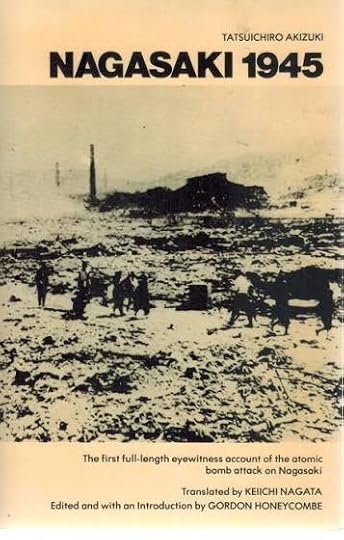
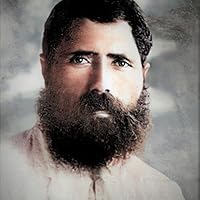
Dr. Akizuki was born in Manzai-machi, Nagasaki. At the time of the bombing, he was the medical director of the Urakami Dai-Ichi Hospital (now the St. Francis Hospital). He was appointed medical director of the St. Francis Hospital in 1952 and named a consultant at that institution in 1986. Dr. Akizuki provided medical treatment to the hibakusha 1.4 kilometers from ground zero. In addition, he has for many years collected eyewitness accounts of the bombing from the hibakusha. He has received several awards, including the Sixth Yoshikawa Eiji Award for Contributions to Culture and Society and the Order of St. Sylvester from the Vatican. He has written "Nagasaki Genbakuki" (A Record of the Nagasaki Atomic Bombing) and "Shi no Doshin'en" (Ring of Death).
This account was difficult to read but it felt necessary to do so. Dr. Akizuki lived through the atom bomb attack in Nagasaki and treated hundreds of its victims. This account makes bare mentions of political developments and simply focuses on the immediate aftermath of the attack. He communicates his frustration at the poor quality of care he could provide, caused both by the lack of medical supplies available to him as well as the lack of knowledge of anything like radiation sickness. The magnitude of the horror was laid out in a simple and short account that should be mandatory reading to truly understand the utter inhumanity of nuclear weapons.
As with all narratives of the bombing of Japan with atomic weapons, this is a harrowing and saddening account, with the added interest of being written by a doctor who had to try to deal with the overwhelming tide of human misery and suffering.
Nagasaki was not the intended target. The initial objective for the second atomic bomb was Kokura; however, due to cloud cover and smoke obscuring the city, the mission was redirected to Nagasaki. This city was a significant target due to its industrial infrastructure, including shipyards, steelworks, and armaments factories. The B-29 bomber Bockscar, piloted by Major Charles W. Sweeney, carried the plutonium-based bomb "Fat Man," which had a blast yield of 21 kilotons. Nagasaki also had a notable Christian population, with a history of hidden Christians who had survived centuries of persecution. This community was centered around Urakami Cathedral, which was tragically destroyed when the bomb detonated 500 feet above ground, erasing dozens of square miles and causing extensive destruction beyond.
Dr. Akizuki, the director of the Urakami Dai-Ichi Hospital, provides a detailed narrative of the immediate aftermath of the bombing on August 9, 1945. His hospital, located just 1.4 kilometers from the epicenter, was severely damaged, yet he and his staff continued to treat the influx of injured and dying victims with extremely limited medical supplies. The book vividly describes the physical and emotional toll on both the survivors and the medical personnel, highlighting the unprecedented nature of the injuries and the onset of radiation sickness, which was not yet understood at the time.
The descriptions of the suffering endured by the hibakusha (atomic bomb survivors) are interwoven with Akizuki's own struggles to comprehend and combat the new and terrifying symptoms of radiation exposure. His account is marked by a profound sense of duty and compassion, as he tirelessly works to alleviate the suffering of his patients despite the overwhelming circumstances. The horrible flash burns, the unseen radiation effects, the misery, the loss, and the utter destruction are painfully described with chilling authenticity. Dr. Akizuki's firsthand observations provide a stark reminder of the catastrophic consequences of atomic weapons and serve as a chilling historical account that must reach a wider audience.
"...In the air-raid shelter of the house, I discovered several injured people, among them Mr Yamano, who had been pinned under a fallen tree in the yard of Urakami Hospital. ‘I can’t stand up - I feel dizzy,’ he complained, breathing feebly. ‘I feel sick in my stomach, and everything tastes bitter.’ ‘But you haven’t been injured, have you?’ I said encouragingly. ‘I don’t think so,’ he said. ‘But I can’t stand up.’ ‘It’s because you’ve been staying in the air-raid shelter. Get outside and take a breath of fresh air. You’ll soon feel better, I assure you.’ I knew nothing as yet of radioactivity and neutron rays.
But among those with no burns at all were many who felt sick in their stomachs and had a burning sensation in their mouths. I thought it was because they had stayed inside shelters ever since the bomb was dropped. Yet, as time passed, they began to suffer from bloody diarrhoea and bleeding gums, followed by bleeding under the skin. The interiors of their mouths turned purple. This was how it was with Mr Yamano. ‘I’m afraid it must be dysentery,’ I said. I felt a chill, gloomy foreboding. I knew how dysentery could become rife on battlefields or in devastated areas. If it’s dysentery, I thought, it could be very serious. In fact, it was far worse than dysentery, but I couldn’t have known that then. No, none of us could have known how terrible their sickness really was..."
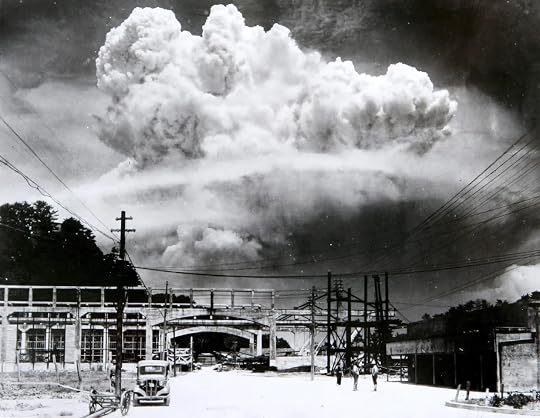
The atomic bomb mushroom cloud over Nagasaki seen from Koyagi-jima on August 9, 1945.
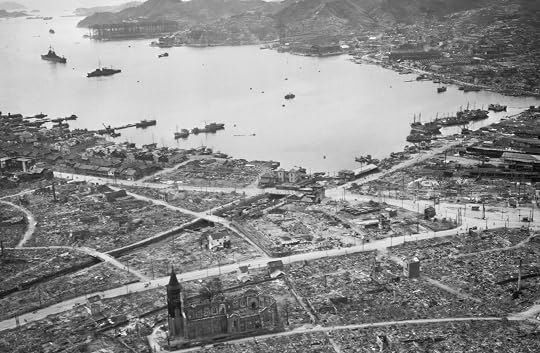
Nagasaki, Japan, 1945. Aerial view of the bomb damage from August 9, 1945. Altitude of 300’. Photographed by USS Chenango (CVE-28) aircraft on October 15, 1945. Official U.S. Navy photograph, now in the collections of the National Archives.
This is a remarkable account by Dr Akizuki, who witnessed the dropping of the 2nd atomic bomb on Nagasaki. Dr Akizuki was the sole doctor in charge of the Urikami Hospital for TB patient when, on 9 August 1945, the atomic bomb ‘Fat Boy’ exploded over Nagasaki. Dr Akizuki survived the blast uninjured & although his hospital was destroyed by fire as a result of the blast, continued to treat his patients & increasing numbers of serious burn victims with nothing but a limited supply of zinc oxide oil & mercurochrome. He describes how he struggled with the massive burns people suffered, trying to removed splintered glass deeply embedded in the muscles of victims backs, & then becoming perplexed by the sickness & death of seemingly uninjured people. It was after the war ended that he realised it was radiation sicknesses - new to medical scientist. This personal narrative is a moving anti-war memoir by a remarkable man who survived until the early 21st century.
I have read a few accounts of the bombing of Hiroshima, but this is the first book of the bombing of Nagasaki. Even more important is the fact that unlike other oral histories, this one is from a doctor (the author, Dr. Akizuki) whose account is mostly from the hospital from which he worked and where he experienced not only the initial detonation of he Atomic bomb, but also worked to save lives. This is also the first account from a medical viewpoint, from the confusion of seeing people not badly hurt, to the radiation sickness these same people encountered during the hours and days later (which only several weeks later were the symptoms recognized as radiation sickness). While this is still a devastating account, the medical take gives the reader a clearer view of what occurred near the epicenters of both Hiroshima and Nagasaki. A worthwhile read because of this fact.
A powerful and moving account of the terrible destruction of Nagasaki by an atomic bomb, the second and last such weapon used against humanity. Argue as you will about whether the bombing of Nagasaki was necessary but reflect on this: about 30,000 died in the first few moments following the explosion. About 3% of those who died were military personnel; 13% were war industry workers; the remaining 84% were ordinary people, mainly the elderly, women and girls, students and children.