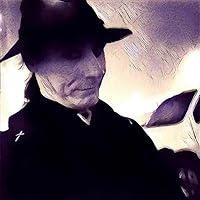
Early novels were risque (with lurid covers), but later moved to writing science fiction.
Not to be confused with fellow SF writer George O. Smith, or George Harmon Smith who wrote similarly risqué pulp novels.
Smith himself used the pseudonyms Jeremy August, Jerry August, Don Bellmore, Ross Camra, M J Deer (with his wife, Jane Deer Smith), John Dexter (a "house name" used by multiple authors); George Devlin, Robert Hadley, Jan Hudson (a "house name"), Jerry Jason, Clancy O'Brien, Alan Robinson, Holt Standish, Diana Summers, Hal Stryker, Hank Stryker, Morgan Trehune, Roy Warren, and J.X. Williams (a "house name") for publishers such as Avalon, Beacon, Boudoir, Brandon House, Epic, Evening Reader, France, Greenleaf, Midwood, Monarch, Notetime, Pike, Pillow, and Playtime.
BUT... not to be confused with Jan Hudson who wrote young adult novels, a female author from Canada. She wrote Sweetgrass and Dawn Rider and was born in 1954 in Calgary Alberta.
H. G. Wells’s 1898 classic has long served as fodder for other writers, from Garrett Putman Serviss’s Edison's Conquest of Mars to Alan Moore’s more recent The League of Extraordinary Gentlemen, Vol. 2. George H. Smith’s novel is firmly in this tradition, albeit with an interesting twist: having failed in their invasion of Earth, the Martians now set their sights on Earth’s parallel world Annwn, a planet technologically similar to Earth but one in which magic enjoys a presence as well as science. Aided by a group of worshipers, the Martians inoculate themselves against the microorganisms that frustrated their previous attempt and prepare for an assault on a much larger scale. Alerted by a few figures from Earth, a small group of Annwnians mobilize to thwart this new effort, but it’s a race against time with a cool and calculated foe – and one determined to learn from their mistakes the first time around.
Smith’s novel benefits from both the novelty of its premise and the infusion of a number of interesting ideas, particularly his inspired concept of pro-Martian humans working for the destruction of their own species. The chapters describing the battles between the humans and the tripods are also excellent, conveying a sense of tension and excitement in many ways even better than Wells did in the original. Yet before readers can get to them they must wade through a considerable amount of tepid dialogue and poor characterization, particularly of the main female protagonist Clarinda McTague, whose jealousy-driven anger detracts from the story whenever she appears. The addition of the certain English detective and his medically-trained sidekick is even more questionable, especially as the conceit of disguising their identities wears thin quickly. Together these factors drag down this otherwise imaginative novel, one that squanders an otherwise interesting departure from Wells’s famous work.
They’re at it again, those pesky Martians. Having been thwarted in their conquest of Earth, the Martian squids have turned their attention to another world, one slightly less technologically advanced than Earth and one with microbes against which the Martians have inoculated themselves. This unlucky world is Annwn. It’s Earth’s near-twin, separated from us by the Shimmering Gates that guard the dimensions of space and time. It was previously used as a setting by the author in “Kar Kaballa” (1969), in which the civilized nation of Avalon is threatened by the Gogs, a sort-of analogue to the Mongol Hordes that attacked our own Europe. Annwn withstood that threat with intervention from Earth in the form of imported Gattling Guns. Here, they get another assist from Earth, in the persons of “Mr H” and “Dr W”, and a tactical book titled “The War of the Worlds,” written by Earth historian H.G. Wells, which details the terror of the Martian attack on Earth for a highly skeptical Annwn bureaucracy. The personages are no less than Sherlock Holmes and Doctor Watson (thoroughly implied but never stated) and Earth is not our Earth but a literary Earth. Since the story is about a second war of the worlds (second war, second world), there are similarities to tale with which we are familiar, especially in the heroic actions of a newly developed diving ram “Thunderbolt” (we had the torpedo ram “Thunder Child”), but there are important differences as well, chief among them is the nature of the world the Martians are trying to conquer. Annwn may be a bit behind Victorian/Edwardian England in technology, but there are certain aspects about that world for which the Martians cannot prepare themselves, specifically the reality of certain magics and myths. The story can be read as a rousing adventure tale with dashing larger-than-life heroes and heroines, a fantastic Sherlock Holmes pastiche, or a well-written science fiction tale firmly in the parallel worlds genre. Either way, this story published (by DAW books) in 1967 is well worth tracking down.
Before I say anything else, I want to emphasize that there are some good points. The heroes are likable, and it is generally well-written throughout. The basic concept- Martians attack a world of magic- is also very intriguing. Considering all this, the book is worth buying.
However (there had to be a however, right?), there are some flaws. 1) A certain Napoleon of Crime is mentioned in an important role in the book but never visibly appears. 2) A small part in the middle consists of a character reading from THE WAR OF THE WORLDS (in other words, space is filled by quotes from the book). 3) Lastly, the final battles in the book occur "off-stage," and the reasons they are not seen directly are annoyingly similar. It's as if the author either wrote too much for his page requirements or nearly missed his deadline.
Writing a sequel to H. G. Wells' classic novel is audacious enough. Setting that sequel in one's own already established parallel fantasy world is definitely going a step further. The author even makes one more unexpected move that I won't specify here. Quite a lot of the early part of the book is setting the scene and educating the reader about this world. This is all done quite compellingly and doesn't feel too much like exposition dump. Once the War of the title begins, it really get going. Smith is brilliant at describing a battle. This is a weird addition to my War of the Worlds collection, but not an unwelcome one.
This was a fast paced, entertaining little book which I enjoyed! Very hard not to draw parallels to the original but this book can stand alone and somehow seemed a little bit "Steampunky"!
Suprisingly it actually kind of works as a sequel to the Classic by H. G. Wells. Even though this is some where in the middle of the Dylan Macbride series I think as long as you have read the Wells novel you shouldn't get too lost.
Long story short a group called "The Circle of Life" has been nursing a surviving Martian. Now They intend to help the Aliens take over a parallel earth. It's up to the great consulting detective Mr. H. and his assistant Dr. W. to cross dimentional barrers in order to stop them from helping the martians unleash a weapon of devistating Power.
A very fasinating read for anyone who likes Victorian SciFi.
Picked this up for 25p because it had a typo on the back page and I liked the pulpy cover. Didn't expect anything out of it and admittedly it's not about to win any literary awards, but it is excellent fun and hard to put down. Interesting characters, funny dialogue, fast-moving (and slightly ridiculous) plot. I didn't realise it was part of a series when I bought it but will definitely look out for the rest.
I'd rate it 9/10 . It's clunky and clumsy, especially at the beginning, but it's basically fast-paced light entertainment (or "escapist fare" if you prefer).