

What do you think?
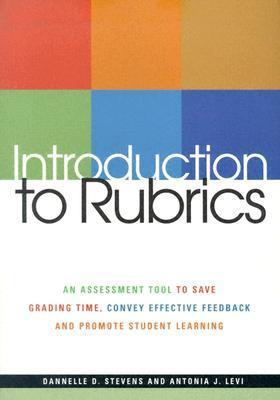
Introduction to Rubrics: An Assessment Tool to Save Grading Time, Convey Effective Feedback and Promote Student Learning
You need rubrics
* You find yourself repeating the same comments on most student papers
* You worry that you’re grading the latest papers differently from the first
* You’re concerned about communicating the complexity of a semester-long assignment
* You question the consistency of your and your colleagues’ grading scales
* Grading is taking up far too much of your valuable time
Research shows that rubrics save professors time while conveying meaningful and timely feedback for students, and promoting self-regulated and independent learning. The reason rubrics are little used in higher education is that few faculty members have been exposed to their use.
At its most basic a rubric is a scoring tool that divides an assignment into its component parts and objectives, and provides a detailed description of what constitutes acceptable and unacceptable levels of performance for each part.
Rubrics can be used to grade any assignment or research papers, book reviews, participation in discussions, laboratory work, portfolios, oral presentations, group work, and more.
This book defines what rubrics are, and how to construct and use them. It provides a complete introduction for anyone starting out to integrate rubrics in their teaching.
The authors go on to describe a variety of processes to construct rubrics, including some which involve student participation.They demonstrate how interactive rubrics--a process involving assessors and the assessed in defining the criteria for an assignment or objective--can be effective, not only in involving students more actively in their learning, but in establishing consistent standards of assessment at the program, department and campus level.
* You find yourself repeating the same comments on most student papers
* You worry that you’re grading the latest papers differently from the first
* You’re concerned about communicating the complexity of a semester-long assignment
* You question the consistency of your and your colleagues’ grading scales
* Grading is taking up far too much of your valuable time
Research shows that rubrics save professors time while conveying meaningful and timely feedback for students, and promoting self-regulated and independent learning. The reason rubrics are little used in higher education is that few faculty members have been exposed to their use.
At its most basic a rubric is a scoring tool that divides an assignment into its component parts and objectives, and provides a detailed description of what constitutes acceptable and unacceptable levels of performance for each part.
Rubrics can be used to grade any assignment or research papers, book reviews, participation in discussions, laboratory work, portfolios, oral presentations, group work, and more.
This book defines what rubrics are, and how to construct and use them. It provides a complete introduction for anyone starting out to integrate rubrics in their teaching.
The authors go on to describe a variety of processes to construct rubrics, including some which involve student participation.They demonstrate how interactive rubrics--a process involving assessors and the assessed in defining the criteria for an assignment or objective--can be effective, not only in involving students more actively in their learning, but in establishing consistent standards of assessment at the program, department and campus level.
112 pages, Paperback
First published June 1, 2004
Ratings & Reviews
Friends & Following
Create a free account to discover what your friends think of this book!
Community Reviews
Displaying 1 - 17 of 17 reviews
July 4, 2022
This book gives a fundamental establishment to employees needing to find out about involving rubrics for evaluating understudy learning like https://inloggenhulp.com/www-menti-co.... I will prescribe it to workforce at my foundation who needs to study the point.
This books guarantee of rubrics saving time is only a case made and the writers believe you should expect it is valid, however no examination in the book upholds that case. Further rubrics don't survey learning. They survey the capacity to follow bearings.
This books guarantee of rubrics saving time is only a case made and the writers believe you should expect it is valid, however no examination in the book upholds that case. Further rubrics don't survey learning. They survey the capacity to follow bearings.

February 20, 2019
This book provides a basic foundation for faculty members wanting to know more about using rubrics for assessing student learning. I will recommend it to faculty at my institution who wants to learn more about the topic.

July 31, 2020
Business Read - But really helped put into play why rubrics are so important for students to understand and excel; to understand what is needed from them. Helps to set them up and what to input in them!

January 12, 2022
This books claim of rubrics saving time is just a claim made and the authors want you to assume it is true, but no research in the book supports that claim. Further rubrics don’t assess learning. They assess the ability to follow directions.

March 6, 2024
Concise overview on creating rubrics for course assignments. I would use this volume during course creation- great tips, hints and ways to go about not only evaluating assignments but also giving students tools to succeed

September 30, 2017
The chapter on creating rubrics with students was most useful for me. I know I will return to this as a resource.

August 26, 2020
A helpful guide to be more systematic when writing rubrics for assignments
November 6, 2020
This is actually super helpful and important if you teach at a college level and/or utilize a syllabus.

February 28, 2023
Excellent, useful book for teaching and grading.
August 20, 2024
Very dry but very informative.

April 26, 2011
So far, as an assessment professional in higher education, I'm finding this book to be an accessible introduction to using rubrics that is neither too simplistic nor too advanced. I'm happy to recommend it to faculty who are looking for a better way to give substantive feedback to their students without sacrificing their sleep!

November 22, 2013
This text is aimed at university professors, but includes material utterly relevant to you K-12 teachers. It is a good briefing in the fundamentals of rubrics but does not reveal anything that a thoughtful practitioner may not have already thought. Overall a useful text as part of the exploration of standards-based assessment.

Read
April 17, 2009Prefer Megan Oakleaf's writing on rubrics
December 12, 2012
Great reference book.
Use this book:
- As a source for pre-made rubrics.
- As a source to learn how to design effective rubrics.
Use this book:
- As a source for pre-made rubrics.
- As a source to learn how to design effective rubrics.

May 22, 2015
Required reading for a graduate course. It found itself onto my shelf for future reference.
June 6, 2016
Who doesn't love rubrics? Great book for teachers. Gives you some REAL tips!

September 16, 2011
easy step by step guide. good reference.
Displaying 1 - 17 of 17 reviews