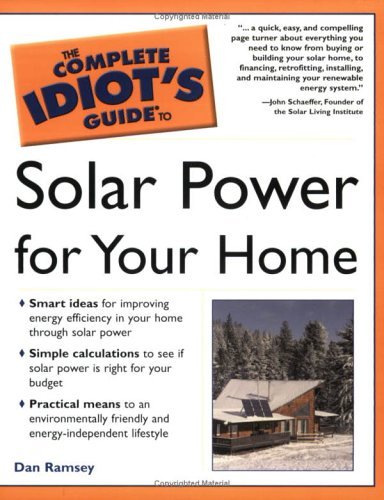
Offers advice and suggestions for building a solar-powered home, including estimating energy needs, selecting the right equipment, and maintaining the system once it is installed.
Dan Ramsey has authored more than 100 books, hundreds of magazine and online consumer guides, and numerous technical documents explaining complex topics in simple terms. Topics include writing skills, home repair, home businesses, aviation, and RV travel. Dan's latest books are the three-part Working Writer Series beginning with WORKING WRITER TIPS: HOW TO WRITE ANYTHING BETTER, FASTER, EASIER. It's FREE on Amazon Kindle. (Reviews appreciated!)
When solar panels first became available for residential homes, it was a much easier process. Wi-Fi wasn’t needed, the panels were strong and well-made, and batteries didn’t complicate the issue. But once the solar industry took off, it became a financial cause with the emphasis on leasing and getting upfront money, with cheaper equipment taking over and profit margins more of a concern for companies rapidly going bankrupt. This book is a bit old-school, as it was published in 2003 (there are newer editions), but it provides a clear-cut explanation of using the power of the sun to improve your energy efficiency, which can be a help as we near the emergence of microgrids and plug-and-play solar.
I worked in the commercial sector of solar, so we weren’t involved in all the scammish idiocy that has now overtaken the residential sector. Many people install solar for the wrong reasons, mainly being sold on the utility costs increasing, without realizing the energy companies and solar companies really do scratch each other’s backs. Last year, a neighbor down the street installed a $64,000 solar system…facing east. This is how bad it’s become. And since it’s a lease, they will have a hard time selling the house, because of the lien and the fact of the company going out of business. So, if you are considering taking on solar, get an old-school book like this to learn what is required, so you can negotiate better and you can truly understand the basic concepts and building coding for solar distribution.
One reason I like this book is that it first emphasizes the responsibility of the owner to do as much to make their house energy efficient BEFORE taking on the burden of solar. Do you have older windows? How is the wall insulation? Do you have an old HVAC unit? What about your appliances? I always suggest people do a load calculation, just as they would before purchasing a new air-conditioning system. If you install solar before you improve your home, you are just wasting money. The fly-by-night solar companies don’t care, as they just want your money. But then you will get into issues with either having too many panels or not enough and then the utility companies will be ruthless. READ THE BOOK!
There is also a section on how the entire solar process works, from the sun hitting the panels to each part needed to make it work. In California, for example, a licensed electrician must be involved to ensure that fires aren’t started, yet many homeowners are unaware of this coding. Batteries became a selling point in 2016 and are cheaper now, but not by much, so this book focuses on the successful use of car batteries, which still power fully off-grid homes using solar panels. So yes, the information is older, but if you travel where off-grid homes have been built without electric connections, you’ll still find car batteries being deployed, although on-grid solar panel homes are only allowed to use battery walls now.
There are chapters on all the different areas of energy efficiency, not just solar by itself. I think this is particularly helpful for readers to understand how their use of solar affects communities and the grid itself. And I always tell people about the issues which come from putting solar systems on their roofs. If you want solar, don’t impact the most important piece of your home (which is the roof). Instead, a good solar company will come up with an implementation plan to place solar creatively around the home. If they don’t know what that is, you shouldn’t sign a contract with them.
Toward the end of the book, there is a section on selling excess power, but that’s changed so many times through the years that you will never have an up-to-date book on that concern. Tax credits appear and disappear, more helpful to the upper classes than to the lower classes. Each state has its own spiffs, so you must be aware of what’s current. For instance, if you decide to buy an electric car in California and you install a car charger, you will be placed on a different rate plan, which means you will need to get solar to offset the cost of already paying a bundle for an electric car. None of this is cheap, which is why so many companies have gone bankrupt. The profit margin is abysmal and requires a sub-set of Solar Bros sales agents to sell crap to you. Know what you need to know and NEVER EVER sign a contract proffered to you on an iPad. Tell them you need a printed contract that must first be analyzed by your attorney. That will scare off the scammers.
Again, it’s sad that the solar industry was hijacked by the nasties, but that can be fully blamed on the lack of leadership at both the left and the right side of the political spectrum. If not this book, sit down somewhere and learn what you can about undertaking such a huge project. And make sure you can clean the panels! There is now another industry which involves “panel cleaners” (they don’t have to be licensed) who keep panels clean because that needs to be done. Because they don’t carry any insurance and aren’t bonded, these “cleaners” can sue you for putting a foot through your roof. And why would you want someone on your roof every other week? Oh yes, no “cleaner” should be power washing your panels. That’s a big no-no, yet I see it almost every day.
I think installing solar is still useful, but it needs to become more affordable (those of us in the industry know how overpriced it is), which was the initial intent, and it needs to become more creative. Again, microgrids and plug-and-play will be more prevalent but also be aware of how insurance will cover these, due to fire risks.
Don’t be put off by solar but also be very careful when someone tells you it’s “free”. Nothing is free.
One of the more interesting aspects of this book is the way that the appeal of the subject matter of the book is somewhat at cross purposes with the reality of it. This book--like many-is littered with assumptions about anthropogenic climate change and the appeal of doing something about it by making one's home a solar one, but then it includes as part of its material a great deal of discussion about the difficulty, legally as well as design-wise, of creating a solar powered or some other sort of renewable energy home in a way that does not involve government subsidy and significant regulatory headaches. And that is not even considering the way that active solar power depends on materials and processes, including battery storage and backup generators and wood stoves, that are not widely viewed as being environmentally friendly. In addition to that, it is a bit off-putting to see the way that the author focuses so much attention on political matters as well as the supposed desirability of increasing the use of solar power in the hope that it will induce more efficient processes to develop solar power for mass market consumers.
This book is between 250 and 300 pages and is divided into four part and a bit more than twenty chapters. The book begins with a discussion of how one can save energy (I), with chapters on looking to the sun (1), estimating one's home energy needs (2), cutting energy bills right now (3), incentives and paybacks for switching to solar (4), financing a solar home (5), building a new solar home (6), retrofitting one's home for solar power (7), as well as saving through solar landscaping (8). This is followed by a discussion of solar energy applications (II), including power generation and storage (9), wind and water power (10), solar water heating (11), and solar space heating (12). After this comes a discussion of solar power systems (III), including supplemental power systems (13), grid-tie systems (14), off-grid system (15), emergency power systems (16), and portable power systems (17). Finally, the main contents of the book end with a section on solar power projects (IV), including buying solar systems and components (18), hiring the brightest solar contractor (19), whether or not to do things for oneself (20), maintaining solar power (21), and making one's life more energy efficient (22). The rest of the book consists of appendices on a solar glossary (i) and solar resources (ii) as well as an index.
This is by no means a bad book. The authors are honest enough that the savvy reader will likely have many questions about whether or not it is wide to engage in solar power to an entire degree, to depend on it as one's power source. While the authors are clearly in favor of using solar power, they are realistic in their judgment of what is necessary for backup and what the trade-offs are as far as using it as a power source. It is difficult to properly manage such matters as electricity when one has to deal with matters of public policy and places where virtue signaling does not always match up with reality. A reader may find a book like this reinforces their desire to switch to or add solar power to their home despite all of the issues--and to take advantage of registered and licensed solar contractors who have a great deal of experience in dealing with the regulations and paperwork involved in working with the utilities when it comes to selling one's excess power to a utility for fun and moderate profit. It is to the authors' credit that the focus is so practical, even if little is less practical than the economics of alternative energy at the present time.