

What do you think?
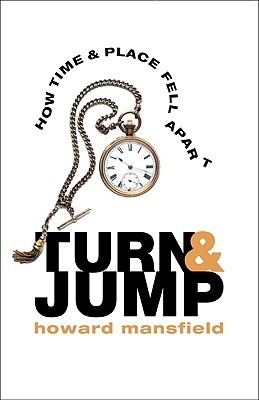
Turn and Jump: How Time & Place Fell Apart
Before Thomas Edison, light and fire were thought to be one and the same. Turns out, they were separate things altogether. This book takes a similar relationship, that of time and place, and shows how they, too, were once inseparable. Time keeping was once a local affair, when small towns set their own pace according to the rising and setting of the sun. Then, in 1883, the expanding railroads necessitated the creation of Standard Time zones, and communities became linked by a universal time. Here Howard Mansfield explores how our sudden interconnectedness, both physically, as through the railroad, and through inventions like the telegraph, changed our concept of time and place forever.
- GenresHistoryNonfiction
272 pages, Hardcover
First published August 16, 2010
About the author
Howard Mansfield
35 books40 followersHoward Mansfield sifts through the commonplace and the forgotten to discover stories that tell us about ourselves and our place in the world. He writes about history, architecture, and preservation as he seeks to understand the soul of American places. He is the author of a dozen books about the stories we tell each other and the ones we refuse to tell. In short, how we chose our ancestors
He is the author of thirteen books, including In the Memory House, of which The Hungry Mind Review said, “Now and then an idea suddenly bursts into flame, as if by spontaneous combustion. One instance is the recent explosion of American books about the idea of place… But the best of them, the deepest, the widest-ranging, the most provocative and eloquent is Howard Mansfield’s In the Memory House.”
Among his other books are Turn & Jump, The Bones of the Earth and The Same Ax, Twice, which The New York Times said was “filled with insight and eloquence. A memorable, readable, brilliant book on an important subject. It is a book filled with quotable wisdom.”
“Howard Mansfield has never written an uninteresting or dull sentence. All of his books are emotionally and intellectually nourishing,” said the writer and critic Guy Davenport. “He is something like a cultural psychologist along with being a first-class cultural historian. He is humane, witty, bright-minded, and rigorously intelligent. His deep subject is Time: how we deal with it and how it deals with us.”
His newest book to be published in October is Invisible Monuments: Tribute, Memory, and the Summoning of the Past. It's about the memorials we debate, dedicate, and then ignore.
We live in an era of monument building. Our monuments, often after fierce debate, are dedicated in ceremonies that try to bring life to the stone -- and then we walk away. The mute stones are left to the pigeons. Our grandest efforts at creating a shared, cultural memory melt to invisibility. Why?
Invisible Monuments looks at these moments of commemoration in the familiar and the unfamiliar. We visit the Vietnam Veterans Memorial, the Bunker Hill Monument, and a once- venerated World War I memorial in England. We journey to a little-known memorial that one grief-stricken family built stone-by-stone for their son lost in war, a place that still draws thousands each year.
And Invisible Monuments looks at the failure to commemorate in the recently rediscovered African Burial Grounds in Manhattan and Portsmouth, New Hampshire, and in the unmarked graves of the Irish immigrants who built the railroads in the woods of New Hampshire. We’re also introduced to an audacious attempt to memorialize the future by building a clock deep in a mountain that is designed to run for 10,000 years.
These memorials are attempts to bring us closer to our ancestors, to say that we are still joined hand-to-hand across the centuries. In Vietnam, says Viet Thanh Nguyen, there are two burials. The first to return the body to the earth, and then the second, when the bones are dug up and brought closer to the village. We do the same.
When we commission memorials, we are trying to bring the bones closer to home. The memorials we build are a second burial. In all the current controversies about what to build and how, and what to tear down, we’ve lost track of why we build monuments. We want the counsel of our ancestors – edited, and chiseled into stone.
Invisible Monuments is about tribute, memory, and the summoning of the past.
Howard Mansfield has written for The New York Times, The Washington Post, American Heritage, The Threepenny Review, and other publications.
He has served as a writer and consultant for museums, written and performed a stage show with composer Ben Cosgrove that was the subject of an Emmy Award-winning film, and he has co-written a documentary film about “The Old Homestead: The Play of the Century.”
He is the author of thirteen books, including In the Memory House, of which The Hungry Mind Review said, “Now and then an idea suddenly bursts into flame, as if by spontaneous combustion. One instance is the recent explosion of American books about the idea of place… But the best of them, the deepest, the widest-ranging, the most provocative and eloquent is Howard Mansfield’s In the Memory House.”
Among his other books are Turn & Jump, The Bones of the Earth and The Same Ax, Twice, which The New York Times said was “filled with insight and eloquence. A memorable, readable, brilliant book on an important subject. It is a book filled with quotable wisdom.”
“Howard Mansfield has never written an uninteresting or dull sentence. All of his books are emotionally and intellectually nourishing,” said the writer and critic Guy Davenport. “He is something like a cultural psychologist along with being a first-class cultural historian. He is humane, witty, bright-minded, and rigorously intelligent. His deep subject is Time: how we deal with it and how it deals with us.”
His newest book to be published in October is Invisible Monuments: Tribute, Memory, and the Summoning of the Past. It's about the memorials we debate, dedicate, and then ignore.
We live in an era of monument building. Our monuments, often after fierce debate, are dedicated in ceremonies that try to bring life to the stone -- and then we walk away. The mute stones are left to the pigeons. Our grandest efforts at creating a shared, cultural memory melt to invisibility. Why?
Invisible Monuments looks at these moments of commemoration in the familiar and the unfamiliar. We visit the Vietnam Veterans Memorial, the Bunker Hill Monument, and a once- venerated World War I memorial in England. We journey to a little-known memorial that one grief-stricken family built stone-by-stone for their son lost in war, a place that still draws thousands each year.
And Invisible Monuments looks at the failure to commemorate in the recently rediscovered African Burial Grounds in Manhattan and Portsmouth, New Hampshire, and in the unmarked graves of the Irish immigrants who built the railroads in the woods of New Hampshire. We’re also introduced to an audacious attempt to memorialize the future by building a clock deep in a mountain that is designed to run for 10,000 years.
These memorials are attempts to bring us closer to our ancestors, to say that we are still joined hand-to-hand across the centuries. In Vietnam, says Viet Thanh Nguyen, there are two burials. The first to return the body to the earth, and then the second, when the bones are dug up and brought closer to the village. We do the same.
When we commission memorials, we are trying to bring the bones closer to home. The memorials we build are a second burial. In all the current controversies about what to build and how, and what to tear down, we’ve lost track of why we build monuments. We want the counsel of our ancestors – edited, and chiseled into stone.
Invisible Monuments is about tribute, memory, and the summoning of the past.
Howard Mansfield has written for The New York Times, The Washington Post, American Heritage, The Threepenny Review, and other publications.
He has served as a writer and consultant for museums, written and performed a stage show with composer Ben Cosgrove that was the subject of an Emmy Award-winning film, and he has co-written a documentary film about “The Old Homestead: The Play of the Century.”
Ratings & Reviews
Friends & Following
Create a free account to discover what your friends think of this book!
Community Reviews
Displaying 1 - 13 of 13 reviews

December 8, 2022
This book starts in a New England museum and ends in a New England graveyard. Howard Mansfield covers a lot of ground on the pages in-between, each essay somehow tied to the ideas of time and place. As is the case with The Same Ax, Twice, Mansfield’s writing is down-to-earth without ever falling into folksy cliché. I have his latest book, Chasing Eden, sitting on the desk in front of me. I can’t wait to start reading it, which I will do as soon as I post this review and refill my coffee mug.

May 22, 2011
I expected a better study of how the sense of time we carry has changed over the years. In several spots I paused and wondered just how the author was making the connection between what he promised with what he was telling me. The five main "anecdotes" are often interesting in themselves -- but I think the author was forcing the issue and assuming we would always experience what he wanted us to feel.

April 11, 2024
Selected for discussion at Tuesday Academy, Howard, a local author, will come to discuss King Phillip's War, the last essay in the book, next week.
We are indeed fortunate. I haven't read much of Howard's work but he writes extremely well, is relevant, and fond of lists. It seems to be a sort of poetic tribute to people. And all about time: 'Before the railrods created Standard Time zones in 1883, and international time zones were adopted the next year, time and place were one. . . . Time became a uniform commodity. Local time is "a relic of antiquity," (p. 130
And about men who stand up for civility (Benjamin Keith): ' "You can't do that here . . . While I know that you mean no harm by it, and only do it from the goodness of your hearts, but others in the audience don't like it and it does not tend to improve the character of the entertainment," He was applauded.' (p. 30)
Without mentioning names, he refers to a local hardware store where you can get just about anything in his essay about the Derby Department store: 'There's a hardware store near me in an old wooden building with narrow aisles packed with stuff, every inch is used. It's like being in a toolbox.' (p.84) it's Edmunds in Antrim of course.
And he's funny! ' "Rumors have some basis in fact; that's how they get started." (p.114)
So go ahead, it's worth the read!
We are indeed fortunate. I haven't read much of Howard's work but he writes extremely well, is relevant, and fond of lists. It seems to be a sort of poetic tribute to people. And all about time: 'Before the railrods created Standard Time zones in 1883, and international time zones were adopted the next year, time and place were one. . . . Time became a uniform commodity. Local time is "a relic of antiquity," (p. 130
And about men who stand up for civility (Benjamin Keith): ' "You can't do that here . . . While I know that you mean no harm by it, and only do it from the goodness of your hearts, but others in the audience don't like it and it does not tend to improve the character of the entertainment," He was applauded.' (p. 30)
Without mentioning names, he refers to a local hardware store where you can get just about anything in his essay about the Derby Department store: 'There's a hardware store near me in an old wooden building with narrow aisles packed with stuff, every inch is used. It's like being in a toolbox.' (p.84) it's Edmunds in Antrim of course.
And he's funny! ' "Rumors have some basis in fact; that's how they get started." (p.114)
So go ahead, it's worth the read!

April 6, 2026
"Before Thomas Edison, light and fire were thought to be one and the same. Turns out, they were separate things altogether." Hmm, yes.
I enjoyed this book of essays about New England history and the ways that time, and time keeping, have shaped our lives. It highlights the ways that humans used to live closer to the earth and its rhythms. How time was relative to each town, how the sun, moon, crops, water and climate were deeply entrenched and intertwined with every facet of life.
I especially enjoyed the chapter "A Family History of Water" which speaks to the importance of water access to life and commerce. And how a dam, flood or a hurricane could completely make or break someone’s life and livelihood.
And I found the chapter "Four Centuries of King Philip's War" a very disturbing, but necessary read. Necessary because "those who don't learn from history are doomed to repeat it" and I hope more people will "learn" and not "repeat".
I enjoyed this book of essays about New England history and the ways that time, and time keeping, have shaped our lives. It highlights the ways that humans used to live closer to the earth and its rhythms. How time was relative to each town, how the sun, moon, crops, water and climate were deeply entrenched and intertwined with every facet of life.
I especially enjoyed the chapter "A Family History of Water" which speaks to the importance of water access to life and commerce. And how a dam, flood or a hurricane could completely make or break someone’s life and livelihood.
And I found the chapter "Four Centuries of King Philip's War" a very disturbing, but necessary read. Necessary because "those who don't learn from history are doomed to repeat it" and I hope more people will "learn" and not "repeat".
October 3, 2023
Very interesting. Very different. Good writer.

November 6, 2010
Howard Mansfield is a local author. My husband regularly runs into him at the local wellness center, and one day came home and asked me to get him a book Mansfield had written. My husband is not a reader, so when he asks to read a book, it is a momentous occasion. I immediately purchased another of Mansfield's books, The Bones of the Earth, which my husband devoured. When Turn and Jump was published, I was sent back to the bookstore to buy a copy of that. I haven't read Bones of the Earth yet, but I just finished this newest one. I really enjoyed it. Mansfield uses local history to illustrate the concept of how our ideas of time and place have changed. His first essay traces the development of how we measure time: first, by the placement of the sun, moon, and stars; next by clocks with each village keeping its own local time; and the eventual standardization of clock time. Along the way, he comments on skills that are lost or changed. Another essay describes the evolution of a store, from a general store to a department store to its demise. The development of vaudeville is described and its relationship to the railroad which gives the book its title. Part of my interest in the book of course comes from the local history aspect, but I've always been interested in how concepts/places have evolved and changed. I am looking forward to reading The Bones of the Earth and other books by Mansfield.

April 14, 2011
I knew that time zones were created by the railroad companies to simplify train scheduling. Prior to the introduction of discrete time zones, every community had its own local time, based on the sun. What I didn't realize was how strongly people associated their place with their time, or how strongly opposed many people were to the very idea of time zones. We take them so much for granted today that it is hard to understand why they would have been so controversial.
This book is really a collection of essays that presents a social history of the U.S. (well, actually, New England). The common thread through each of these essays is an analysis of the many different ways in which we measure time and how the changes in technology and society have changed the way we understand and perceive time. The rise of the industrial age separated work from the seasonal and weather dependent time keeping of the farmer and tied the workers to a clock. Commerce operates on a time of its own, reflected in the changes from small general stores to department stores to "big box" stores. And while it might seem that we have a long history (especially in New England), if we step back and look at the broader sweep of history, we find that our experiences are nothing but the briefest blip on the scope of human history.
This book is really a collection of essays that presents a social history of the U.S. (well, actually, New England). The common thread through each of these essays is an analysis of the many different ways in which we measure time and how the changes in technology and society have changed the way we understand and perceive time. The rise of the industrial age separated work from the seasonal and weather dependent time keeping of the farmer and tied the workers to a clock. Commerce operates on a time of its own, reflected in the changes from small general stores to department stores to "big box" stores. And while it might seem that we have a long history (especially in New England), if we step back and look at the broader sweep of history, we find that our experiences are nothing but the briefest blip on the scope of human history.

November 2, 2014
This is a book that, over generations and centuries, ponders the nature, the rhythms of time. Although centered on New Hampshire and rural Massachusetts, where the author found many of his inspirational sources, it speaks to wider cultural changes. Certainly it speaks to American culture, using a storekeeper's diary, a history of water mills and water ecology, the "Old Homestead" play that performed to audiences already experiencing industrial changes. It speaks to gradual changes in economy and industry, and to sudden, wrenching shocks in that history: the 1938 hurricane and flooding; the 1676 slaughter of native people in "King Philip's War" and the economic trauma that followed.
The prose is easy, eloquent, and well suits the material. "The Old Homestead was a time play, it was a clock. Its slow pace was the real story: Look at how slowly time used to pass. We had time to chat. We were barefoot. We did chores. On the stage [the main character] Uncle Josh is a man who owns his time. He does not answer to a clock, to an overseer or foreman. Out in the street, there were time battles, time wars, fights for work and wages."
Strongly recommend.
The prose is easy, eloquent, and well suits the material. "The Old Homestead was a time play, it was a clock. Its slow pace was the real story: Look at how slowly time used to pass. We had time to chat. We were barefoot. We did chores. On the stage [the main character] Uncle Josh is a man who owns his time. He does not answer to a clock, to an overseer or foreman. Out in the street, there were time battles, time wars, fights for work and wages."
Strongly recommend.

Want to Read
July 16, 2010He was on NH Public Radio. Interview found here.
A good lesser known nonfiction author.
http://www.nhpr.org/node/33602
A good lesser known nonfiction author.
http://www.nhpr.org/node/33602
July 11, 2011
Howard Mansfield discusses this book with Whole Terrain in this blog entry

August 31, 2011
A wander through history, mostly local New England history with a master storyteller. The final chapter, about King Phillip's War was especially powerful.

July 11, 2010
Excellent local history. Quick read.

November 16, 2010
Excellent! Really makes you think about the "speed" of life, as we know it.
Displaying 1 - 13 of 13 reviews