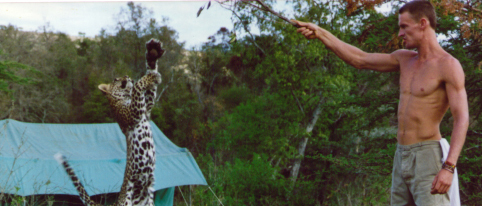
'No other book I know takes you so deeply into the secret world of the leopard' - Brian Jackman, safari writer In 1993, game ranger Graham Cooke had the opportunity to parent two six-week-old leopard cubs. Establishing himself and his charges in a small, tented camp in the South African bush, Graham set about his task of habituating the cubs to the dangers of the wild, in preparation for their eventual release. But first he had to gain the young leopards' trust. Boycat, the slightly bigger male cub, proved to be an easy-going character, and after initial reservations he soon settled in. However, his sister, Poepface, was less easily swayed. Her complex character and strong reservations persisted, despite Graham's efforts to win her trust. Eventually, Poepface relented, and so began a love story; a powerful bond. When, a year later, Graham prepared the cubs for their release into the remote South Luangwa Valley, he knew it was the beginning of the end. Joining the cubs on daily walks to familiarise them with their new home, Graham knew that soon it would be time to let go. Set in both in the bushveld of South Africa and the wilderness that is the South Luangwa Valley, My Life with Leopards is a story interwoven with love, loss, danger and heartbreak. Praise for My Life with Leopards : 'Set in the spectacular wilderness of the South African lowveld and later in Zambia's Luangwa Valley - both vividly portrayed - this is as poignant a tale of unrequited love as you are ever likely to read. And, like the best animal stories, it tugs at the heartstrings without ever descending into anthropomorphism' - BBC Wildlife Magazine 'This compelling story is a 'must-read' for anyone who loves nature and the challenges of helping two young leopards get back to their wild world. Well-written, entertaining and emotional; to be enjoyed' - Richard Leakey 'I found myself turning the pages wanting to know what was coming next, and I admit at times getting choked up and teary eyed. Having been fortunate enough to have visited the South Luangwa Valley, many years after this story takes place, I wondered if any of the Leopards I saw there were the descendants of Graham's Poepface' - Purr and Roar Online Review If sometimes you feel as though you want to run off and work in the bush and escape urban life this book is a great compromise. The beautifully written moments of these little leopards' lives are detailed to make one feel as though you are in the camp with them, walking along a thorny path of Londolozi' s bushveld - Life In Balance Magazine Fransje van Riel was born in The Netherlands and lived there and in the UK before settling in South Africa. Now living in Cape Town, she supports several animal-related projects, and her other books include Life with Darwin - and Other Baboons. My Life with Leopards is her third book.
When Fransje first visited the African wilderness through her work as cabin attendant with KLM in March 1991, an old childhood dream of experiencing the thrill of observing wild animals came true.
Inspired by the writings of Brian Jackman, Fransje tried her hand at writing and fast forwarding a decade later, moved to the tip of the African continent to embark on a new career.
Following many freelance travel and wildlife stories for magazines and newspapers, Fransje wrote her first book Life With Darwin and Other Baboons as a way to highlight the work of Karin Saks and the maligned primates of South Africa.
A second book, The Crowing of the Roosters, followed a year later. The story was a true account of a Xhosa woman, Nomfusi Yekani, through whose eyes the reader journeys through time, rural village life and apartheid. The book was nominated for the 2005 Alan Paton/ Sunday Times Literary award.
Her latest book, My Life with Leopards - Graham Cooke's Story, is currently in its 3rd edition.
Fransje and Graham are hosting special My Life With Leopards Safaris in Zambia - taking small groups of guests back to the remote South Luangwa where two very special leopards were released in 1994.
This book made more of an impression on me than I expected it to. I don't consider myself a leopard enthusiast (not that I don't like them, but I just don't really know much about them) and I have never heard of Graham Cooke before, either.
I was to find out that Graham Cooke was a game ranger, whom we meet here in 1993 as a 22-year-old working at Londolozi, a game resort in South Africa. Human emotion and animal instinct meet when he is given the opportunity to parent two six-week-old leopard cubs. With that comes the task of habituating the cubs to the dangers of the wild in preparation for their eventual release.
"Was I really capable of becoming a parent to two baby leopards? How would I protect them in a challenging environment where lions, hyenas and other leopards roamed freely [...]? Would I know instinctively how to care for them? Where would I even start?"
It's a heartbreaking story of love, trust and loss. Graham Cooke spent a full year looking after Boycat and Poepface. As a reader, you feel like you get to know both of them yourself. Boycat is the playful, outgoing one, whose trust Cooke easily gains, while his sister Poepface is more of a vigilant observer, clever, reserved and protective. It was engaging reading about Cooke's relationship to the leopards, as it's certainly a difficult one. Predators are not to be underrated and they're ultimately not made for a life in cages. And yet, you get the sense that they became a family, that they shared a bond of real trust and affection.
"I wanted to let them know that it was more than just being with a pair of stunning big cats; it went much deeper than that. I'd had to work hard to win their trust and to understand how their complex minds worked, yet the sense of fulfilment and completeness I felt when I was with them was overwhelming."
The writing was flawed, but still effective. There's an clumsy expression here and there, yet van Riel did an excellent job at portraying Cooke's feelings. However, it struck me as odd that this book, written in the first person, that felt very personal and memoir-like, was not penned by whose perspective it is taking. They seemed to have written the story closely collaborating, but still... how much creative freedom has she taken? How accurately has the story been portrayed? There's no way of finding out.
It also left me wondering about the ethics of raising animals a lot. There's no doubt Cooke is full of respect for animals: there's a passage talking about how his parents took him to a zoo as a kid, as he loved animals and how he couldn't stop crying afterwards, thinking about how the animals lived in cages. It's a fair point, but it did make me ask myself if it's that different from keeping leopard cubs in order to make them star in a film (which was the point of raising those two here)?
All in all, considering I originally didn't have a particular interest in the subject, this was a touching and engaging tale worth your while if you're into animal stories.
I had expected to be more gripped by this book than I initially was. The story, which is about raising leopard cubs, was something that appealed to me but at times my attention wandered. However, when I got to the the last quarter where they move them to an island in Zambia surrounded by crocodile infested waters, I couldn’t put it down. It was both thrilling and emotional. To have a close connection with such magnificent creatures must have been the experience of a lifetime for the author. I didn’t like the fact that the leopards were moved around to play a part in a movie, even being sedated to be flown from South Africa to Kenya and back, but the author had no say in that and at least he was on hand to help make them feel reassured. I would recommend this book.
Anyone who has read Joy Adamson’s books will rekindle some of that awe of experiencing life in the company of our big cats.
Graham Cooke’s tale is no less engaging, written as a first-person account by Fransje van Riel. We enter the world of the somewhat whimsically named Boycat and Poepface, a brother-and-sister pair of leopard cubs, and follow their antics from the bush camp in Londolozi to the Zambian wilderness and their eventual release.
From the start, it is clear that over a year Cooke formed a close bond with his charges, and it’s this emotional entanglement that makes the story all the more heart-rending. Humans and leopards live in two different worlds, and this is something Cooke understands. Nature is red in tooth and claw, and the cubs must learn to survive in a dangerous world, or die.
Author Van Riel does a sterling job of evoking the sights and sounds of the African bush with lush descriptions, and brings readers directly into Cooke’s world. Some memorable moments include Cooke’s description of the hat game he used to play with Boycat or the chaos the cubs caused during filming in a Maasai homestead.
But not once do we forget how dangerous the African bush is. Cooke’s brushes with danger serve as stern reminders that the untamed areas are exactly as the name suggests – a wilderness, where man had better tread softly.
With this in mind, readers had best beware that any real-life account involving wild animals is bound to reflect nature’s harsh existence. What is abundantly clear is that Cooke gave his all to make a personal sacrifice, facing death in the process, to see to these big cats’ eventual release.
This is not a story about conservation, but a snapshot, illustrating a brief moment when two very different worlds touched. I’ll admit that the ending brought a tear to my eye.
3.5 stars. Although I am a huge animal lover, and I thought this would be a completely amazing true story, the writing just wasn't great - and there are some problems about the story I just couldn't ignore. Essentially two leopards born into captivity and then hand raised so they can be in a film - which I can't say I support. There are obvious flaws in the care/raising of the cubs - though I guess one can say if they live to adulthood then it was all okay - i think we know a great deal about how to raise cats better than this, and how to better prepare them for life in the wild. The "ray of hope" for these animals is that they will be released to the wild - but are they really prepared for that, and are they old enough and experienced enough to survive on their own? I won't put any spoilers in the review, but certainly I found it a concern throughout the book.
The other weird thing it is not written by the guy who raised the cubs but from his perspective, which is odd, and at times it feels like the writer took too many liberties filling things in to try and make the story more marketable. Parts just don't seem authentic, where she tries to get into the mind of the animals or the guy, Graham, who raised the cubs.
I don't doubt that the guy who interacted with the cubs loved them, that it was an amazing experience for him, and that he was changed by it. However, I don't think it was necessarily in the best interest of the cubs or that the experience was nearly as good for them - and I felt sorry for them throughout the book. It is an interesting story, but one I think a true animal lover walks away from with mixed feelings.
Graham Cooke's story told through Fransje van Riel's words is an amazing story of courage, love, triumph, and sadness as he rears two amazing leopard cubs to re-wild back into the plains of Africa. Heartfelt and emotional, this book will make you smile and touch your heart. The writing will make you feel like you're in the heart of Africa. Anyone with interest in bigs cats and a love of wildlife should read this book.
I very much enjoyed this book. I love animals and used to dream of having a job on an expedition just like this. Being let into Graham's world was an amazing experience. I love the way he chronicles everything, detailing each little piece so you can be there with him as he raises these two leopard cubs. You can hear the hyenas howling in the night, yipping to each other in their quest for scraps, the lions snuffling as they explore through the camp, it was so "in your face" I loved the raw power of it.
All much more amazing after having been to londolozi! We felt tearful when leaving after only 4 days, I can't imagine having actually living/working there and having to leave. What a wonderful and heartbreaking story!
I liked the description of nature and the sounds you hear in the bush. The bond between Graham and the leopard cubs was amazing. I cried for his loss when he had to leave them in the wild. Anyone interested in African wildlife should read this. If you’ve been on safari I think you’ll appreciate the story even more. I know I did having sent time on game drives over the years.
Beautiful beyond words. Absolutely loved the writing, easy to read, very emotional, lovely. Would love to know if he ever saw Poepface again or heard of her ........