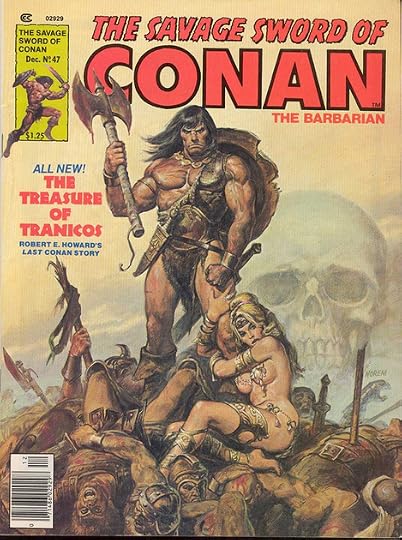
With writers Roy Thomas, Michael Fleisher, and Bruce Jones contributing to The Savage Sword of Conan in the early 1980s, the action-filled comics magazine continued its long, successful run exploring the lush and dangerous world of Conan's Hyboria. This volume reprints most of the black-and-white Conan tales from 1981, with the artistic talents of John Buscema, Gil Kane, Ernie Chan, Ernie Colon, Alfredo Alcala, and others adding to the uncensored excitement! The Savage Sword creative teams presented in this latest tome deliver timeless adventures featuring Robert E. Howard's beloved barbarian, and such classics as the "Temple of the Tiger," "Dwellers in the Depths," and "Moat of Blood" are reprinted here for the first time ever! Collecting selections from The Savage Sword of Conan the Barbarian issues #61 through #71, this volume also includes the frontispieces and pinups from each issue, drawn by Alex Toth, Joe Chiodo, Ernie Chan, Carl Potts, Tony de Zuniga, and others!
Roy Thomas was the FIRST Editor-in-Chief at Marvel--After Stan Lee stepped down from the position. Roy is a longtime comic book writer and editor. Thomas has written comics for Archie, Charlton, DC, Heroic Publishing, Marvel, and Topps over the years. Thomas currently edits the fanzine Alter Ego for Twomorrow's Publishing. He was Editor for Marvel comics from 1972-1974. He wrote for several titles at Marvel, such as Avengers, Thor, Invaders, Fantastic Four, X-Men, and notably Conan the Barbarian. Thomas is also known for his championing of Golden Age comic-book heroes — particularly the 1940s superhero team the Justice Society of America — and for lengthy writing stints on Marvel's X-Men and Avengers, and DC Comics' All-Star Squadron, among other titles.
Also a legendary creator. Creations include Wolverine, Carol Danvers, Ghost Rider, Vision, Iron Fist, Luke Cage, Valkyrie, Morbius, Doc Samson, and Ultron. Roy has also worked for Archie, Charlton, and DC among others over the years.
I need to take a break from these stories: overindulgence in one's favorite food can make one sick. I'm getting my fill of mighty barbarian thews and sinuous enchantress curves, of repetitive plots and purple prose.
70 issues of the comic have exhausted the original Robert E Howard stories, and the publishers are struggling to come up with anything original. Michael Fleisher and Bruce Jones are not up to the talent of long-term scriptwriter Roy Thomas, who I hope will return soon to full time employment.
In the artwork department,luckily, John Buscema is still in top form, well assisted by Alfredo Alcala, Tony de Zuniga, Gil Kane and Ernie Chan - all names familiar to the fans of sword & sorcery.
The covers are unfortunately the most memorable part of some of the issues. I would like to see a return to the policy of writing longer stories, spread over several volumes, instead of the single issue ones in this sixth collection that I struggle already to remember what they were about. I think the best one has some kind of warrior ants in it.
recommendation: to be consummed in small portions and spread over a longer period of time.
As I've said in prior reviews, I think the longer black and white stories of Savage Sword are generally much better than the color series. There was less restrictions on the story and art, and Conan isn't really a character meant for PG stories.
Another great volume with the great art this series is known for and some great writing from Bruce Jones (one of my personal favorite comic writers), Michael Fleischer, and, as always, Roy Thomas.
Classic Black and White Conan tales from the 80's originally published in Marvel Comics legendary "Savage sword of Conan" B&W monthly magazine. Loved this stuff! Roy Thomas was gone by the end of this book and the quality began to drop with Michael Fleischer writing some of the stories. Bruce Jones added some stories in this issue and was a decent second choice to Roy Thomas.
The first few volumes of Dark Horse's collected Savage Sword of Conan are perhaps the gold standard of sword-and-sorcery comics, and it is a shame that the physical volumes are out of print and some are relatively cost prohibitive to track down in good condition (a double shame because while these are perfectly fair volumes, they are paperbacks on cheaper quality paper and not exactly prone to be long-term collector's items). Likewise it is a shame that the overall quality of content has begun to slip, ceasing to be must-reads and becoming something more middling-to-good rather than great. Chances are, if you are power reading these volumes from the first onward, around volume 5 or volume 6 (this one) is where exhaustion will start to take its toll.
There are still excellent moments and good stories, here, but Roy Thomas does not seem to have the spark he had in earlier volumes - where he was adapting more directly from the source - and Bruce Jones and Michael Fleischer provide more hit or miss stories. Jones pens two and one of them, "The Children of Rhan," is perhaps my favorite in the entire volume despite having some issues while the other, "The Dweller in the Depths," is a confused morass that entangles humor and horror into a conclusion that at least is adequately gonzo (and I'll admit, the hapless guards trying to correct the fleeing Conan-and-wench duo's attempt at remembering directions to escape at least made me chuckle, as out-of-place as it was). Fleischer has the tropes down, but deals pretty much all of them into every story he writes, so that the book becomes repetitive with scheming nobility enacting out various intrigues while Conan fears magic (but not so much he doesn't fling a sword into the belly of its practitioners) and beds women and then flees yet more guards that do pretty much nothing but boast before taking a sword to the throat or face or whatever body part ensures they die with a single blow. Thomas, for his part, is much the same as Fleischer, and you only have to see the bloated "The Eye of the Sorcerer" (the only Thomas tale that is credited solely to him rather than him adapting someone else's story/script) to see how stretched for the content the title has become: a meandering excursion involving a strange caravan and bat-winged humanoids and an otherworldly city and an ancient, three-eyed sorcerer and scheming nobles and a semi-giant bear and a pair of buxom wench sacrifices and a flash-flood and a father-son side story.
By the end of the volume, most of the stories are long and prone to take five pages to tell two worth of plot and only a couple really ever make it seem like there is any real struggle or purpose (as opposed to Conan simply dallying a few pages before leaping into action and killing exactly the right number of people to set things right). And while a couple have Conan using his brains over his brawn, one such scene involves Conan doing a bad impression of a long dead king to lead a successful riot against would-be plotters-to-the-throne (including wearing a helmet that should not have been found in a ghoul-ridden tomb since it was a plot point earlier in the story...said plot point having had it brought up from the said ghoul-ridden tomb though apparently no one at the time paid much attention the large, glowing monstrosity guarding the armor).
There are many volumes of Savage Sword after this one, so one imagines that somewhere along the line the quality improves enough to keep people's interest, but I suppose I shall see.
This volume collects stories from 1981. They’re largely formulaic, as you would expect from a magazine that produced a 50 page conan tale every month.
Conan begins and ends each adventure alone, a roving wanderer in search of fortune.
There is normally a damsel in distress, a corrupt ruler or wizard, plenty of thugs, and some kind of monster or demon for the finale. Most tales involve political scheming and treachery (this in particular grows tedious). Allies are forged and often lost, but always parted. Conan gets captured and imprisoned a lot, but his enemies never finish the job. Vast treasure hordes tantalize, but Conan never rescues more than a few trinkets.
The words mighty-thewed, comely wench, selfsame, and Crom must be included in every episode.
The quality of each story varies; the better ones have something unique to make them stand out. Usually the villain.
Most memorable are the one with the child-woman-monsters, the one with ants, the one with a plant creature in a moat, and the one with a body-swapping wizard.
There are three different writers — Michael fleischer, Bruce Jones, and Roy Thomas. They’re fairly similar.
Roy Thomas is the most prolific Conan writer and the most verbose. His prose is often awkward and notably over-written, with an abundance of unnecessary captions. Redundant narration, flowery description, and irrelevant info.
Michael Fleischer is much the same, but with smoother prose and slightly less congestion.
Bruce Jones is the best of them, with a leaner (for conan) style and more original ideas. Notably, he employs a sense of mystery in the opening of his two tales to generate suspense.
There are 4 artists.
Buscema is the indisputable master, one of the greatest draftsmen in history. Beautiful, dynamic figure work with an economy of line. A mastery of light and shadow, of “spotting blacks.” Effortless and elegant multi-figure compositions.
Gil Kane is garbage. At least his style is original and distinct. But it’s crude (thick-lined) and linear (no sense of light and form), with pedantic anatomical detail and a lack of emotional feeling.
Ernie Chan is a buscema imitator who does a passable job, but never approaches the deftness of the master’s line, nor his skill in conveying action.
Ernie Colon is another Buscema imitator, though his faces stand out as the most unique and expressive. That skill serves his Agatha Christie-style mystery episode with its multiple eccentric suspects.
Continuing my annual-ish trawl through the Savage Sword of Conan collections. There are still a lot more ahead of me so I should probably speed up the reading process up but so far it feels just the right speed.
Preferred this volume to the previous one, mainly because there are no King Conan stories in this one and in one story ("The Dweller in the Depths") Conan even displays a somewhat unusual madcap, screwball sense of humour.
It seems that after issue forty of savage sword, that while the art stayed great, the writing went downhill. Every story seems the same. To much dialogue, not enough action or repetitive, cookie-cutter villains adds lame ideas. Not a keeper in any case.