Été 1940, un peuple hagard se retrouve sur les routes de l'exode. Été 1944, la joie de la Libération efface la honte de la défaite. Entretemps, les Français ont vécu avec l'ennemi. Ils ont acclamé un Maréchal qui tendait la main à l'oppresseur nazi et parlait, les ruines encore fumantes, d'une "France nouvelle". Ils traversent ces années noires, partagés entre la résignation et la résistance, hantés par les difficultés matérielles.Henry Rousso, historien de la période de Vichy, retrace ces événements dont le souvenir est toujours vif.
Henry Rousso first worked on the history of the Second World War and post-war period. His early writings focused on political and economic history of the Vichy regime. Then he turned to a history of memory of the war and spent much of his thinking to the history of collective memory and uses of the past. He is currently working in a multidisciplinary and comparative perspective on the relationship between history, memory and justice, and more generally on the epistemology of contemporary history.
Born in Cairo in 1954, graduated from the Ecole Normale Superieure de Saint-Cloud (1974-1979), ”agrégé” in history (1977), Henry Rousso holds a ”Habilitation à diriger des recherches” (Institut d’Etudes Politiques Paris, 2000). He joined the CNRS in 1981, he participated in the creation of the IHTP inaugurated a year before, which he headed from 1994 to 2005.
He was a member of the National Committee of the CNRS (1987-1994) and Secretary General of the International Committee for the History of the Second World War, which is based in Paris (1990-2000). He presided in 2001 the ”Entretiens du Patrimoine”, and from 2002 to 2004, the Commission on Racism and Holocaust deniers at the University Jean Moulin-Lyon III, established by the Ministry of Education.
He has been research associate or visiting professor in many places : Center for European Studies (Harvard University, 1986-1987), Munich (Bosch Stiftung, 1990), New York University (1992), Dartmouth College (1994), Center for Advanced Holocaust Studies, U.S. Holocaust Memorial Museum (2005), Texas A & M University (2007), Jena Center Geschichte des 20. Jahrhunderts (2009).
He is a member of several editorial boards : Vingtième Siècle, History and Memory, South Central Review, SegleXX. Revista catalana di Stòria, Les Cahiers du Judaïsme, Cahiers d’histoire du temps présent (Bruxelles), and several scientific councils : Centre français de recherche en sciences sociales (CEFRES, Prague, Chair), Centre de recherche de l’Historial de Péronne, Mémorial de la Shoah de Paris, Mémorial de la Paix à Caen, Jena Center Geschichte des 20. Jahrhunderts (Allemagne), Gedenkstätte Buchenwald (Allemagne), Museum of the Second World War (Gdansk), etc.
He taught at the École normale supérieure de Cachan (1998-2004) and the Institut d’études politiques de Paris (1988-1990 & 2007-2010). He supervised doctoral students at the University of Paris-Ouest-Nanterre La Défense, most of them in (co-tutelles) with European and North American universities. In September 2011 onward, he will join the École doctorale d’histoire at Paris 1 where he will supervise doctorates, and he will give a seminar in the master program "Histoire des sociétés occidentales contemporaines (XIXe- XXIe siècles)".
He runs the series : "Contemporary European History, Berghahn Books (Oxford/New York), with Konrad Jarausch.
Since 2006, he coordinates the European Research Group (GDRE) "The European Network for Contemporary History" EURHISTXX.
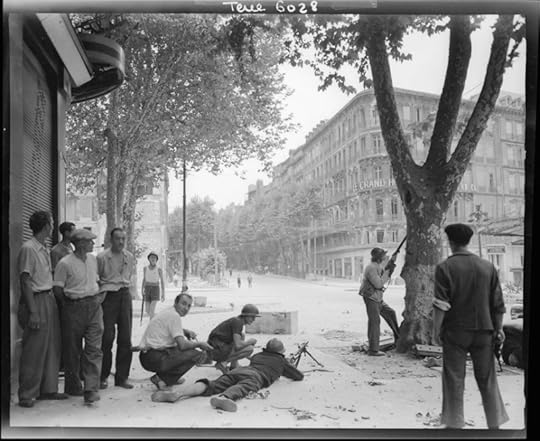
August, 1944. Marseille, FFI (Forces françaises de l'intérieur) en embuscade
This excellent, small-formatted book includes both text and ample photographs. It is part of the excellent decouvertes-gallimard.fr series (http://www.decouvertes-gallimard.fr/D...), many items of which (in the art section, at least) have been translated into English (and published by Abrams Discovery - e.g.: https://www.goodreads.com/book/show/2...). This is the work of a fine historian, Henry Rousso, and is directed towards a lay audience. It forms an excellent introduction to Vichy, and is far better suited to this purpose than Robert Paxton's well known book on Vichy, which is too dense and detailed for this purpose. At the same time, Rousso is clearly in command of the primary sources and is reliable. An excellent book.
It covers the history, the economy, the culture, the personalities, the mood -- manners -- everything that gives a picture (or, I should say rather, a 'portrait'), in brief format, of the circumstances of these dark years. One comes away with a sense of what it was like to have lived there and then.
His treatment of Vichy and the Jews is especially good -- as he shows that Vichy anti-semitism was home-grown and 'autochthonous'; by itself (quite without German pressure), Vichy was happy to exclude Jews and others from civic life and even to intern them. But it did not imagine going down the road of the Final Solution. And when it did, forced by circumstance, it did so with eyes "wide shut" -- refusing to see where it was leading.
He also explains well the difference between the hard-core collaborationists like Doriot (a former Communist, who ended up as a Nazi thug and demagogue -- there is a book about this phenomenon by Ph. Burrin, called Le derive fascist) and the << collaboration d'Etat > of the Petainists -- which was more a collaboration of (delusional) necessity -- 'delusional' because many of them actually believed (according to Rousso) that they could thus secure France as an 'equal" partner in the Neue Europa of Nazi dreams.
Petainism, in other words, was unquestionably fascist (far more than was the authoritarian regime of Franco) -- and largely indiginous -- but it was not Nazi (at least until the time of Laval, Doriot, and then Darnand). It was, if I can put it thus (Rousso does not), what happens when the anti-dreyfusards finally triumphed and got themselves somewhat modernized.
Finally, one meets here such ideologically bizarre figures as Colonel Remy - the great hidden figure of the Resistance -- who began his career with the L'Action Française of Charles Maurras and ended as a postwar, anti-Gaullist, Petain apologist -- his resistance career midway not withstanding; François Darlan, the fascist, Vichyist admiral turned dissident, was assassinated by an anti-fascist monarchist just after he had turned his support to the Allies; and Joseph Darnand, the radical (Salò Republic style) leader of the fascist Milice, a member, at the end, of the Waffen-SS, who, for all that, despised and feared the Germans, and who tried three times to leave Vichy and join the Resistance, only to be rebuffed each time.
The French is clear and simple -- and the book quite appealing.