An award-winning founder of Isotope magazine chronicles how the study of meteorites became a modern science, in a natural history that documents the contributions of key individuals and traces landmark discoveries in Antarctica, Greenland, and other world regions.
Christopher Cokinos is the author of Hope Is the Thing with Feathers: A Personal Chronicle of Vanished Birds and The Fallen Sky: An Intimate History of Shooting Stars, both from Tarcher/Penguin. The winner of a Whiting Award, Cokinos has traveled across the world, from Greenland to Antarctica, in search of the stories of science and history that inform his writing. Committed to weaving memoir into research-driven narratives, Cokinos loves to explore the connections between lives and landscapes. With his partner the writer Kathe Lison, Cokinos lives along the Blacksmith Fork River in northern Utah.
God, how I tried to like this book. The concept - natural history/science about meteorites mixed with literary memoir - is basically catnip to me. However, the execution went so, so wrong. A sinking feeling crept in within the first few pages, and before I reached 120 pages, had grown into a roaring despair at the thought of spending another 350 pages with Cokinos as my guide. The problems are twofold: the "poetic" writing style is ridiculously purple and unforgivably murky, and the author himself is seemingly an insufferable bastard.
The writing is clearly straining for beauty and profundity, and its failures are laughable. The spine of at least one thesaurus clearly broke to bring us this text, and metaphors pile up with a nonsensical absurdity that has all the charm of listening to a stoner's "deep thoughts." The clarity of good science writing (and good writing generally) is sacrificed to the darker needs of Cokinos' literary pretensions.
Ah, and what pretensions those are! Now, I'm all for the raw honesty of an author shining a light on themselves, but Cokinos offers a terrible admixture of weaseling equivocation about his obvious moral failings and preening pride in the interest his own tale must hold. The fundamental story, obscured as it is by the prose, is that Cokinos had an affair, left his wife, and then annoyed a bunch of people around him through endless depressions and neuroses while purporting to research meteorites. He all but lays the blame for his crumbled marriage on his ex-wife's feet, as she had the gall not to share all of his interests, and he glosses over his own indiscretions in ending up with his new partner. Although he talks endlessly about his depression and anxieties, I detected not one sign that Cokinos ever took any responsibility for his own actions. I would have gladly divorced the son-of-a-bitch too.
Interspersed with all his sad sack tales are occasional stories about the discoverers of meteorites, who are inevitably compared to Cokinos' current situation through tenuous analogies and a fair amount of hand-wringing about his own inadequacies. It's too bad about the author ruining what could have been a really amazing book. I couldn't finish this one.
(This review might be overly harsh, but it's the spurned lover lamenting what really should have been great.)
It took me a while to finish this book, although it is by far the best account of the dangers and wonders of meteoritic addiction I have read. Unfortunately, the author tries to mix the scientific and historical story of meteorites and their seekers with his personal life story in a way that is quite distracting at times and (sorry to say) not very interesting. I would rather not know that the author made love to his new girlfriend on a particular night of his trip to Germany to see one of these fallen stones. It is good for him I am sure but it's his life and the relation to the meteorite search is far fetched at best. Once you get over these odd personal touches the reading is quite interesting and worthy of your time -- at least if these ancient stones appeal to you.
I wanted to hear about meteorites; I didn't want to hear so much about the author's personal life. He's a beautifully talented writer, but diving into his own emotional turmoil hurts the book in the end because sometimes it means that it grows so intimate that the reader can't follow his trajectory (pun intended) and the purpose of the prose grows murky.
"The Fallen Sky" is wonderfully informative and a terrific read for the most part (I did, indeed, learn a lot about meteorites), but sometimes it seems schizophrenic: does the author want it to be historical non-fiction, an exploration narrative, or "Eat, Pray, Love" with rocks instead of pasta?
When I signed up for a book on meteorites, I didn't know I was also agreeing to listen to a man vaguely whine about relationship issues. I couldn't stand it after 35 ltd, so did a flip through-one that could've been done in 35 seconds.
I wanted a lot more about the asteroids and a lot less about his masturbatory "self-reflection" about his affair and whatnot. I don't mind some memoir-type science writing but this was self-indulgent and the author seems like a dick. Disappointing.
It took me a long time to finish this one. Some of it was fascinating, some of it was a bit technical, some of it was too personal. I don't mind when an author puts himself into the story, in fact this often makes a potentially dry subject more interesting (standing in the footsteps of polar explorers! travelling to Antarctica to pick up meteorites!). In this case, however, giving the reader glimpses of his failing marriage really didn't enhance the story. Overall though, good information, and now I'm excited about a trip to Meteor Crater which is not far from my home.
Finally, I'm finished. I'd started this a few years ago when I was teaching astronomy, but only got to page 79. Lots of poor reviews, but I gave it another go. Not real interesting, but lots of facts and he's not a bad writer. I would not really recommend this book to anyone.
Every now and then a book comes along that bridges the disparate disciplines of science, history and literature. "To See Every Bird on Earth" by Ted Koeppel is one of those and a beautiful work it is; Mark Jaffe’s "The Gilded Dinosaur" about the early days of American paleontology is another; Kevin Krajick’s "Barren Lands," a history of diamonds and diamond hunting is, as we used to say in England when I was a lad, “a rattling good read.”
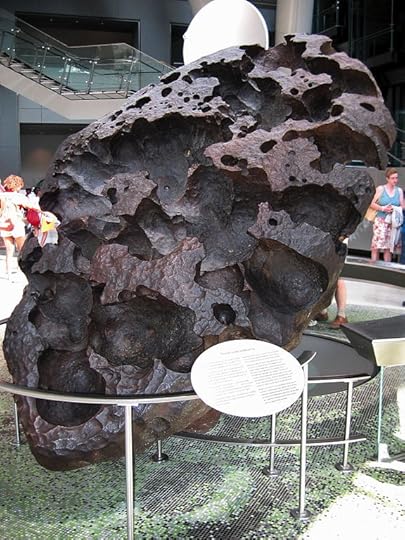
The latest happy addition to my rather short list of must-read literary science non-fiction is The Fallen Sky: An Intimate History of Shooting Stars, by Christopher Cokinos, published by Penguin Books on July 30. The Fallen Sky may appear, on the surface, to be an exploration of the history of meteorites and meteorite hunters, but it is much more: a subtle journey through the author’s mind and memory on a quest for knowledge and understanding. While examining the lives of important and wildly eccentric figures in meteorite history—such as Ellis Hughes, an Oregon farmer who spent months absconding with the 15-ton Willamette iron meteorite in 1902—Christopher also shines the hard light of reason on his own life and motivations.
Landing somewhere between "The Cambridge Encyclopedia of Meteorites" and "Zen and the Art of Motorcycle Maintenance," "The Fallen Sky" is not just a thought provoking history of space rocks. It is also a meditation on the fascinating dangers of obsession, our place in the universe, and it asks why a few of us are driven to embark upon sometimes-hopeless missions to find clarity of purpose through collecting, studying, and occasionally stealing, natural history wonders.
Christopher is the editor of "Istope: A Journal of Literary Nature and Science Writing," a professor of English at the University of Arizona, and a poet. In an earlier work, "Hope Is the Thing with Feathers," he chronicled humanity’s savage extermination of certain North American birds, such as the passenger pigeon and the Carolina parakeet. In his introduction to "The Fallen Sky" he recounts how “I couldn’t yet fathom that the grief I felt about their fates was also, in part, an expression of many inarticulate griefs I carried in my life . . . I went outside at night and looked up . . . and I saw meteors—sudden, thin streaks on any given night.”
My own science writing leans towards the personal narrative, a memoir of road trips, hazards, and adventures, and I always attempt to infuse my words with the passion and wonder that I experience in my work with space rocks. Christopher Cokinos succeeds better than I have in this lofty ambition. "The Fallen Sky" is a lyrical and beautifully written book; an intriguing, inspiring and unique work; and one that I will ponder, re-read, and enjoy for light years to come.
This is a book of history, meteors and personal introspection. I particularly enjoyed the history parts - stories of the people (men and women) who found meteors and became obsessed by them. I know nothing about meteors and the information about them was probably at a good level - I learned something but didn't learn even more and discovered that I am not very interested in meteors but quite interested in the people who are obsessed by them.
Throughout the book there is a sub-story about the author and his emotional distress. During the work on the book he has an affair, leaves his first wife, moves in with his lover. I found these stories somewhat distracting and mildly annoying. Then he goes on a field trip to Antarctica to work with a group that collects meteors there. He recalls the great Antarctic explorers - Shackleton, Amundson, Scott, Mawson - and briefly compares today's exploration with theirs. I loved that part. But most of this part of the book (nearly 1/4?) deals with the author's emotional difficulties in Antarctica. I should have hated it, but I realized that I would have the same sort of difficulties. He was insecure about doing things correctly and about finding meteors and about fitting in. He became acutely depressed and had to be evacuated from the field. I related totally. An odd ending to the book, but overall not bad.
And I did learn about meteors
This entire review has been hidden because of spoilers.
The book is easy to read. There isn't much technical language; nor is there much of a background requirement in astronomy and so forth.
There is a lot of information about meteorites. Classification, origin, ramifications for the developing Earth are included, along with many other attributes. A number of historic, well-known, or spectacular meteorites are described, as are several colorful characters whose careers were built around or intersected meteorites; one was Robert Peary of North Pole fame.
Perhaps a third of the book is devoted to the author's personal observations and longings. This is where the word "Intimate" in the subtitle comes from I believe. Mostly these are without factual information about the subject; the author has made it easy to move past those sections if wanted.
This seemed to be a fair introduction to meteorites for a general reader, and a good telling of all the background history as well. However, those who cannot skip read may find this difficult to get through.
Off this review: The Fallen Sky: An Intimate History of Shooting Stars By Christopher Cokinos (Penguin Group) When Cokinos isn’t chronicling the solar system’s origins or recounting obsessive tales of explorers trekking to the ends of the Earth in pursuit of exotic rocks from the sky, he’s telling the reader about the dissolution of his first marriage or his struggles with depression. But this unflinching introspection sets the stage for Cokinos’ transformation, as he delves deeper into his subject and grasps the profound links between shooting stars and life here on Earth.
"The Fallen Sky" was a failed attempt to tie the search for meteorites with the author's discovery of himself. The moments of strong storytelling about meteorite hunters were destroyed by the author's personal ramblings. At times, I felt like I had picked up someone's personal journal where they were exploring topics assigned by their therapist. In all honesty, I have no idea how this book got published. It is awful, uncomfortable, and becomes more poorly written through each succeeding chapter. Skip this book and move on. Contains considerable profanity.
I give up...dull, dry and too much about his ex-wife and current wife that are not germaine to the subject of the book in my opinion. I had such high hopes going in but it met none of my expectations.
Books I cannot finish are like a failed relationship. They don't make me angry but instead disappointed for the loss of what could of been.
Not only is the sky amazing, not only are meteorites a stunning reminder that we live in space, but Chris Cokinos's book uncovers also the passion of people who chase meteorites. It's a story full of drama and pathos. Cokinos is that rare environmental writer who can combine love of humanity with love of the planet. Should be on every list for people who love good stories.
An interesting and well written story of the start of the cosmos and how the eccentric and the obsessed are committed to their passion above all else; searching the unknown, exploration of the undiscovered, and the sacrifices made to achieve these goals. This book covers it all, however it covers way too much of his divorce with his first wife and how great his current wife is.
Cokinos weaves a number of tales together about those who have searched for meteors and the effect of the falling of meteors through history. He relates his personal experiences of famous areas that have impact events in their history. The book concludes with the author's experiences hunting for meteors in Antarctica. The book is interesting overall but some parts are better than others.
Part autobiography, part science, a book of journeys. Enjoyable read, a little disappointed that pictures were not included. Recommend using google maps and wikipedia along with the book to understand the places visited and the people discussed.
If I were in the right mood, I think I could get through this. At the time, Cokinos came across a bit too self-absorbed; I didn't like the inclusion of all his personal problems. I may try it agian someday, as the writing was fine.
The science and history was interesting, but WAY too much unnecessary commentary about the author's personal life. If it had added to the narrative, that would be one thing, but it felt juxtaposed, forced, and a tad desperate for attention and approval.
More a sappy memoir than a book about meteors and meteorites. Two things are apparent from reading the book: 1. Mr Cokinos feels a great deal of guilt about his broken first marriage; and 2. He thinks he's a poet. But he's not.
... And I thought of you. One of Dylan's most beautiful and overlooked lyrics has been running through my mind since picking this book up at Powell's Books. I was genuinely disappointed that Cokinos's book didn't live up to Dylan's lyrics.
Cokinos spends more time on the history than the science of meteors, which become shooting stars when they flame across Earth's atmosphere, and meteorites when the surviving rock-iron core impacts land. When he does include the science, he doesn't do a good job of making the science understandable to the laymen like me. His recitation of facts is not enlivened with examples that draw out the meaning. And unfortunately his history jumps too quickly from subject to subject and forwards and backwards chronologically for readers to get a clear picture of the flow and the implications of the history.
But perhaps the most distracting element of The Fallen sky is Cokinos's persistent and annoying pattern of inserting his personal story into the history. During the early years of research and writing he was going through a difficult period in his marriage, apparently carrying on an affair while remaining with his wife. While he seems to want readers to know and treat his personal history as equally important as the history of his subject, he isn't honest enough (or a good enough writer) to tell his story directly. He hints at things he has done, apparently beyond the affair, that make him reprehensible and responsible for the eventual divorce, but we never know for sure. All we really know is that this writing style is a distraction and annoyance which gets in the way of the history of shooting stars.
Yet the recorded history of human encounters with meteorites, from medieval accounts of falling skies and divine retribution to modern accounts of following shooting stars and finding meteorites on the ground at the end of the trajectory, is interesting enough to keep the reader fighting through the interference of Cokinos's writing style. The characters who realized what these "rocks" really were, where they came from, and how they shaped the landscape of the world they impacted are worthy of Cokinos's best bits of writing, evoking images of Indiana Jones chasing relics through the trackless prairies and along the route of old Route 66 through America's Southwest in the middle of the 20th century.
Which leads me to a final criticism: with all of these worthy characters, wild geography, and distant landscapes, there is not a single picture in this book! Instead we are left with Cokinos's 1,000 words that are not the equal of one picture of a meteorite which could help us make sense of his scientific description of the materials and appearance of different types, of the people who chased them, of impact craters in Arizona and Australia, and of the distant reaches of Antarctica where Cokinos joined modern explorers daring winter's worst to find meteorites lying in open view on blue ice.
So unfortunately if you see a shooting star, I can't recommend you think of The Fallen sky unless you are willing to fight through the frustration like I did. Depending on your tolerance for Cokinos's writing style the effort will outweigh the reward.
The Fallen Sky is a chatty narrative of Christopher Cokinos’ search for meteorites (the remnant of meteors that hit the Earth). The book intersperses personal stories with history and science to discuss many aspects of shooting stars, including: - The discovery of famous meteorites (like the Willamette pictured above). - Meteorite hunters, traders and collectors - Famous meteorite impact craters - The dangers meteorites pose to Earth - Those who study meteorites (called meteoricists, because the obvious term “meteorologist” was already taken) - And others
I don’t have a lot to say about this one. Conkinos can write, but his style is long-winded. He has a couple other quirks that I found somewhat odd: - Cokinos continually inserts himself into the narrative and chooses to get fairly personal. He seems to relish writing about the time he left his wife for another woman?!? Awkward. - For a popular science book, it’s written in a style that I would describe as ‘embellished’ … almost florid at times. This made a bit more sense when I learned that Cokinos is also a poet. - He likes to go to locations where something interesting once occurred and ponder the event, even when there’s no longer much of anything to see. For example, he’ll go out of his way to describe a cornfield in great detail in which a meteor once landed, even though it’s now indistinguishable from any other corn field on the planet.
I’ll also say this … as a non-scientist Cokinos makes a number of dubious claims. - He spends a great deal of time on the panspermia theory of life’s origins on Earth (the idea that bacteria from outer space hitched a ride on a meteor or comet and seeded our planet with life). - He discusses some weird idea that graphite whiskers are responsible for the effects attributed to “dark energy”. Neither of these, and other, claims are widely held by scientists.
By the end of the book Cokinos gives up any pretense of writing about meteorites, to write exclusively about himself. I suspect this is where his real passion lies.