

What do you think?
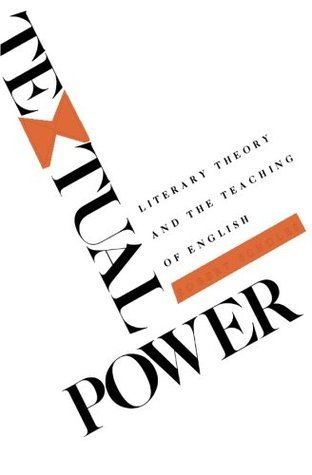
Textual Power: Literary Theory and the Teaching of English
“Robert Scholes has written an enviable book on the uses and abuses of literary theory in the teaching of literature. One of [his] most forceful points…is that ‘literary theory’ is not something a teacher may either ‘use’ or not use, for teaching itself is an unavoidably theoretical activity.”—Gerald Graff, Novel
“Scholes’ emphasis in Textual Power is indicated by the book’s subtitle. After a provocative analysis of disciplinary values and departmental tendencies…[he] proposes that ‘we must stop “teaching literature” and start studying texts’…His book is essential for college libraries.”—R.C. Gebhardt, Choice
“There is no issue more current, more relevant to the present scene, than the problem of pedagogy and its relation to contemporary theory. Textual Power is an important, provocative, and above all useful contribution to this discussion.”—Gregory L. Ulmer
Robert Scholes, author of Structuralism in Literature and Semiotics and Interpretation among other books, is Alumni-Alumnae University Professor of English and Comparative Literature at Brown University.
“Scholes’ emphasis in Textual Power is indicated by the book’s subtitle. After a provocative analysis of disciplinary values and departmental tendencies…[he] proposes that ‘we must stop “teaching literature” and start studying texts’…His book is essential for college libraries.”—R.C. Gebhardt, Choice
“There is no issue more current, more relevant to the present scene, than the problem of pedagogy and its relation to contemporary theory. Textual Power is an important, provocative, and above all useful contribution to this discussion.”—Gregory L. Ulmer
Robert Scholes, author of Structuralism in Literature and Semiotics and Interpretation among other books, is Alumni-Alumnae University Professor of English and Comparative Literature at Brown University.
180 pages, Paperback
First published January 1, 1985
About the author
Robert Scholes
78 books18 followersRobert E. Scholes was an American literary critic and theorist. He is known for his ideas on fabulation and metafiction.
Ratings & Reviews
Friends & Following
Create a free account to discover what your friends think of this book!
Community Reviews
Displaying 1 - 2 of 2 reviews
January 6, 2020
The first few chapters are the best you can hope to find on succinct composition pedagogy. The rest of the book is great deconstructionalist theory, but skimmable for other purposes.

March 13, 2008
Scholes’s book is an exploration of power relations in the English classroom, and how this affects education. Includes useful commentary on the Ernest Hemingway work In Our Time.
Acquired 1996
The Word, Montreal, Quebec
Acquired 1996
The Word, Montreal, Quebec
Displaying 1 - 2 of 2 reviews